



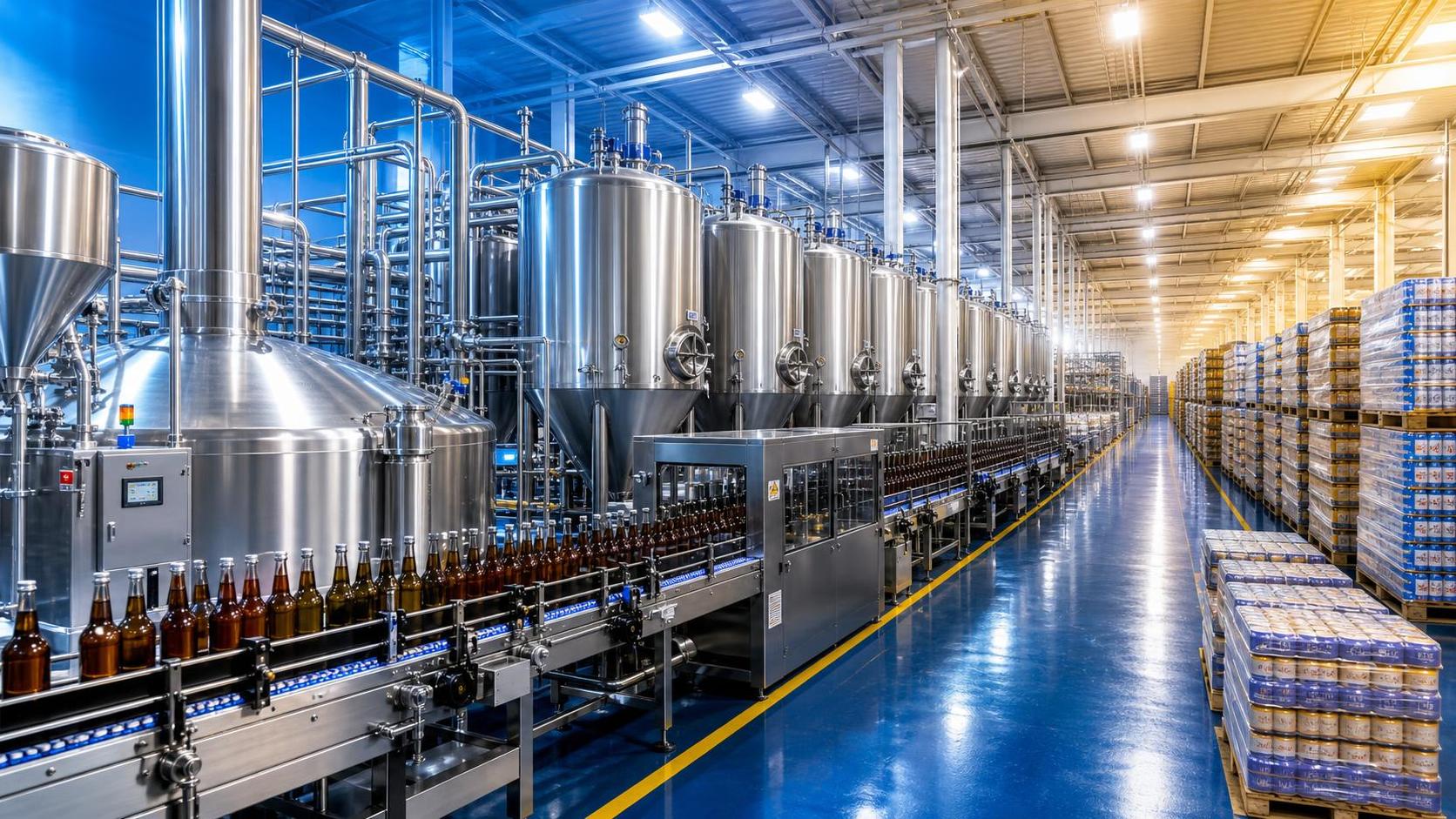
Planning capacity for large scale beer production is not a simple exercise in choosing a larger brewhouse or installing more fermentation tanks. The practical question is whether the entire operation—from wort production and cellar scheduling to packaging, warehousing and outbound logistics—can support the intended sales model without creating a new bottleneck every time volume rises.
This matters especially in a market where breweries may supply a mix of branded products, private-label programmes, export orders, food-service accounts and seasonal releases. A plant designed only around its initial flagship lager may struggle when demand shifts toward wheat beer, low-calorie products, fruit-flavoured beers or smaller OEM/ODM batches. Capacity therefore needs to be planned as a scalable operating system, not as a single annual production number.
For large scale beer production projects, the most reliable starting point is a demand-led capacity model. Engineering decisions should follow a realistic view of product mix, order profiles, channel requirements and service levels—not optimistic market forecasts alone.
Define capacity in saleable beer, not brewhouse volume
Breweries frequently describe capacity by brewhouse size: for example, hectolitres per brew or brews per day. This is useful for preliminary equipment discussion, but it does not describe how much finished beer the plant can actually sell.
Saleable capacity is constrained by several stages:
- brewhouse output and wort cooling capacity;
- fermentation and maturation residence time;
- filtration, stabilization and blending capability where used;
- bright beer tank availability;
- packaging line speed, changeover time and yield;
- warehouse dwell time and loading capacity;
- quality release procedures and export documentation;
- distribution lead time, especially for distant markets.
A plant can have an apparently large brewhouse and still be unable to meet orders because fermentation vessels are occupied, packaging is limited to one format, or finished goods cannot be held under suitable conditions. For project planning, the relevant figure is annual packaged and released volume at the required quality standard, divided by package format and market destination.
The calculation should distinguish between theoretical capacity and sustainable capacity. Theoretical capacity assumes ideal equipment availability, full crew coverage, stable demand, no delays in packaging materials and minimal cleaning or maintenance interruption. Sustainable capacity includes normal cleaning-in-place cycles, planned maintenance, product changeovers, quality holds, seasonal demand peaks and a reasonable operating buffer.
Using theoretical capacity as the investment baseline is one of the common causes of under-designed brewery projects. It leaves no room for the normal variation of commercial brewing.
Start with a demand profile rather than a single forecast
Annual demand forecasts are necessary, but they are not enough. A plant may expect to sell 100,000 hectolitres in a year, yet the operational requirement will be very different if half of that volume is needed over four summer months, if export customers purchase in full containers, or if supermarket promotions create short-term peaks.
A useful planning model separates demand into at least four categories:
- Base volume: stable, repeatable demand for core SKUs such as mainstream lager;
- Seasonal volume: higher demand around holidays, warm-weather periods or promotional campaigns;
- Development volume: new flavours, specialty products and trial listings with uncertain repeat rates;
- Contract volume: OEM, ODM or private-label production that may require different packaging, recipes, labels or delivery schedules.
These categories have different implications for plant design. Core lager volume may justify dedicated fermentation and high-speed packaging. Specialty beer may require flexible dosing, separate handling of fruit preparations or other ingredients, additional cleaning validation and smaller campaign sizes. Contract orders can be commercially attractive, but they often generate disproportionate scheduling complexity when customers request short lead times, distinctive packaging or frequent artwork changes.
Capacity planning should therefore use monthly demand scenarios, not only annual averages. A base case, high-growth case and constrained case are usually more valuable than a single forecast presented as certain. The high-growth case tests where bottlenecks will appear. The constrained case helps avoid committing capital to equipment that will remain underused if a key market launch is delayed.
Match brewhouse design to the product portfolio
Brewhouse capacity must be assessed together with recipe complexity. A portfolio based mainly on filtered lager can support high repeatability and a relatively predictable production rhythm. A broader range involving German-style wheat beer, sugar-free or low-calorie beer, fruit beer and functional specialty beer introduces more variable process requirements.
High-adjunct recipes, for example, may require additional raw-material handling or cereal cooking arrangements. Wheat-heavy grists can affect lautering performance. Fruit additions may be handled in the cellar rather than the brewhouse, but they still require controlled dosing, traceability and effective cleaning. Reduced-calorie products may need different fermentation management or enzyme use, depending on the formulation and local regulatory requirements. These are not reasons to avoid portfolio diversity; they are reasons to avoid assuming that every SKU consumes identical plant time.
For a large scale beer production facility, a modular brewhouse configuration is often preferable to a design optimized only for maximum batch volume. The decision depends on expected batch frequency, recipe variation, shift patterns and expansion strategy. In some cases, a moderately sized brewhouse with multiple daily brews gives better flexibility than a single oversized system that creates large inventory commitments for every production run.
Project teams should also test whether the wort cooling system, cold liquor tank, yeast propagation capability and spent-grain handling can support peak brew days. A brewhouse is not truly capable of repeated turns if these supporting systems cannot recover between batches.
The cellar usually determines the real production ceiling
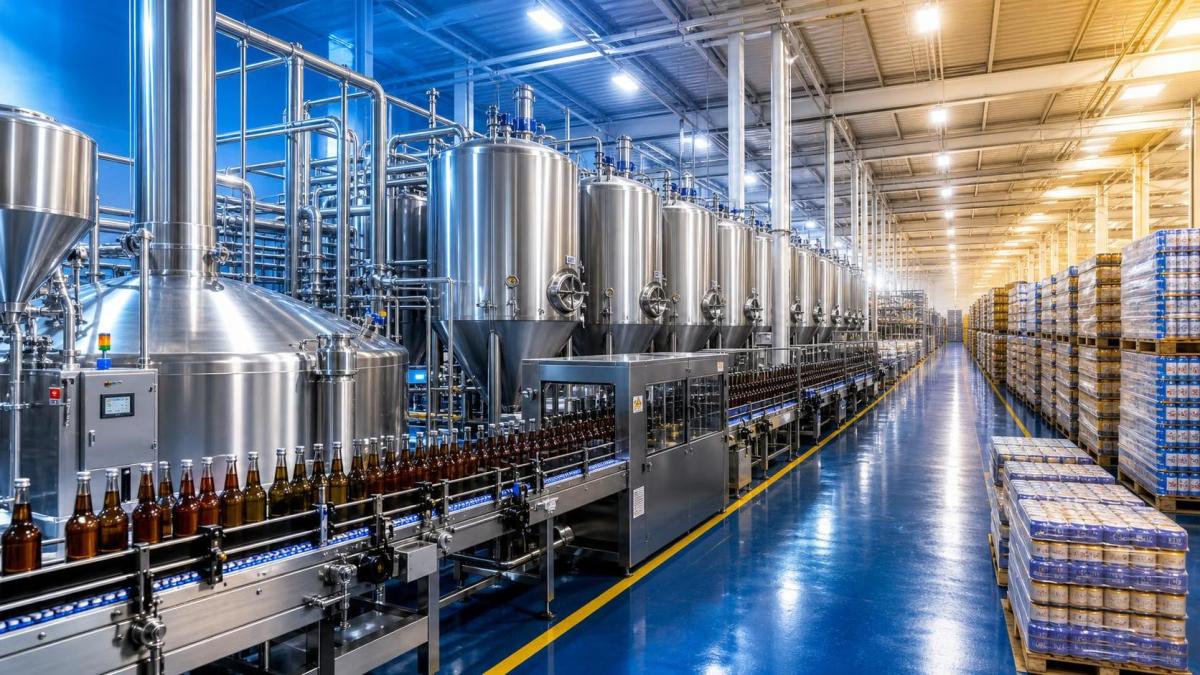
In many breweries, fermentation and maturation capacity—not brewhouse throughput—is the most important long-term constraint. The core calculation is straightforward: required tank volume depends on daily wort production multiplied by the average residence time in fermentation, maturation and any additional conditioning period, with allowances for tank heel, cleaning, operational contingency and product segregation.
The difficult part is that residence time differs by beer style and process. A fast-moving lager programme may have a very different tank occupancy profile from a wheat beer or specialty release. If the plant serves multiple channels, some products may also need longer conditioning to meet sensory expectations or export shelf-life requirements.
Tank sizing needs to reflect usable rather than nominal volume. Headspace, foaming behavior, carbonation practice, dry hopping where applicable, tank bottoms, losses and cleaning intervals all reduce practical capacity. A cellar designed with no redundancy can become unstable when one vessel is unavailable for inspection, repair or a quality investigation.
There is also a strategic choice between larger and smaller unitanks. Larger tanks reduce the number of transfers and can lower handling complexity for high-volume brands. Smaller tanks improve scheduling flexibility, reduce the risk attached to a single batch and suit private-label or market-specific production. Many scalable plants use a mixed tank farm: larger vessels for core volume and a smaller flexible block for specialty, export and OEM/ODM work.
Bright beer tanks deserve the same attention. If packaging capacity is high but bright beer tank volume is insufficient, the packaging line waits. If bright beer tanks are oversized relative to the filling schedule, beer may sit longer than intended and working capital rises. The right balance depends on line speed, package mix, planned packaging campaigns and the time needed for quality release.
Packaging is a capacity decision, not an end-of-line purchase
Packaging frequently becomes the limiting step once sales grow. The issue is not only nominal containers per hour. Actual output is shaped by line efficiency, format changeovers, label and carton changes, can or bottle supply, inspection systems, pasteurization requirements, coding, palletization and planned maintenance.
A line designed for one high-volume can format may be highly efficient but poorly suited to mixed retail and hospitality demand. Conversely, a line capable of handling cans, glass bottles, multipacks and different carton formats offers commercial flexibility, but every format change consumes time and raises operational complexity.
The packaging strategy should be built around expected order economics. Long production campaigns are efficient for core brands and large private-label orders. Short runs can be viable for premium, seasonal or channel-specific products, but only if the expected margin covers lost line time, cleaning, material handling and quality checks.
It is useful to measure packaging capacity in “productive hours” rather than calendar hours. A nominal 16-hour shift does not equal 16 hours of saleable output. Changeovers, start-up losses, stoppages, cleaning and inspection must be included. If the project economics depend on unrealistically high line utilization from the first year, the plan is fragile.
Packaging material procurement must be integrated into the capacity plan. Cans, bottles, crowns, labels, cartons and shrink film may have different lead times and minimum order quantities. For export business, country-specific labels, language requirements, deposit-system obligations or retail packaging specifications can turn an apparently simple production schedule into multiple material-dependent campaigns.
Utilities must be designed for peak operating conditions
Utilities are often treated as supporting infrastructure, yet their limits can directly reduce output and product consistency. Refrigeration, steam or thermal energy, compressed air, carbon dioxide, water treatment, wastewater handling and electrical supply should be assessed against peak simultaneous demand rather than average consumption.
For example, refrigeration load rises when wort cooling, fermentation temperature control, cold storage and packaging operations overlap. A system that functions during normal production can become inadequate during summer demand peaks or when the plant begins operating more shifts. Similarly, compressed air quality and reliability affect valves, automation and packaging equipment; unstable supply can create recurring line stoppages.
Water planning should consider both volume and quality. Brewing liquor treatment, process water, cleaning water and utility use may have different requirements. Wastewater discharge capacity and treatment obligations should be reviewed early, particularly where high-strength effluent, cleaning chemicals or variable production campaigns may affect discharge conditions. Retrofitting these systems after commissioning is typically more disruptive and expensive than providing phased expansion space at the start.
Build expansion paths into the site layout
Scalability is not achieved merely by selecting equipment advertised as expandable. The site must physically support the next phase. This includes floor loading, building height, access for vessel installation, pipe rack routing, drainage capacity, electrical switchgear space, cold-room expansion, warehouse circulation and truck loading arrangements.
A phased project should identify which assets are installed for ultimate capacity at the beginning and which are added later. Certain foundations, utility mains, drainage routes and control-system architecture are economical to size for future growth during the first construction phase. Other equipment, such as additional fermenters, bright beer tanks or a second packaging module, can be deferred until demand is proven.
The wrong approach is to overbuild every part of the brewery “just in case.” Idle assets create depreciation, maintenance obligations and unnecessary financing pressure. The better approach is to protect the expansion option while investing only where early oversizing prevents costly future disruption.
Plan for quality consistency across increasing volume
As volume rises, quality risks become more systemic. A small variation in raw materials, dissolved oxygen pickup, carbonation, microbiological control or package integrity can affect a much larger quantity of beer. Capacity planning must therefore include laboratory throughput, sampling points, traceability systems and quarantine space for products awaiting release.
Automation can improve repeatability, but it does not remove the need for disciplined process control. Recipe management, batch records, cleaning validation, yeast management and sensory evaluation should be able to scale with output. Where the plant produces customer-specific formulations, change-control procedures are particularly important. A substitution in flavouring, packaging material or processing aid may have implications for product specifications, labelling and customer approval.
For export-oriented breweries, shelf-life validation and package performance are part of capacity planning because slow quality release or rejected export consignments can occupy valuable warehouse and working-capital space. The plant should define how retained samples, traceability records and recall procedures will operate before commercial volumes increase.
Use a bottleneck review before committing capital
Before approving a large scale beer production investment, project teams should run the proposed operating model through a bottleneck review. For each demand scenario, ask what limits output first: brewhouse turns, cellar days, filtration, bright beer availability, filling hours, warehouse positions, utility load, labour availability or outbound transport.
The answer may change by season and by product category. That is normal. The objective is not to eliminate every constraint; it is to make sure the constraint is understood, manageable and economically sensible.
A well-planned brewery does not aim for every department to have identical spare capacity. It aims to place flexibility where commercial uncertainty is highest, protect quality-critical processes from overload and ensure that the next expansion can be completed without interrupting the core business. When capacity is planned this way, growth becomes a sequence of controlled decisions rather than a cycle of urgent equipment purchases and missed delivery commitments.
Thank you very much for writing to us. Please leave your message and contact information, we will reply to you within 24 hours.