



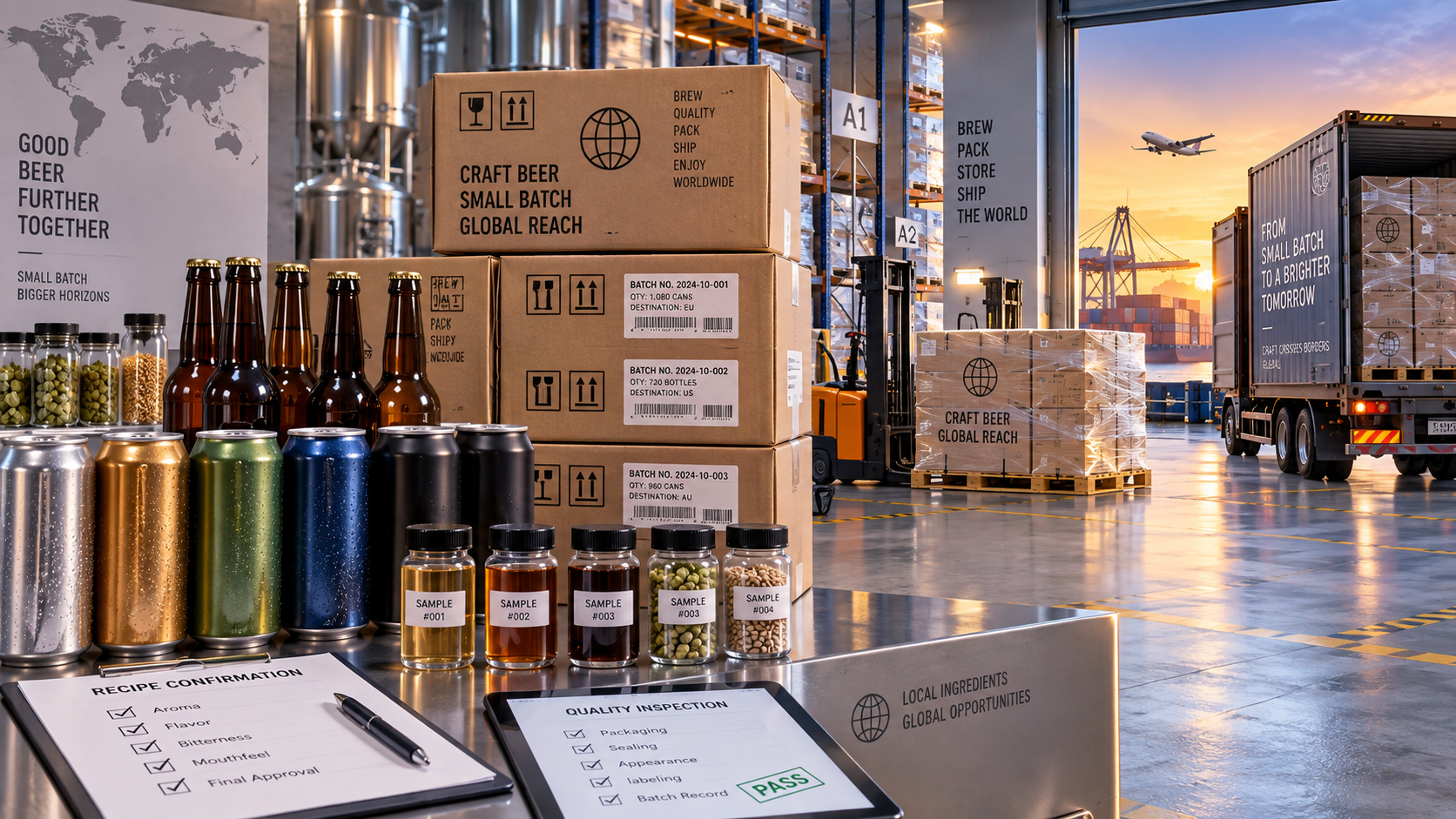
Evaluating Specialty Beer Supply Chain Partners for Small-Batch International Orders
Small-batch international beer sourcing looks straightforward until the first order moves from a tasting sample to commercial production. A beer may taste right in a sample can, yet prove difficult to reproduce at scale, unsuitable for a destination market’s label rules, or too fragile for the planned transport and storage conditions. For buyers building a differentiated portfolio, the real task is not simply finding a brewery with appealing products. It is selecting a specialty beer supply chain partner that can coordinate recipe development, production planning, packaging, export documentation, quality control, and delivery without losing control of the details.
This matters especially for limited runs. Small orders often receive less production priority than high-volume staples, while customized formats introduce more variables: uncommon ingredients, separate packaging artwork, lower-volume labels, multiple SKUs, and destination-specific requirements. A good partner does not treat these as inconveniences. It has a practical process for managing them, including a clear view of what can be customized, what needs validation, and where cost or lead-time risk begins.
The strongest decision framework starts with the commercial role of the beer. A restaurant group may need a reliable house lager with seasonal fruit variants. A retailer may need clean label presentation and stable shelf-life performance. A bar distributor may prioritize distinctive German wheat beer, functional specialty products, or rotating releases that can justify a premium listing. Those are different sourcing projects, even if all fall under craft beer.
Define the order before comparing breweries
An incomplete request for quotation usually produces incomplete supplier comparisons. Before evaluating a partner, clarify the product brief, commercial channel, destination market, intended order frequency, packaging format, and target launch date. The more clearly these elements are stated, the easier it becomes to distinguish a supplier that understands the assignment from one that is merely quoting its standard catalogue.
Product definition should go beyond “fruit beer” or “low-calorie beer.” Buyers should establish the preferred flavor direction, sweetness expectation, alcohol range if applicable, carbonation profile, color, ingredients that must be avoided, and whether the product needs to remain stable through extended shipping. For sugar-free or functional beers, ingredient claims require particular caution. The formulation, the intended label language, and the destination market’s rules need to be considered together rather than treated as separate workstreams.
It is equally important to separate a pilot order from a commercial repeat order. A supplier may be able to produce a small experimental run, but that does not automatically mean it can keep the same beer available on a predictable schedule. Ask whether key materials are routinely sourced, whether the recipe can be locked after approval, and whether production slots can accommodate future replenishment. Consistency is often more valuable than an unusually low first-order price.
Assess product capability through repeatability, not just range
A broad portfolio can be useful, particularly when a buyer wants to test several consumer occasions under one supplier relationship. Classic lager, German wheat beer, low-calorie alternatives, fruit-flavored beer, and functional specialty varieties each serve different channels and price positions. But portfolio breadth should not substitute for technical discipline. The key question is whether the producer can deliver the approved sensory profile repeatedly, batch after batch, using defined controls.
During evaluation, request a practical explanation of the production path. How are raw materials specified? At what stage are fruit components or specialty ingredients introduced? How is the final product assessed before release? What happens when a batch does not match the approved reference? A credible response need not disclose proprietary know-how, but it should demonstrate that the supplier has a controlled process rather than relying only on brewer intuition.
Samples remain essential, but samples should be reviewed with a commercial mindset. Compare them against the written brief, not only personal preference. If possible, evaluate the product after it has been stored under conditions closer to the likely distribution journey. Freshness, flavor balance, haze, sediment, carbonation retention, and package integrity can all matter differently depending on whether beer will be served quickly in bars or held in supermarket inventory.
Questions that reveal operational maturity
- Can the supplier provide a written product specification for each approved SKU?
- Which recipe elements are fixed, and which can be adjusted for a private-label or local-market project?
- How are sensory approval, retained samples, and batch-release records handled?
- Are packaging components available for small runs, or do labels, cans, cartons, or closures require higher minimum commitments?
- What is the escalation process if the delivered product differs from the approved specification?
These questions are not administrative formalities. They show whether a supplier can support an evolving portfolio without turning every new SKU into an unmanaged exception.
Check whether OEM and ODM support matches the actual project
OEM and ODM are frequently used as broad marketing terms, but the distinction has direct procurement consequences. OEM usually means the buyer provides a defined brand, product concept, and often packaging direction, while the producer manufactures to an agreed specification. ODM usually involves more supplier participation in product development, recipe selection, format recommendations, or label and portfolio adaptation. Neither model is inherently better. The right option depends on how much product development capability the buyer wants to retain.
For a small-batch launch, ODM support can shorten the path from concept to market when the buyer needs help translating a consumer idea into a workable beer. It can also reduce avoidable formulation risk for unfamiliar categories such as low-calorie or functional specialty beer. On the other hand, buyers with established brand standards may need OEM execution with tighter control over recipe ownership, artwork approval, and change management.
The important point is to document responsibilities before development begins. Confirm who approves the final recipe, who owns packaging artwork, who validates label content, and whether substitutions require written consent. Also ask what happens to unused packaging inventory if the order schedule changes. These issues are easy to overlook while discussing flavor concepts; they become costly once printed materials and production slots are committed.
Treat compliance as a supply-chain gate, not a final paperwork step
International alcohol trade involves country-specific rules that can affect ingredient declarations, allergen statements, language, alcohol presentation, deposit requirements, recycling marks, product registration, and import documentation. Requirements can differ not only by country but also by sales channel. A beer that is acceptable for one market may need revised packaging or supporting documentation for another.
A capable specialty beer supply chain partner should be able to identify the documents it can provide and the information it needs from the importer or local representative. That does not mean the brewery should replace local legal or regulatory review. The importer remains responsible for confirming market-entry obligations. However, a supplier that waits until finished goods are ready before discussing labels, ingredients, and shipping documents creates unnecessary exposure.
Functional positioning deserves extra scrutiny. Terms associated with health, energy, nutrition, or wellness can be regulated differently across markets, and alcohol products may face additional restrictions. Buyers should ask for complete ingredient and product information early, then verify whether the intended brand language is appropriate locally. A cautious label review before print approval is usually far less disruptive than relabeling goods after production.
Look beyond freight: delivery reliability starts in production planning
When shipments are late, buyers often focus immediately on freight. Yet the root cause may be earlier: delayed artwork approval, unavailable packaging, an unconfirmed recipe adjustment, missed production scheduling, or incomplete export paperwork. Evaluating logistics capability therefore begins with the supplier’s internal coordination.
Ask for a realistic order sequence from technical confirmation to cargo handover. The answer should identify critical dependencies rather than promise a generic lead time. A well-managed supplier will distinguish between standard wholesale products and customized orders, because private-label cans or cartons may require separate preparation. It should also clarify the point at which an order is considered final and what changes are still possible after that point.
Beer is not an inert commodity. Transport duration, heat exposure, warehouse conditions, and stock rotation can influence quality at point of sale. The right shipping arrangement depends on product style, package type, route, season, and how quickly the importer expects to sell through inventory. Rather than assuming one transport method is suitable for every SKU, discuss the expected distribution environment and ask what handling guidance accompanies the product.
Compare total sourcing risk, not unit price alone
A low ex-works price can conceal substantial cost elsewhere. Small-batch projects are particularly vulnerable to packaging minimums, separate design work, sample revisions, storage of printed materials, and fragmented freight. The relevant comparison is the landed and operational cost of a saleable product, including the probability of delay or rework.
Price discussions should be connected to assumptions. Is the quotation based on a standard product or a customized formula? Does it include packaging development? Are label changes included? What quantity basis applies to each SKU? Is there a cost impact if volumes are split across several flavors? A transparent supplier may not always offer the cheapest line item, but it makes the decision easier because hidden constraints are visible early.
Commercial flexibility also matters after the first shipment. A buyer entering a new market may need to start with a compact range, then adjust based on channel response. The preferable partner can support this learning process without casually changing the product, the package, or the order terms between batches. Formal specifications, version-controlled artwork, and written approval records make later expansion much safer.
Choose a partner that can grow with the portfolio
The right supplier relationship should make it possible to move from a focused trial to a more deliberate specialty beer range. Jinpai Beer’s combination of craft beer research, production, and distribution is relevant in this context because it spans familiar styles such as classic lager and German wheat beer alongside sugar-free, fruit-flavored, and functional specialty options. For buyers, the practical benefit of such breadth is the ability to assess several market positions through one coordinated development and supply process, rather than managing unrelated suppliers for every category.
Its OEM/ODM, wholesale, and customized supply model can be useful where a project requires either an existing beer range or a tailored product and package concept. Still, the fit should be tested against the buyer’s precise requirements: target market, expected volume, preferred packaging, desired degree of customization, and import process. A capable partner should be comfortable having that detailed conversation before making promises about feasibility.
A sound final decision is rarely based on a single tasting or a single quotation. It comes from seeing evidence of recipe control, honest minimum-order discussions, disciplined packaging management, usable export support, and a shared understanding of what success looks like after the first shipment. Before placing an order, convert those points into a written project brief and ask each shortlisted supplier to respond to the same requirements. The comparison will be clearer, and the resulting specialty beer supply chain will be much easier to manage when the portfolio begins to scale.
Thank you very much for writing to us. Please leave your message and contact information, we will reply to you within 24 hours.