



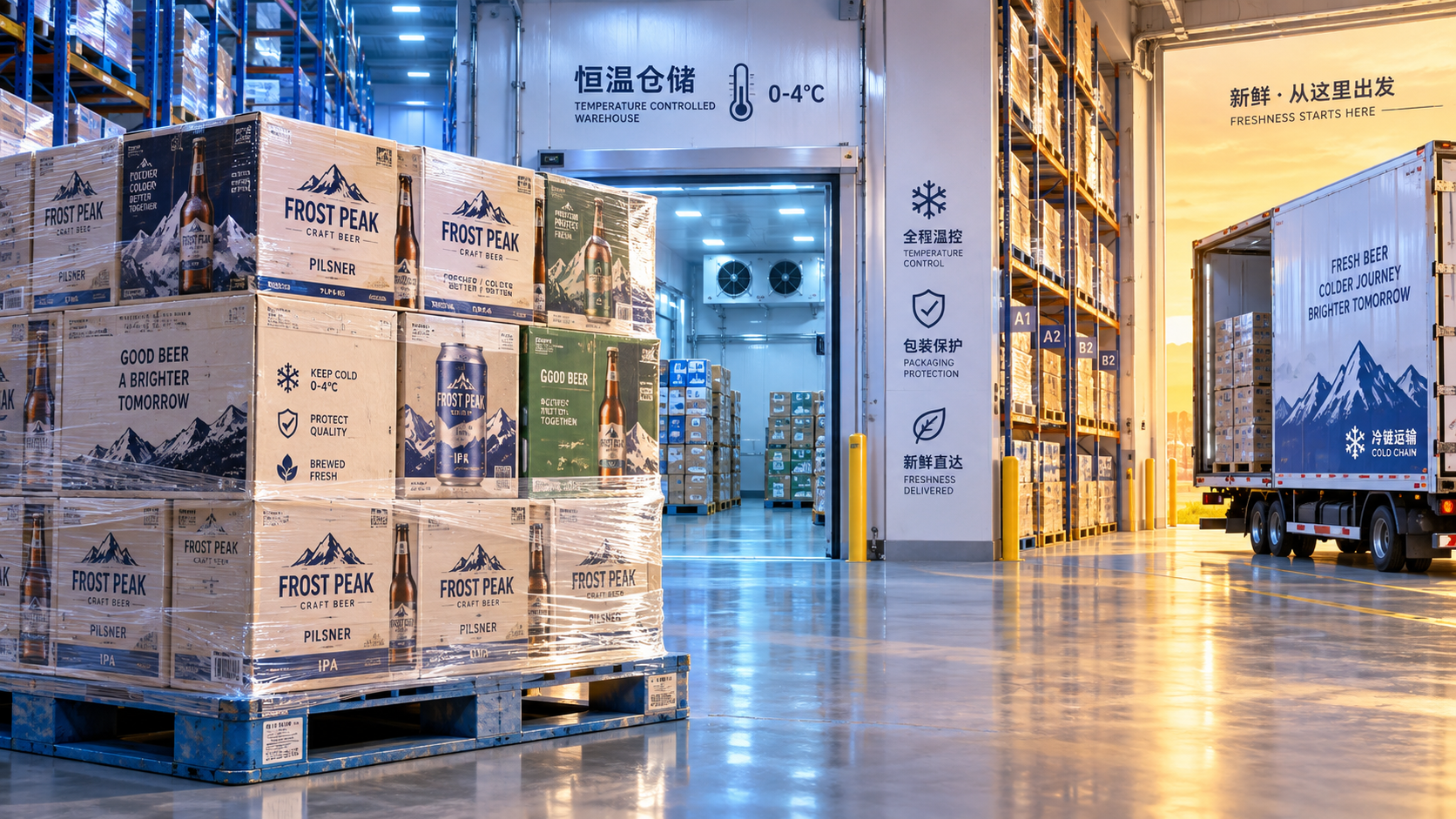
A specialty beer supply chain can fail long before a bottle or can reaches the shelf. The most visible loss may be a broken carton or a returned case, but the quieter losses are often more damaging: a wheat beer that tastes tired after sitting warm, a fruit beer with dulled aroma, or a low-calorie beer that reaches the customer outside its intended freshness window.
For warehouse teams, delivery operators, buyers, and retail staff, beer quality is not protected by a single decision. It is protected by a chain of ordinary actions: receiving a shipment out of the sun, stacking cases correctly, checking dates before replenishment, and reacting quickly when refrigeration fails. In specialty beer, where flavor profiles are often more delicate than mainstream products, those actions directly affect whether the consumer gets the experience the brewer intended.
This guide looks at the points where a specialty beer supply chain most commonly breaks down, why those failures happen, and what operators can do to reduce avoidable waste.
Specialty Beer Is Less Forgiving Than It Looks
Beer is stable compared with many fresh beverages, but it is not indestructible. Different styles respond differently to heat, light, movement, oxygen exposure, and time. A classic lager may show staling through a flatter, less crisp finish. German wheat beer can lose its lively aroma and characteristic yeast-driven character. Fruit-flavored beer may lose brightness or develop an unbalanced sweet note when stored poorly. Functional specialty beers, sugar-free products, and low-calorie formulations may also have their own storage sensitivities depending on ingredients and packaging.
That is why “the cartons are dry and nothing is broken” is not an adequate receiving standard. A shipment can look perfect while its flavor has already been compromised by several days in a hot transfer area or a vehicle with inconsistent temperature control.
Operators do not need to turn every warehouse into a laboratory. They do need to recognize that specialty beer quality is cumulative. One warm afternoon may not ruin a product. Repeated exposure across factory dispatch, port handling, local storage, and final delivery can gradually shorten its usable shelf life.
Temperature Risk: The Damage You Cannot Always See
Temperature excursions are among the most common and least visible supply-chain problems. Beer kept at a stable, appropriate temperature generally retains its intended flavor longer than beer that repeatedly warms and cools. High heat accelerates flavor aging. Large swings create additional stress, particularly when products are held in containers, loading bays, or retail back rooms without climate control.
The difficult part is that temperature risk rarely comes from one obvious failure. It comes from routine friction in the operation:
- Pallets waiting outside before warehouse intake.
- Containers parked in direct sunlight during customs or scheduling delays.
- Mixed-temperature vehicles carrying beer alongside products with different requirements.
- Retail back rooms that become hot during peak trading hours.
- Cases placed beside heaters, windows, kitchen doors, or refrigeration exhaust.
- Cold storage that cycles too aggressively or suffers unnoticed outages overnight.
It is also important to distinguish between chilled service requirements and long-term storage needs. Not every beer must remain refrigerated throughout every stage, but every beer benefits from protection against excessive heat and unnecessary fluctuations. The right handling plan should follow the product’s label guidance, ingredients, packaging format, destination climate, and expected sales cycle.
Build a temperature map before adding more refrigeration
When quality complaints appear, many businesses immediately conclude that they need more cold storage. Sometimes they do. More often, they need a clearer map of where heat enters the process.
Walk the actual route a pallet takes: unloading area, staging zone, warehouse rack, picking lane, delivery vehicle, customer receiving point, and retail display. Note where it waits, not just where it is stored. A case may spend most of its life in a suitable warehouse, then lose quality during repeated hours on a warm loading dock.
Simple temperature monitoring can reveal patterns that staff do not notice during normal shifts. Data loggers for longer routes and spot checks in problem areas help identify whether the issue is a specific vehicle, a transfer window, a storage zone, or seasonal weather. The aim is not to collect data for its own sake; it is to decide where operational changes will protect the product most effectively.
Practical controls that work on busy days
Good temperature control is often about discipline rather than expensive equipment. Schedule receiving and dispatch to minimize outdoor waiting time. Keep beer away from direct sun even during short staging periods. Use insulated or temperature-managed transport where route length and climate make it necessary. Train drivers to avoid leaving product in parked vehicles longer than required.
At retail level, give staff a simple rule: beer should not be stored wherever the room happens to have spare space. A dry, shaded, reasonably stable area is far safer than a window display, hot stockroom corner, or space beside cooking equipment. For products intended to be sold chilled, move stock into refrigeration early enough to cool evenly before service rather than rushing warm cases into a cooler just before a promotion.
Breakage Is Usually a Packaging-and-Handling Problem, Not Just Bad Luck
Glass breakage creates an immediate operational headache. There is lost inventory, cleanup time, safety risk, potential contamination of nearby cartons, and sometimes a difficult conversation with a customer who received damaged goods. Yet repeated breakage should never be accepted as an unavoidable cost of distributing beer.
In a specialty beer supply chain, breakage tends to appear at handoff points: loading from pallet to vehicle, moving cases between warehouses, delivering to bars with narrow access routes, or replenishing crowded supermarket shelves. Every transfer adds a chance for impact, vibration, incorrect stacking, or unstable loads.
Packaging matters, but packaging only works when it is matched to the route. A pack designed for a short local delivery may need additional protection for international freight, multi-stop distribution, or mixed pallet loads. Glass bottles, cans, and different carton formats each have different strengths. Cans remove the risk of shattered glass, but they can dent under excessive compression or rough handling. Bottles require particularly careful control of carton integrity, pallet stability, and vertical stacking limits.
Check the pallet before it becomes a claim
The best time to identify a breakage risk is before the pallet leaves the facility. Operators should check that cartons are dry, square, and free from crushed corners; stretch wrap is secure without pulling cases out of shape; pallet edges are protected where needed; and heavier products are not creating pressure on lighter cartons.
Overhang is a frequent source of damage. When cartons extend beyond the pallet edge, they are exposed to forklift contact, vehicle vibration, and impacts in tight warehouse aisles. Uneven stacking is equally risky. It may look acceptable when stationary, then shift during braking or turning.
For deliveries to restaurants, bars, and small retailers, the final meters matter as much as the long journey. Staff may carry individual cases down stairs, through wet entrances, or across uneven surfaces. Handles, carton bases, and case weight should be considered alongside product presentation. If the route routinely involves manual handling, a packaging decision made only for shelf appearance may create avoidable losses later.
Separate damage reporting from blame
Teams often underreport minor damage because they do not want to slow down a shift or be blamed for a problem. That makes patterns harder to see. A practical reporting process should capture the product, lot or date code, location, type of damage, and likely cause when known. Was the carton wet on arrival? Did the pallet lean? Was the case damaged during store delivery? These details are more useful than a generic “broken stock” entry.
Reviewing damage by route, carrier, packaging format, and handling stage can reveal whether the solution is improved loading, revised pallet configuration, stronger secondary packaging, or staff training. It is far more productive than replacing a few damaged cases and waiting for the same issue to return.
Shelf Life Is Managed by Time, Not by the Printed Date Alone
A best-before date is essential, but it is not a complete shelf-life strategy. The remaining quality window depends on how the beer has been treated since production. A product that has spent months in favorable conditions is not equivalent to one that has spent the same time moving through hot or poorly managed storage.
For operators, the central question is simple: will this product reach the consumer with enough freshness remaining for the intended channel? A fast-moving bar may sell through a shipment quickly. A specialty grocery store in a lower-volume market may need more cautious purchasing and replenishment. Export destinations with long transit times require planning before the production order is placed, not when stock is already approaching its date.
Different beer styles also deserve different attention. Hoppy and aroma-led beers can be especially vulnerable to loss of freshness character. Wheat beers and fruit beers may need closer rotation because the aromas that make them appealing are often what consumers notice first. Classic lager may remain commercially acceptable for a longer period under proper storage, but it should still be protected from heat and outdated inventory practices.
Use FEFO, not merely FIFO
First in, first out is useful, but first expired, first out (FEFO) is more accurate for beer operations. Products should be picked and replenished according to the earliest date, even when they were received at different times or came from separate deliveries. This matters when a warehouse combines stock from several production lots, import shipments, or returned retail inventory.
A workable FEFO system does not have to be complicated. Date codes should be visible at pallet and case level. Warehouse locations should avoid mixing lots without clear identification. Pickers need an easy way to recognize which stock must move first. At the retail shelf, staff should rotate existing stock forward before adding new cases behind it.
The most common mistake is treating date checks as a monthly administrative task. By the time an aging report is reviewed, short-dated stock may already be buried in a back room. Frequent, targeted checks work better: inspect slow-moving SKUs, promotional leftovers, remote storage locations, and accounts with irregular reorder patterns.
Where Inventory Control Quietly Undermines Beer Quality
Inventory errors do more than create stockouts. They cause beer to sit in the wrong place for too long. An inaccurate system may show a product as available when it is actually on a blocked pallet, in a damaged return area, or hidden behind newer inventory. Teams then reorder unnecessarily while older stock remains untouched.
Returns deserve particular care. Beer returned from a retailer may have been exposed to unknown storage conditions. It should not automatically go back into saleable inventory simply because the packaging looks intact. Establish a clear inspection process that considers date, visible damage, storage history where known, and whether the product has remained within acceptable handling conditions.
Seasonal demand creates another trap. Fruit-flavored beer may move quickly in warm months, while specialty and functional beers may be ordered for events, campaigns, or changing consumer preferences. Forecasting should account for these patterns, but operators should avoid using optimistic sales expectations as a reason to overstock. Freshness is part of the product value; excess inventory can turn a successful purchase into a margin problem.
A Receiving Checklist That Protects the Next Step
Receiving is one of the few moments when operators can stop a problem from spreading. Once questionable stock is mixed into warehouse inventory, traced across multiple orders, or sent to customers, the cost of correction rises quickly.
- Check outer cartons for moisture, crushing, punctures, and visible leakage.
- Confirm pallet stability, wrap condition, and signs of shifting during transport.
- Verify product name, pack format, quantity, lot details, and date codes against the delivery record.
- Record obvious temperature concerns, such as stock arriving unusually warm after transit.
- Quarantine damaged or uncertain cases rather than placing them directly into available inventory.
- Move accepted stock promptly into its assigned storage area and preserve lot visibility.
The checklist should be short enough to use during a busy delivery window. If it is too detailed, staff will bypass it. The real value comes from consistency and from having a clear escalation route when something does not look right.
Supplier Coordination Makes the Supply Chain More Resilient
Beer distributors and operators cannot manage these risks alone. The brewer, packaging provider, freight partner, importer, warehouse, and retail account all influence final product condition. Clear communication is especially important for global distribution, where transit times, climate conditions, customs delays, and local storage practices vary widely.
When sourcing craft beer, operators should discuss expected lead times, packaging options, recommended storage conditions, date-code practices, pallet specifications, and the realistic sales cycle for each market. A supplier offering a broad portfolio—from classic lager and German wheat beer to sugar-free, fruit-flavored, and functional specialty beers—can also help buyers select products that fit the channel rather than forcing one format into every environment.
For private-label, OEM, or ODM projects, supply-chain planning should begin during product and packaging development. Bottle shape, can format, carton design, case count, pallet arrangement, and destination climate all influence how reliably the finished beer will travel. A good-looking pack that performs poorly in distribution can damage both product quality and brand confidence.
The Goal Is a Beer That Still Tastes Intentional
Temperature, breakage, and shelf-life risks are often treated as separate operational topics. In reality, they are connected. A delayed shipment may sit in heat; the rushed recovery may involve rough handling; the resulting inventory may be sold too late because lot rotation was unclear. Small gaps can compound until the customer opens a beer that no longer reflects the brewer’s work.
A stronger specialty beer supply chain is built through repeatable habits: protect stock from heat, stabilize every load, rotate by date, inspect at each handoff, and share information before problems become claims. These practices do not remove every risk, but they give operators far more control over the quality that reaches the shelf, the bar, and ultimately the glass.
Thank you very much for writing to us. Please leave your message and contact information, we will reply to you within 24 hours.