



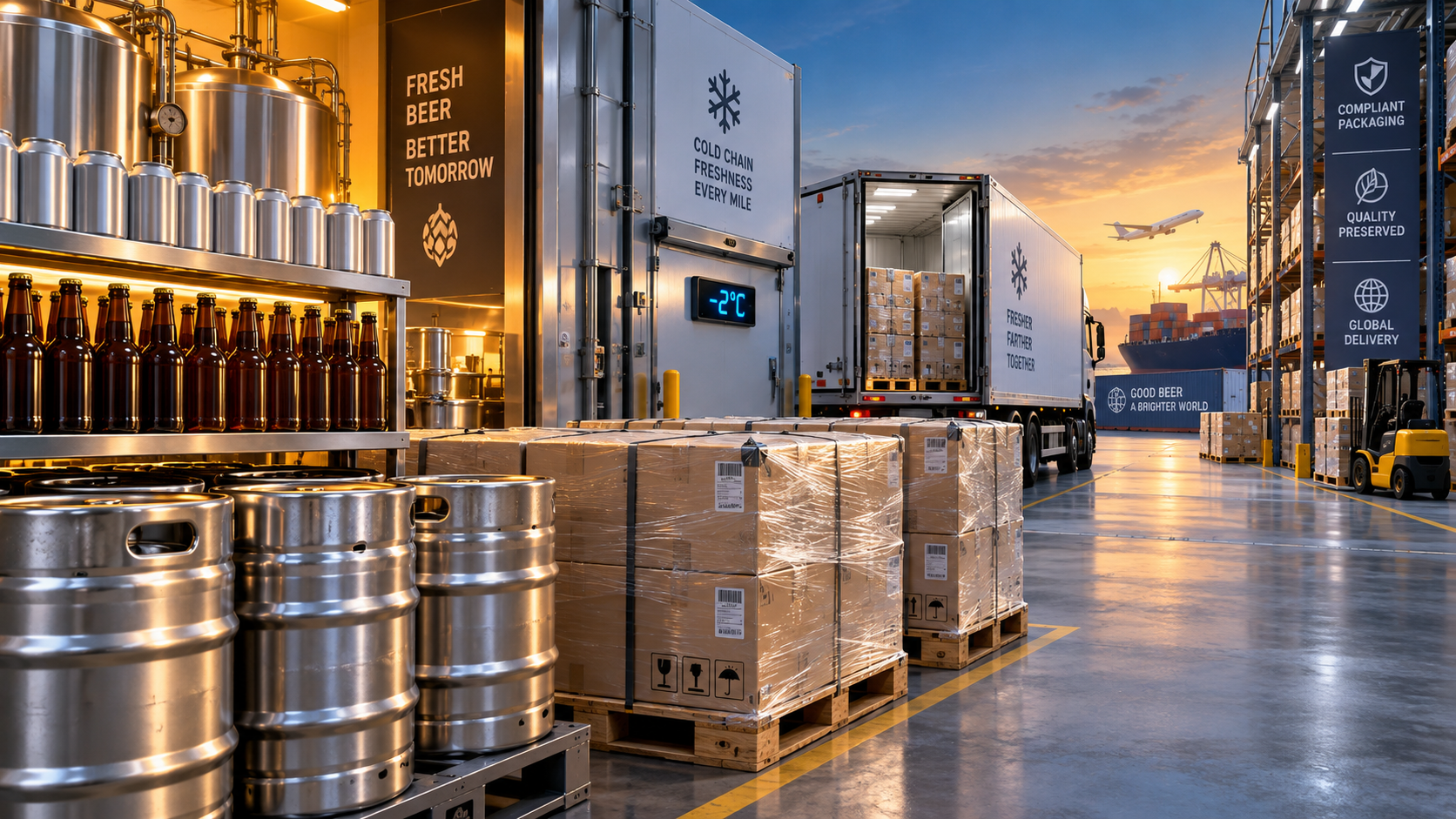
Cross-border craft beer distribution is becoming less dependent on the simple question of whether a beer is distinctive enough to attract attention. The harder question is whether that distinction can survive the route from brewery to shelf, taproom, restaurant or online order without creating excessive cost, compliance exposure or inventory risk.
That shift is reshaping the specialty beer supply chain. Importers and distributors are placing greater value on portfolio reliability, packaging suitability, documentation discipline and the ability to adjust products for local channels. A broad catalog still matters, but it no longer compensates for inconsistent batch quality, poorly matched pack formats or a supplier that cannot support market-specific requirements.
The implication is significant: cross-border specialty beer is moving from an opportunistic import business toward a more managed supply-chain category. The strongest distribution models increasingly treat product development, regulatory preparation, logistics design and channel planning as connected decisions rather than separate functions.
Distinctive beer is no longer enough to secure distribution
Specialty beer historically benefited from scarcity. A German-style wheat beer, fruit-led beer, low-calorie product or seasonal release could create interest because it differed from familiar mainstream offerings. That logic remains relevant at the consumer level, but distribution decisions have become more demanding.
A distributor evaluating imported craft beer now has to consider whether the product can occupy a stable role in its portfolio. A retailer may need a pack size that suits shelf dimensions and local purchase behavior. A bar may need keg formats, dependable replenishment and predictable sensory performance. Restaurants may prefer beers that complement food menus and can be supplied with enough continuity to avoid frequent menu changes. E-commerce operators need packaging that can tolerate parcel handling and product data that can be translated accurately for digital listings.
These requirements make “specialty” less of a product descriptor and more of a supply-chain challenge. A beer can be technically well made and creatively positioned, yet still be commercially difficult if its landed cost is volatile, its shelf-life window is too narrow for the chosen route, or its packaging is incompatible with destination-market recycling rules.
Portfolio design is shifting from single-product imports to controlled range architecture
Cross-border buyers increasingly need portfolios that can serve more than one route to market. The commercial objective is not necessarily to offer the maximum number of styles. It is to build a range in which each product has a defined role and operational profile.
A stable lager may function as the volume-oriented entry point for restaurants, supermarkets and mixed retail accounts. Wheat beer can provide a recognizable style cue for consumers seeking imported or traditional European profiles. Fruit-flavored beers can address seasonal menus, casual drinking occasions and selected convenience or social channels. Sugar-free, low-calorie and functional specialty beers may fit wellness-oriented or differentiated retail concepts, but require particularly careful communication because ingredient, nutrition and health-related claims can be regulated differently across markets.
The important trend is not the existence of these styles themselves. It is the way they are being assembled into ranges that balance discovery with repeatability. A distributor that imports only limited releases may gain attention but face uneven reorder patterns. A distributor focused only on dependable core styles may protect operational efficiency but lose the ability to refresh its offer. The more resilient model combines a core range with controlled specialty extensions, using each category according to its replenishment, margin and channel characteristics.
This also changes the supplier relationship. Buyers need clearer information on which products are permanent, seasonal, limited or customizable. They need visibility into minimum order quantities, production lead times, substitute packaging options and whether formulations can be held consistent over repeated orders. Without that clarity, assortment planning becomes vulnerable to stock gaps and forced delisting.
Freshness management is becoming a commercial discipline, not only a quality issue
Beer quality can change materially between packaging and consumption. Oxygen pickup, light exposure, temperature variation and time affect different beer styles in different ways. Delicate hop-forward beers may lose their intended aroma relatively quickly, while stronger or darker products can have a different stability profile. Fruit ingredients, natural extracts and certain functional additions may introduce further sensory or physical stability considerations.
For cross-border trade, the relevant question is not simply the stated shelf life. It is how much of the usable quality window remains after production scheduling, export documentation, port handling, customs clearance, inland transport and warehouse allocation.
That requires a more disciplined approach to inventory age. Importers should distinguish between legal shelf life and commercial freshness. A product may remain compliant for sale while no longer presenting the flavor profile on which its specialty positioning depends. This distinction is especially important for products sold at premium prices, where consumers are less forgiving of tired aroma, flat carbonation or inconsistent appearance.
Packaging decisions follow from this reality. Cans can offer strong protection from light and can be efficient for some retail and e-commerce models. Glass bottles may align with premium presentation or established channel expectations but require attention to breakage risk, container deposits and labeling space. Kegs can be appropriate for hospitality accounts, although reverse logistics, deposit management and draft-system conditions become part of the supply-chain equation.
Cold-chain capability can be useful for selected products and routes, but it should not be treated as a universal remedy. The underlying commercial model must still account for transit duration, warehouse dwell time and turnover speed. A slow-moving imported beer with high storage requirements can become structurally expensive even when its initial product quality is strong.
Compliance is moving upstream into product and packaging development
One of the most consequential changes in specialty beer distribution is the earlier involvement of compliance work. Labeling, language requirements, allergen declarations, alcohol statements, ingredient rules, deposit schemes, food-contact obligations and customs classifications can affect whether a product is viable in a destination market. These are not matters that can reliably be resolved after containers are loaded.
Beer containing cereals raises allergen-labeling considerations. Fruit beers, sugar-free products and functional specialty beers may require closer review because product names, ingredient descriptions and nutritional or functional messages can create regulatory questions. A phrase that appears commercially harmless in one market may be treated as a nutrition, health or medicinal implication in another.
Packaging artwork also has a longer commercial life than many businesses assume. If every market requires a separate label, the complexity affects inventory allocation, print runs, approval cycles and the risk of obsolete stock. Some businesses address this through destination-specific back labels or over-labeling systems; others plan multiple artwork versions from the beginning. Neither approach is automatically superior. The appropriate choice depends on volume, local rules, packaging materials and the degree of brand consistency required.
Excise administration deserves equal attention. Alcohol products often involve procedures and documentation that differ from ordinary packaged food imports. Errors in product classification, alcohol-strength information, bonded movement arrangements or customs records can delay release and raise costs. A supply chain that looks efficient on a freight quotation can fail if the importer, customs broker and supplier are not aligned on product data before shipment.
From container economics to total landed-risk economics
Freight rates remain important, but they are an incomplete basis for supplier selection. The relevant financial measure is the cost of serving the intended channel with an acceptable quality and service level.
For specialty beer, total landed risk includes more than production price, freight and duty. It can include label revisions, testing requirements, customs clearance delays, damaged packaging, temperature exposure, insurance conditions, storage, deposits, write-offs from aged inventory and the capital tied up in slow-moving stock. A lower ex-works price can become less attractive if it requires large production runs, has limited packaging flexibility or leaves too little remaining shelf life at arrival.
This is why mixed-load and consolidation capability are receiving more attention. A buyer that can combine several compatible products may test a range without committing to a full-container quantity of each SKU. The trade-off is added coordination and potentially higher unit logistics cost. Whether it is worthwhile depends on the value of reduced assortment risk and faster market learning.
Similarly, regional warehousing can reduce delivery time to local accounts, but it also introduces inventory holding risk. Direct shipment may preserve freshness in some circumstances by avoiding an extra warehouse stage, yet can be less responsive for replenishment. The choice should be made by product velocity and channel demand patterns, not by a general preference for either centralized or localized stock.
OEM and ODM are becoming tools for market fit rather than simple private labeling
OEM and ODM capabilities are increasingly relevant in cross-border craft beer because they give distributors and brand owners a way to reduce the mismatch between a brewery’s existing range and a destination market’s needs. The value is not limited to placing a private label on a standard product.
At a practical level, customization may involve alcohol strength, bitterness level, sweetness, fruit profile, pack size, can or bottle format, outer-case configuration and artwork adaptation. It may also involve creating a range with price points that suit a particular channel, such as a premium restaurant listing, a supermarket promotion format or a gifting-oriented seasonal package.
However, customization creates its own controls. A buyer should establish which elements are genuinely adjustable, which require new raw-material sourcing, and which will alter production lead time or minimum order quantity. Formula changes can affect stability, declarations and sensory consistency. Artwork changes can affect compliance. Smaller runs can increase unit cost and complicate production scheduling.
The strongest OEM/ODM relationships therefore begin with a written specification rather than a creative brief alone. The specification should define the product style, target alcohol range, sensory direction, packaging format, fill volume, target shelf life, labeling responsibilities, sample approval process, quality tolerances and change-control procedure. This reduces the common problem in which a customized product is approved as a concept but insufficiently defined for repeat production.
Traceability and data quality are becoming competitive infrastructure
As specialty portfolios expand, the commercial importance of clean product data increases. Importers need reliable information for customs declarations, distributor systems, retail listings, menu descriptions and recalls if they become necessary. This includes batch identification, production dates, best-before dates, alcohol content, net volume, ingredients, allergens, packaging configuration and country-of-origin information where relevant.
Traceability is often discussed mainly as a food-safety obligation. In practice, it also supports faster commercial decisions. If a distributor can identify which batches are located in which warehouse and which accounts received them, it can manage aging stock, investigate complaints and allocate replenishment more effectively. Poor batch visibility turns a small quality issue into a wider inventory and reputation risk.
Digital product information also matters for online channels. Consumers buying specialty beer online cannot inspect a label in person. Product pages need accurate style descriptions, alcohol information, allergen details and pack contents. Inconsistent data between the physical label, the importer’s records and the e-commerce listing can create compliance concerns as well as customer-service problems.
Supplier resilience is being evaluated at the operational level
A specialty beer supplier may offer an appealing catalog but still be unsuitable for sustained export distribution if it lacks production planning discipline, documentation support or communication procedures. The supplier assessment is moving beyond taste panels and sample approval toward operational resilience.
Relevant questions include whether production capacity is reserved or allocated only after orders are confirmed; whether raw materials and packaging components are sourced consistently; whether the brewery can provide batch-level certificates and export documents in the required format; and whether it has a clear process for handling specification changes. These are not administrative details. They determine whether a distributor can confidently commit a product to a retail listing or hospitality program.
Supply resilience should also be judged against the complexity of the range. A brewery producing classic lagers, wheat beers, fruit beers and functional specialty products may need different ingredient controls, cleaning procedures and production sequencing. The distributor does not need to manage the brewery’s operations, but it should understand whether product complexity is supported by appropriate quality systems and realistic lead times.
The distribution advantage will come from reducing avoidable complexity
The specialty beer supply chain is not becoming simpler. Consumer expectations, product differentiation, packaging choices and compliance demands all create more variables. The commercial advantage lies in deciding which complexity creates value and which merely adds cost or risk.
A differentiated portfolio can create value when each product has a clear route to market. Localized packaging can create value when it improves compliance and shelf conversion. OEM or ODM development can create value when it solves a genuine assortment gap. Additional variants, custom formats or highly fragmented orders become liabilities when they lack a defined sales role or cannot move fast enough through the system.
Cross-border craft beer distribution is therefore being reshaped by a more disciplined view of specialty. The winning proposition is not simply unusual beer. It is a product range that remains recognizable, compliant, stable and economically manageable from brewery production through to the final point of sale.
Thank you very much for writing to us. Please leave your message and contact information, we will reply to you within 24 hours.