



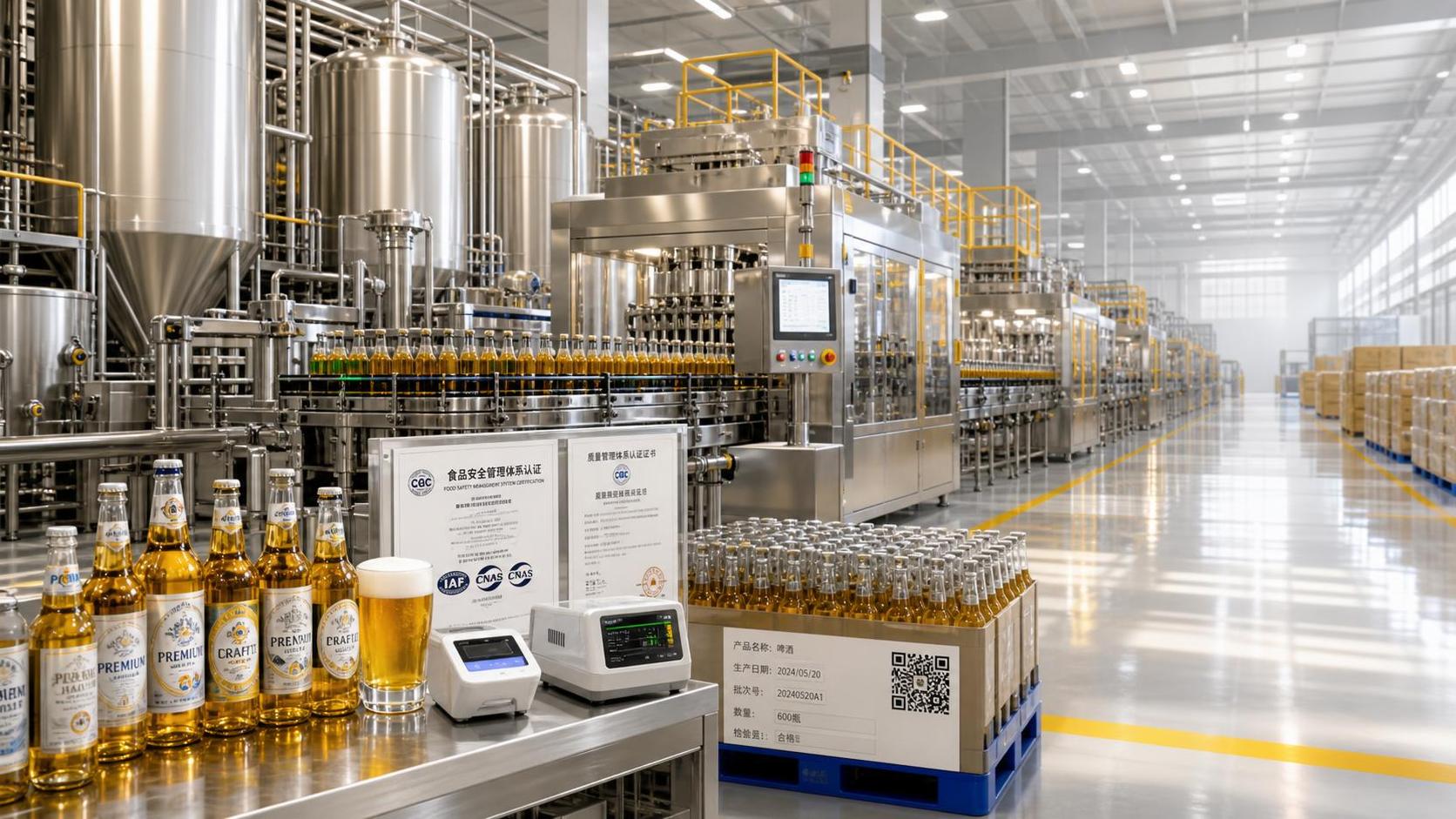
It is often late in the shift when the difficult question arrives: a distributor asks for proof that the brewery can meet its supplier requirements, an auditor requests a clearer record of a corrective action, or a production team finds that a batch released for packing does not match the documentation used for the previous shipment. The beer may taste right, the line may be running, and the warehouse may be full, yet the business still faces a practical problem: can it demonstrate consistent control?
For large scale beer production, certifications are not merely documents displayed in a reception area. They create a working framework for controlling ingredients, brewing, filtration, packaging, storage, traceability, sanitation, and release decisions. When production volume rises, a small gap in one area can spread quickly across multiple tanks, filling runs, pallet lots, or export orders. The useful question is therefore not “Which certificate looks best?” but “Which certification system addresses the risks in our actual operation?”
Start with the pressure point, not the certificate name
A brewery considering certification can easily receive conflicting advice. One buyer may mention HACCP. Another may request ISO 22000. A retailer may prefer FSSC 22000. Meanwhile, local authorities may focus on licensing, labeling, alcohol control, hygiene rules, wastewater requirements, or product registration. Treating these as interchangeable causes wasted effort and incomplete preparation.
The first task is to identify why certification is being considered. Common triggers include expanding from local distribution to wider retail channels, adding contract manufacturing, introducing fruit-based or functional products, operating a higher-speed packaging line, or supplying markets with formal supplier-approval procedures. Each trigger changes the risk profile.
For example, a traditional lager operation may already understand malt, hops, yeast, water, fermentation, and cold storage very well. But a new fruit-flavored beer can introduce additional concerns around ingredient specifications, allergen declarations, dosing control, microbial stability, supplier approval, and label verification. A sugar-free or low-calorie beer may require tighter alignment between formulation records, process controls, and label claims. The certification route should reflect those operational realities.
HACCP: the operating logic behind food-safety control
Hazard Analysis and Critical Control Points, usually called HACCP, is the foundation that many breweries use to organize food-safety decisions. It is a preventive system. Instead of waiting for a finished product problem, the brewery maps the process, identifies reasonably foreseeable hazards, decides where control is essential, sets limits or operating criteria, monitors those controls, and defines actions when something goes wrong.
In brewing, hazards do not all behave in the same way. A biological concern may be linked to contaminated ingredients, yeast handling, equipment hygiene, or post-process contamination at packaging. Chemical issues can involve cleaning chemicals, lubricants, pesticide residues in agricultural materials, allergen cross-contact, or incorrect additions. Physical hazards may arise from broken glass, metal wear, damaged packaging components, or maintenance work near open product.
A common mistake is to build a HACCP plan around a generic brewing flow chart and stop there. A useful plan must match the site. It should show where raw materials enter, where water is treated, how rework is handled, which tanks connect to which lines, where filtration occurs, how cans, bottles, kegs, or closures are stored, and how product is segregated during holds. If the actual flow differs from the approved flow, the plan is no longer a reliable control tool.
HACCP is sometimes requested as a standalone program, especially where a customer wants evidence of basic food-safety controls. It can be a sensible starting point for a facility developing its management system. However, on its own, it may not satisfy customers seeking a broader, independently certified food-safety management framework.
ISO 22000: connecting hazards to a managed system
ISO 22000 is an international food-safety management system standard. It includes HACCP principles, but it also requires the organization to manage the wider system around them. This includes communication, documented information, internal audits, management review, corrective action, competence, supplier control, emergency preparedness, and continual improvement.
The distinction matters in a brewery with multiple production teams and varied products. HACCP can identify that package integrity is important; ISO 22000 pushes the operation to show who owns the control, how monitoring records are reviewed, how recurring deviations are analyzed, whether staff are trained for the task, and how leadership evaluates system performance.
For large scale beer production, ISO 22000 can be particularly helpful when the brewery needs consistent practices across expanding shifts, sites, warehouses, or product categories. It creates a common language between brewing, packaging, maintenance, procurement, laboratory work, and distribution. It also makes it easier to explain the system to external stakeholders without relying on individual employees’ knowledge.
Still, ISO 22000 certification does not remove the need to comply with local law. Alcoholic beverage requirements are jurisdiction-specific. A brewery must separately identify applicable licensing, excise, food-contact packaging, labeling, product composition, deposit, recycling, occupational safety, environmental, and import-export rules. Certification supports disciplined control; it does not replace legal obligations.
When FSSC 22000 becomes the more practical route
FSSC 22000 is a food-safety certification scheme built around ISO 22000, sector-specific prerequisite program requirements, and additional scheme requirements. It is often considered when a brewery supplies organizations that expect certification recognized across complex food and beverage supply chains.
Its practical value is not simply a different certificate. The scheme gives greater structure to prerequisite programs: the day-to-day conditions that make HACCP workable. In a brewery, those conditions may cover cleaning and sanitation, pest management, water quality, maintenance, employee hygiene, foreign-material control, waste handling, warehouse conditions, glass and brittle-plastic management, and transport practices.
Consider a packaging hall where the product is protected by pasteurization, filtration, or another validated process step. The control can still be undermined by poor container handling, ineffective cleaning after maintenance, inadequate compressed-air controls, or confusion between released and held pallets. A robust prerequisite program makes such weaknesses visible before they become a finished-product issue.
FSSC 22000 may be suitable where supply-chain expectations are demanding, where export opportunities require a recognizable food-safety scheme, or where the operation needs a detailed framework for managing a broad range of supporting controls. It is not automatically necessary for every brewery. The deciding factor should be customer requirements, market plans, operational complexity, and the organization’s ability to maintain the system after certification.
Do not overlook ISO 9001 and ISO 14001
Food-safety certification answers only part of the control question. Beer production also depends on repeatable quality characteristics: alcohol content, bitterness, color, carbonation, sensory profile, package fill, dissolved oxygen targets where applicable, and shelf-life performance. ISO 9001, a quality management system standard, may be useful when the brewery needs stronger control of specifications, change management, complaint handling, supplier performance, calibration, and process improvement.
ISO 9001 does not replace HACCP, ISO 22000, or FSSC 22000 because it is not specifically a food-safety standard. Its value lies in disciplined quality management. For operations producing different beer styles, private-label products, or customized formulations, it can help formalize how product requirements are agreed, changed, verified, and released.
ISO 14001 may also be relevant where environmental management is a material business requirement. Brewing uses water, energy, chemicals, packaging materials, refrigeration, and wastewater systems. Environmental expectations can come from authorities, communities, customers, or internal sustainability goals. Again, it is not a substitute for food-safety certification, but it may support a wider management approach.
A decision path that avoids duplicate work
Before selecting a certification body or writing procedures, gather evidence from the operation. Review customer contracts and supplier questionnaires. List markets served and markets planned. Identify all product types, package formats, outsourced activities, warehouses, and transport arrangements. Then compare those facts with the standard being considered.
Use the following questions as a working review rather than a paperwork exercise:
- Is a documented HACCP-based system already in place, and does it reflect the real production flow?
- Which food-safety certification, if any, is explicitly required by current or prospective customers?
- Are prerequisite programs written, implemented, verified, and supported by records?
- Can every finished batch be linked to ingredients, processing records, packaging materials, and shipment information?
- Are product specifications and labels controlled when recipes, suppliers, or regulations change?
- Do outsourced laboratories, storage providers, pest-control contractors, and transport partners have defined responsibilities?
- Can the brewery demonstrate that deviations are investigated and that corrective actions are checked for effectiveness?
The answers usually reveal the best sequence. A site with limited formal controls may need to strengthen prerequisite programs and HACCP discipline first. A brewery with a mature HACCP system but growing customer requirements may be ready for ISO 22000 or FSSC 22000. An operation facing recurring specification inconsistency may need quality-system elements alongside food-safety certification.
Evidence auditors and buyers tend to examine closely
Certification assessments are rarely difficult because people do not understand brewing. They become difficult when practices are informal, records are incomplete, or different departments describe the process differently. A brewer may know exactly why a tank was held, but if the hold reason, evaluation, disposition, and release authorization are not traceable, the system cannot prove control.
Ingredient approval is a frequent focus. Malt, hops, yeast, adjuncts, flavorings, processing aids, cleaning chemicals, packaging materials, and gases should have clear specifications and approved sources. Where a product contains novel flavors, botanical extracts, fruit preparations, sweeteners, or functional ingredients, approval should include intended use, storage needs, allergen information where relevant, legal status in the destination market, and documentation for label review.
Traceability should also be tested, not assumed. A useful exercise starts with a finished can, bottle, keg, or pallet code and works backward to production records, raw materials, packaging lots, process conditions, and dispatch information. Then reverse the exercise: select an incoming ingredient lot and determine which finished batches received it. The point is not to produce an attractive traceability procedure; it is to confirm that records connect under normal working conditions.
Cleaning and sanitation records need the same practical attention. Procedures should define equipment, chemical concentration or use conditions, contact time where applicable, rinse requirements, verification method, and responsibility. When cleaning is changed because of a new beer style, maintenance activity, or production schedule, the impact should be reviewed rather than handled as an undocumented adjustment.
Certification should not become a once-a-year project
The most common failure pattern is a rapid documentation effort shortly before an audit, followed by a gradual return to informal habits. This is especially risky in large scale beer production because line changes, employee turnover, seasonal demand, and new product launches can quickly make old documents inaccurate.
Build a routine in which records are reviewed while they are still useful. Investigate recurring package defects, sanitation deviations, out-of-specification laboratory results, customer complaints, and supplier nonconformities for root causes rather than closing them with a temporary correction. Use internal audits to observe the work as performed, including night shifts, storage areas, rework handling, and changeovers. Management review should address unresolved risks and resource needs, not simply approve a completed meeting record.
Certification is most valuable when it helps people make better release, hold, escalation, and change-control decisions on ordinary production days. HACCP provides the preventive safety logic. ISO 22000 adds management-system discipline. FSSC 22000 can provide a more detailed and widely recognized food-safety scheme where supply-chain expectations call for it. ISO 9001 and ISO 14001 may support quality and environmental priorities, but neither replaces food-safety control.
The right choice is the one that matches the brewery’s markets, products, process risks, and ability to sustain documented practice. A certificate may open a conversation with a buyer, but reliable daily control is what keeps that conversation from becoming a product withdrawal, rejected delivery, or difficult audit finding.
Thank you very much for writing to us. Please leave your message and contact information, we will reply to you within 24 hours.