



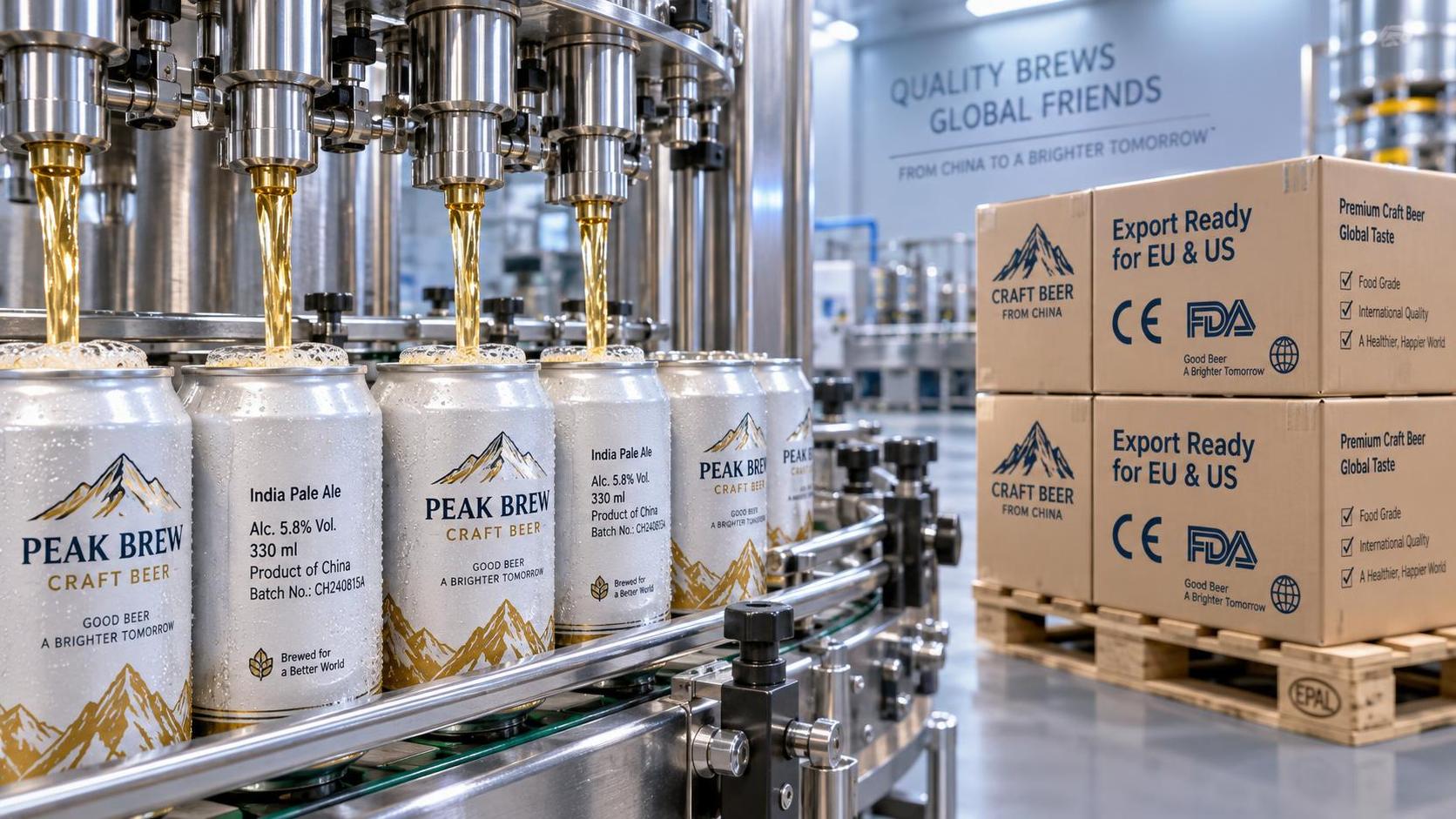
Sourcing beer wholesale from China is not just about finding the lowest price—it’s about identifying a supplier who aligns with your import standards, regulatory requirements, and brand integrity. For procurement professionals managing global beverage portfolios, a misstep in vetting can lead to delayed shipments, rejected customs entries, inconsistent quality across batches, or even reputational risk in premium retail or on-premise channels. You’re not evaluating a commodity; you’re selecting a long-term production partner whose processes directly affect shelf life, flavor stability, label compliance, and traceability—all under international food safety frameworks.
Start with this: if your current sourcing process relies solely on factory photos, MOQ quotes, or third-party inspection reports without verifying documentation ownership, process control depth, or post-shipment support responsiveness, you’re likely overlooking critical failure points before the first container clears port. This checklist focuses on what matters at the procurement stage—not marketing claims or facility aesthetics—but verifiable, actionable criteria that shape real-world outcomes for importers handling craft beer into regulated markets like the EU, US, Canada, Australia, or Japan.
Food Safety & Regulatory Documentation Must Be Owned, Not Borrowed
Many suppliers present ISO 22000 or HACCP certificates—but procurement teams often miss whether those certifications are issued to the actual brewing facility (not a trading company), cover the specific beer categories you’re importing (e.g., fruit-flavored or low-calorie variants), and include export-specific clauses like allergen control or ethanol labeling compliance. Request the original certificate number and verify it directly with the issuing body. Also confirm whether the facility holds a valid China Export Food Producer Registration Number (issued by CNCA), which is mandatory for all beer exports to the EU and increasingly required by US FDA prior notice submissions.
For US-bound shipments, ensure the brewery is listed in the FDA’s Foods Facility Registration database—and that the registration includes “alcoholic beverages” under product scope. A mismatch here triggers automatic hold at US ports. Similarly, for EU imports, check whether the facility appears on the EU Commission’s List of Approved Third-Country Establishments—a requirement since 2023 for all non-EU breweries exporting to member states.
Batch Traceability Isn’t Optional—It’s Your Recall Lifeline
Craft beer’s sensitivity to temperature, light, and oxygen means batch-level traceability isn’t theoretical—it’s operational. Ask for documented evidence of how the supplier tracks raw materials (malt origin, hop lot numbers, yeast strain IDs), fermentation parameters (temperature logs per tank, pH shifts), and packaging dates—including time stamps down to the hour. If they provide only generic “batch codes” without linking to internal production records, assume full recall coordination will be manual, slow, and error-prone.
Test their system: request the full trace record for one past export batch—covering malt receipt, wort cooling logs, fermentation start/end times, filtration pressure curves, and fill-line timestamps. If they can’t deliver this within 48 business hours—or if records lack version control or digital signatures—treat it as a red flag. Real-time traceability enables targeted recalls instead of broad market withdrawals, reducing cost and liability exposure.
Packaging Standards Must Match Your Market’s Physical & Regulatory Realities
A 330ml can may look identical across suppliers—but structural integrity, coating compatibility with acidic fruit beers, and seam integrity under tropical shipping conditions vary widely. Don’t rely on visual inspection alone. Require test reports for:
– Internal lacquer migration (especially for citrus or sour variants)
– Can seam integrity (double-seam thickness, wrinkle count, tightness)
– Glass bottle annealing consistency (measured via thermal stress testing)
– Label adhesion under humidity cycling (75% RH at 35°C for 72 hours)
Also verify whether packaging components—crown caps, can pull-tabs, labels—are sourced from suppliers approved under the brewery’s food-grade material management system. Unapproved inks or adhesives can leach into beer during storage, triggering non-compliance in markets with strict migration limits (e.g., EU Regulation (EC) No 1935/2004).
OEM/ODM Capability Requires Process-Level Validation—Not Just Design Flexibility
“We do OEM” is common. “We validate your recipe at scale without flavor drift” is rare. Ask how they handle recipe transfer: Do they conduct pilot brews with your exact yeast strain and hop schedule? Do they adjust mash pH and sparge temperature based on your water profile—not just replicate gravity and ABV? Are cold-side adjustments (dry-hopping timing, centrifuge settings, carbonation pressure) calibrated to your target mouthfeel—not just industry averages?
Request anonymized data from a recent OEM project: original spec sheet vs. final lab results across five key parameters (IBU, SRM, diacetyl, acetaldehyde, CO₂ volume). If variance exceeds ±5% on more than two metrics—or if no comparative data exists—assume formulation fidelity will degrade beyond pilot scale.
Logistics Support Is Measured in Response Time, Not Just Incoterms
FOB pricing looks clean until your container misses its vessel slot due to unfiled fumigation certificates or incorrect HS code classification. Confirm whether the supplier handles:
– Pre-shipment phytosanitary certification (for wooden pallets or crates)
– Correct HS code assignment (e.g., 2203.00.90 for flavored beer vs. 2203.00.10 for standard lager in US HTS)
– Real-time container tracking with gate-in/gate-out timestamps
– Emergency document reissuance within 4 business hours (not “next business day”)
Ask for a recent example where they resolved a customs delay—what caused it, how they intervened, and how long resolution took. If they cite “customs agent handled it,” probe further: did the supplier initiate corrective action, or simply forward emails?
Quality Consistency Depends on Raw Material Sourcing Control
Craft beer’s flavor hinges on ingredient provenance—and Chinese breweries source malt, hops, and fruit bases globally. Verify whether they own or contract-manage their malt supply chain. Some import European Pilsner malt but store it in non-climate-controlled warehouses, leading to Maillard-driven stale notes within weeks. Others use domestic wheat but don’t test for mycotoxin levels annually—exposing you to EU rejection risk.
Request their last three malt/hop certificates of analysis (CoA), focusing on moisture content, protein ratio, alpha acid stability, and pesticide residue screening. If CoAs show >12% moisture in malt or >30% alpha acid loss in stored pellet hops, expect accelerated oxidation in your finished beer—even before shipping.
Procurement isn’t about ticking boxes—it’s about mapping each verification point to a concrete operational risk. The suppliers who withstand scrutiny on traceability, documentation ownership, packaging validation, and raw material control are the ones who prevent costly delays, protect brand equity, and scale reliably across markets. When evaluating beer wholesale China options, treat every answer not as a yes/no, but as evidence of process discipline.
Thank you very much for writing to us. Please leave your message and contact information, we will reply to you within 24 hours.