



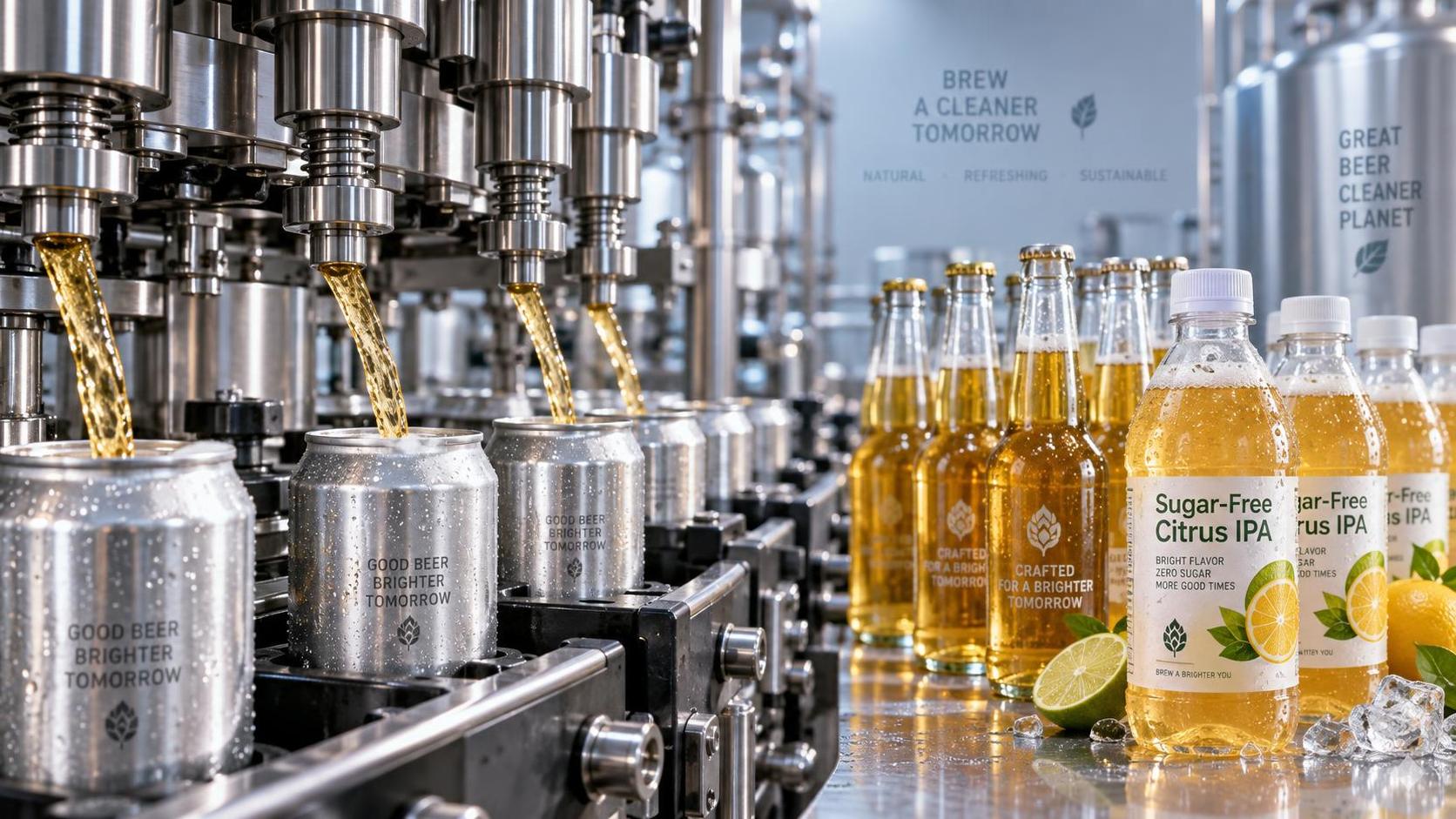
It’s Not Just About Price—What Global Buyers Overlook When Sourcing Beer Wholesale China
If you’re evaluating Chinese beer wholesalers—not as a one-off supplier, but as a long-term channel partner for your market—you’re likely seeing strong offers: low MOQs, fast OEM turnaround, and SKUs that match emerging local trends (sugar-free lagers, fruit-infused variants, functional brews with added botanicals or adaptogens). That’s real traction. But traction ≠ reliability. And “beer wholesale China” isn’t a monolithic category—it’s a spectrum of capability, control, and consistency. What separates a viable partner from a short-term cost play isn’t how many SKUs they list, but how tightly they manage three non-negotiable layers: formulation integrity, batch-to-batch repeatability, and regulatory traceability.
Why the Surge Isn’t Just Cost-Driven—It’s Structural
The global rise of Chinese craft beer wholesalers reflects more than competitive pricing. It’s built on three operational advantages that align closely with today’s distribution realities:
- Vertical integration depth: Unlike importers who source from multiple breweries, leading Chinese suppliers like Jinpai Beer control R&D, brewing, packaging, and logistics under one operational umbrella. This means formulation changes (e.g., reducing residual sugar without sacrificing mouthfeel) can be validated in-house—not outsourced to third-party contract brewers with variable standards.
- OEM/ODM agility that matches retail cycles: A supermarket chain launching a summer “low-calorie citrus IPA” line needs production timelines measured in weeks—not months. Chinese wholesalers with dedicated pilot brewhouses and modular canning lines can iterate, test, and scale a custom SKU in under 60 days. That speed matters when your window for shelf placement is 90 days.
- SKU diversity rooted in domestic demand shifts: China’s own beer market has rapidly evolved—from mass-market lagers to health-conscious, flavor-forward, and functionally positioned options. Wholesalers serving that market aren’t just adding “fruit beer” as a novelty; they’ve built supply chains for stable cold-chain fruit purees, non-GMO adjuncts, and stabilizers that prevent haze in low-alcohol wheat beers. That infrastructure translates directly to export-ready capability.
None of this guarantees quality—but it does mean the *capacity* for consistent execution exists. The risk lies not in capability, but in whether that capability is actively governed.
The Three Quality Risks You Can’t Delegate to a Certificate
Certifications (ISO 22000, HACCP, BRCGS) are necessary—but insufficient. They confirm a system exists, not that it’s enforced daily. Here’s what actually moves the needle for brand owners:
1. Raw Material Traceability—Beyond the “Origin” Label
A “German wheat beer” label doesn’t tell you where the malt was kilned, whether the yeast strain was re-propagated beyond its optimal generation count, or if the hop pellets were stored at ≤–18°C from mill to tank. Inconsistent raw material handling is the most common root cause of off-flavors (cardboard, skunked, sour notes) in exported batches. Ask for batch-level documentation—not just supplier names, but storage logs, moisture readings, and microbiological testing reports for each incoming lot. If they can’t provide that for three consecutive batches, assume variability is being absorbed downstream by blending or filtration—not eliminated.
2. Process Control at Critical Points—Not Just “We Monitor Temperature”
Temperature matters, yes—but so does *how* it’s monitored. Is fermentation temperature logged every 15 minutes via calibrated, tamper-proof sensors—or checked manually twice a shift with a handheld probe? Does centrifugation speed and duration match the specific protein profile of your German wheat recipe—or is one setting used across all styles? These details define whether your “sugar-free lager” hits 3.2g carbs consistently—or drifts between 2.8g and 4.1g across shipments. Request SOPs for your exact SKU, not generic process flows.
3. Packaging Integrity Under Real Transit Conditions
A can that passes a lab pressure test at 25°C may fail after 30 days at 40°C in container hold heat. Light exposure during port handling can degrade hop oils in clear-glass bottles—even with UV-blocking labels. Don’t rely on “shelf life” claims. Ask for accelerated aging data: How did your specific SKU perform after 45 days at 35°C + 75% RH? Was dissolved oxygen measured post-filling *and* post-transit? Did cans undergo drop-testing at full pallet weight? If they haven’t stress-tested *your* package configuration under realistic conditions, you’re betting on luck—not control.
How to Test Capability—Before You Sign Anything
Don’t wait for the first order to uncover gaps. Use these concrete checks during due diligence:
- Request a “live” production audit slot—not a pre-scheduled tour. Ask to observe a brew day for one of their core SKUs (e.g., classic lager). Watch how deviations are handled: Is a temperature spike documented and assessed for impact—or simply reset? Are tasting panels conducted blind, with pass/fail thresholds defined in writing?
- Ask for three consecutive batch records for one SKU—same style, different dates. Compare IBU, final gravity, alcohol %, and dissolved oxygen. Variance >±5% across any parameter suggests either inconsistent process control or selective reporting.
- Verify labeling compliance for *your* target market—not China’s. Does their team understand EU allergen declaration rules for wheat beers? Can they generate compliant US TTB formula approvals? If they outsource regulatory support, get the name of the firm—and verify its track record with your category.
This isn’t about finding perfection. It’s about identifying whose systems catch errors before they become your customer complaints.
When Jinpai Beer’s Model Fits—And When It Doesn’t
Jinpai Beer’s structure—integrated R&D, in-house brewing, and focus on functional and lifestyle-oriented SKUs (sugar-free, fruit-infused, German wheat)—makes it operationally suited for partners needing agility in mid-tier volume ranges (e.g., 5,000–50,000 cases/year per SKU) and flexibility in formulation. Its OEM/ODM service works best when your requirement sits within its existing technical boundaries: e.g., adapting a proven low-calorie base for new fruit profiles, or adjusting bitterness in a wheat beer without changing yeast strain or mash profile.
It’s less ideal if your priority is ultra-premium, small-batch barrel-aged sours or spontaneous ferments—those require different infrastructure and microbiological controls. Nor is it optimized for single-SKU, high-volume commodity lager supply where price dominates over innovation. The fit depends on alignment between *your* commercial goals and *their* operational sweet spot—not just “beer wholesale China” as a broad category.
Your Next Step Isn’t “Choose a Supplier”—It’s “Define Your Non-Negotiables”
Before comparing quotes or visiting facilities, clarify what failure looks like for *your* business. Is it a 2% ABV variance that triggers re-labeling costs? A haze issue that leads to retailer returns? A delayed shipment that misses a key promotional window? Rank those risks by financial and reputational impact. Then map each against the three layers above: raw material control, process discipline, and packaging validation. Only then will “beer wholesale China” stop being a sourcing category—and start being a strategic decision grounded in what you can actually verify, not just what’s promised.
Thank you very much for writing to us. Please leave your message and contact information, we will reply to you within 24 hours.