



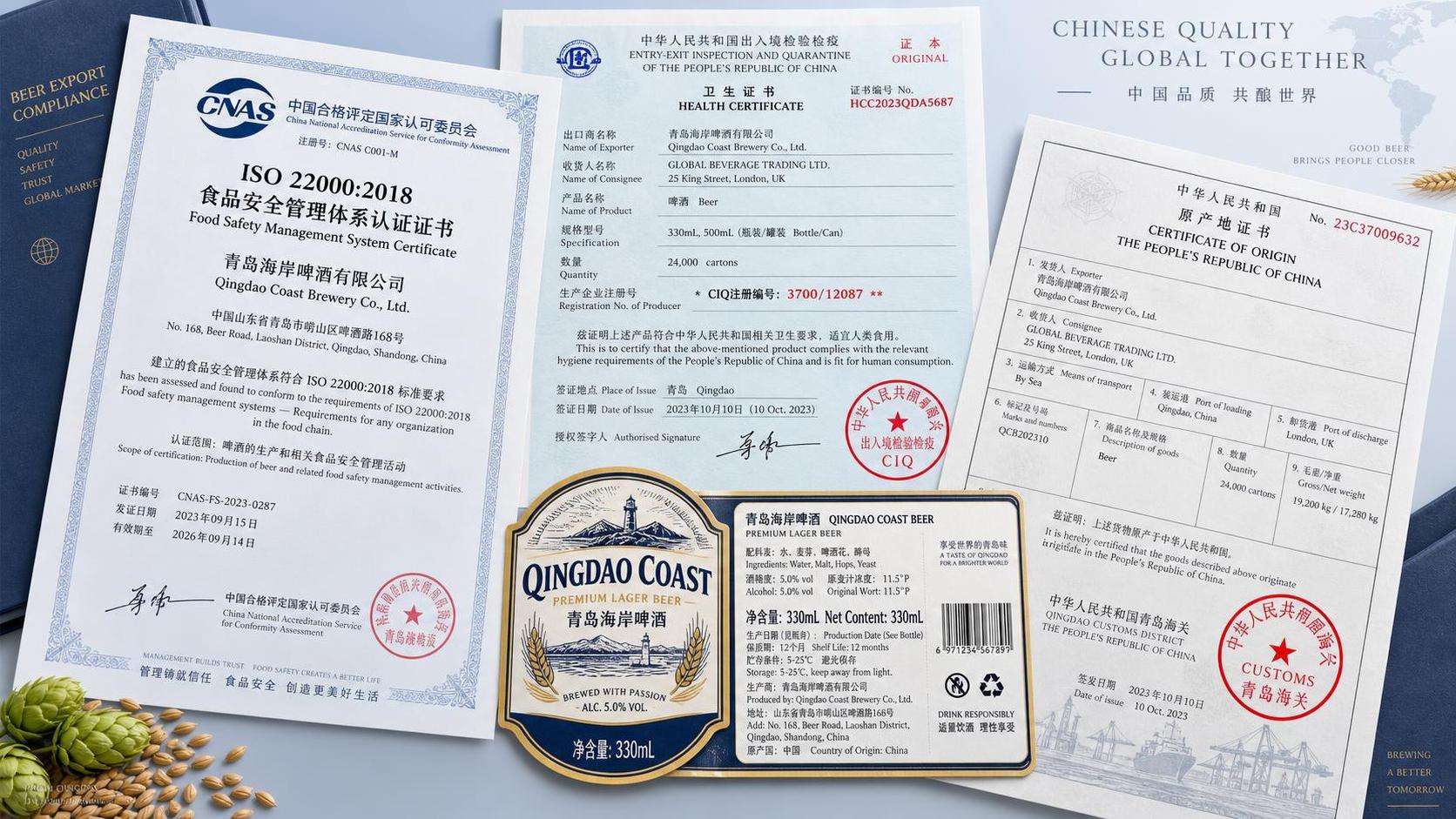
Verifying food safety compliance and export documentation for beer wholesale China suppliers isn’t a one-time box-checking exercise—it’s an ongoing due diligence process that directly impacts customs clearance, shelf-life integrity, and brand reputation in your home market. For quality assurance managers, food safety officers, and procurement specialists vetting Chinese craft beer suppliers, gaps in documentation or inconsistent implementation of standards often surface only after shipment—leading to detention at port, costly rework, or rejected consignments. At Jinpai Beer, we produce lagers, wheat beers, low-calorie, fruit-infused, and functional specialty brews under auditable HACCP, ISO 22000, and CIQ-recognized protocols—but verification rests with the buyer. This guide outlines what to request, how to validate it, and where inconsistencies most commonly appear—not as theoretical requirements, but as actionable checkpoints tied to real regulatory touchpoints.
Start with the Core Certifications—and Verify Their Scope
Don’t assume “ISO 22000 certified” covers your product. Certification scope matters: the certificate must explicitly list beer (or “alcoholic beverages”), include bottling/canning operations if applicable, and name the exact facility producing your order. Request the full certificate—not just a logo—and cross-check its validity via the issuing body’s public database (e.g., CNAS for Chinese-accredited bodies). Similarly, CIQ (China Inspection and Quarantine) registration is mandatory for export, but registration alone doesn’t guarantee batch-level traceability. Confirm the supplier’s CIQ registration number appears on their official export declaration forms—not just marketing materials—and that it’s active in the General Administration of Customs of the PRC’s public registry.
Export Documentation: What Must Be Present—and Why Each Element Is Non-Negotiable
The commercial invoice, packing list, and Certificate of Origin are foundational—but insufficient without alignment. Discrepancies between them trigger automatic scrutiny. For example, if the invoice lists “craft lager” but the Certificate of Origin states “malt beverage,” customs may classify it differently, affecting duty rates and import eligibility. The health certificate—issued by CIQ or an authorized third party—is where food safety compliance becomes operational. It must specify: (1) alcohol content (vol%), (2) absence of prohibited additives (e.g., unauthorized colorants or preservatives), (3) microbiological limits aligned with your destination’s standards (e.g., EU Regulation (EC) No 1829/2003 for GMOs, or FDA 21 CFR Part 101 for labeling), and (4) batch numbers traceable to production records. Jinpai Beer issues health certificates with batch-specific test reports attached—including yeast viability, residual chlorine, and heavy metal screening—because generic certificates rarely satisfy high-risk markets like the EU or Canada.
Traceability Isn’t Just a Label Claim—It’s a System You Can Test
A supplier claiming “full batch traceability” should provide immediate access to production logs for any given batch number—not just a statement. Ask for the raw material receipt date for malt, hops, and water treatment records; fermentation temperature logs; filtration and pasteurization parameters; and final QC release data. These documents must be time-stamped, signed by responsible personnel, and retained for at least two years post-expiry. If your supplier shares a digital traceability portal, verify it allows you to input a batch code and retrieve all linked records—not just packaging dates. In practice, delays in document retrieval or inability to match a label batch code to internal production logs indicate fragmented systems, not just poor communication.
Label Compliance: Where Language, Format, and Substance Intersect
Export labels for beer must meet dual requirements: Chinese domestic labeling law (GB 7718-2011) *and* destination-market rules. GB 7718 mandates Chinese-language allergen declarations, alcohol content, and net volume—but many exporters omit English translations required abroad. More critically, ingredient listings must reflect actual formulation, not generic terms. “Natural flavors” won’t pass EU scrutiny; “raspberry puree (2.1%)” will. Nutritional information panels must be calculated—not estimated—and validated against lab analysis of the specific batch. Jinpai Beer prints bilingual labels with verified nutritional data per batch, because discrepancies here cause re-labeling delays at EU ports, where non-compliant labels are treated as adulteration.
Third-Party Audit Readiness: Beyond the Report Date
An audit report dated six months ago tells you little about current practice. Instead, ask for evidence of corrective actions taken since the last audit—especially for non-conformities related to sanitation, pest control, or supplier approval. Request recent internal audit schedules and minutes covering critical control points: raw material receiving, cleaning-in-place (CIP) validation, and finished product storage conditions. If the supplier uses external labs, confirm they’re accredited to ISO/IEC 17025—and that test reports include method references (e.g., AOAC 992.15 for alcohol content). Unaccredited labs may generate technically sound results, but regulators often reject them outright.
What to Do When Documents Don’t Align
If the health certificate lists a different production date than the batch code on the carton, don’t accept an email explanation. Require a revised certificate issued by CIQ—or, if time permits, request a physical inspection of the warehouse to verify stock rotation and labeling consistency. If allergen statements differ between the technical dossier and the label, pause shipment until the discrepancy is resolved in writing, with supporting lab data. These aren’t bureaucratic hurdles—they’re early warnings of systemic gaps in documentation control, which correlate strongly with deviations in process control during actual production.
Final Verification Step: Match Paper to Physical
Before signing off on a shipment, compare the export documents against a physical sample: check that the batch code on the bottle matches the one on the health certificate and packing list; verify the alcohol percentage on the label aligns with the test report; confirm the net volume stated matches the fill level observed. This step catches mislabeling, transcription errors, and version mismatches—issues that account for over 60% of beer-related customs holds in major Asian and North American ports. Jinpai Beer conducts this match-check internally before release, but independent verification remains your responsibility as the importer of record.
Thank you very much for writing to us. Please leave your message and contact information, we will reply to you within 24 hours.