



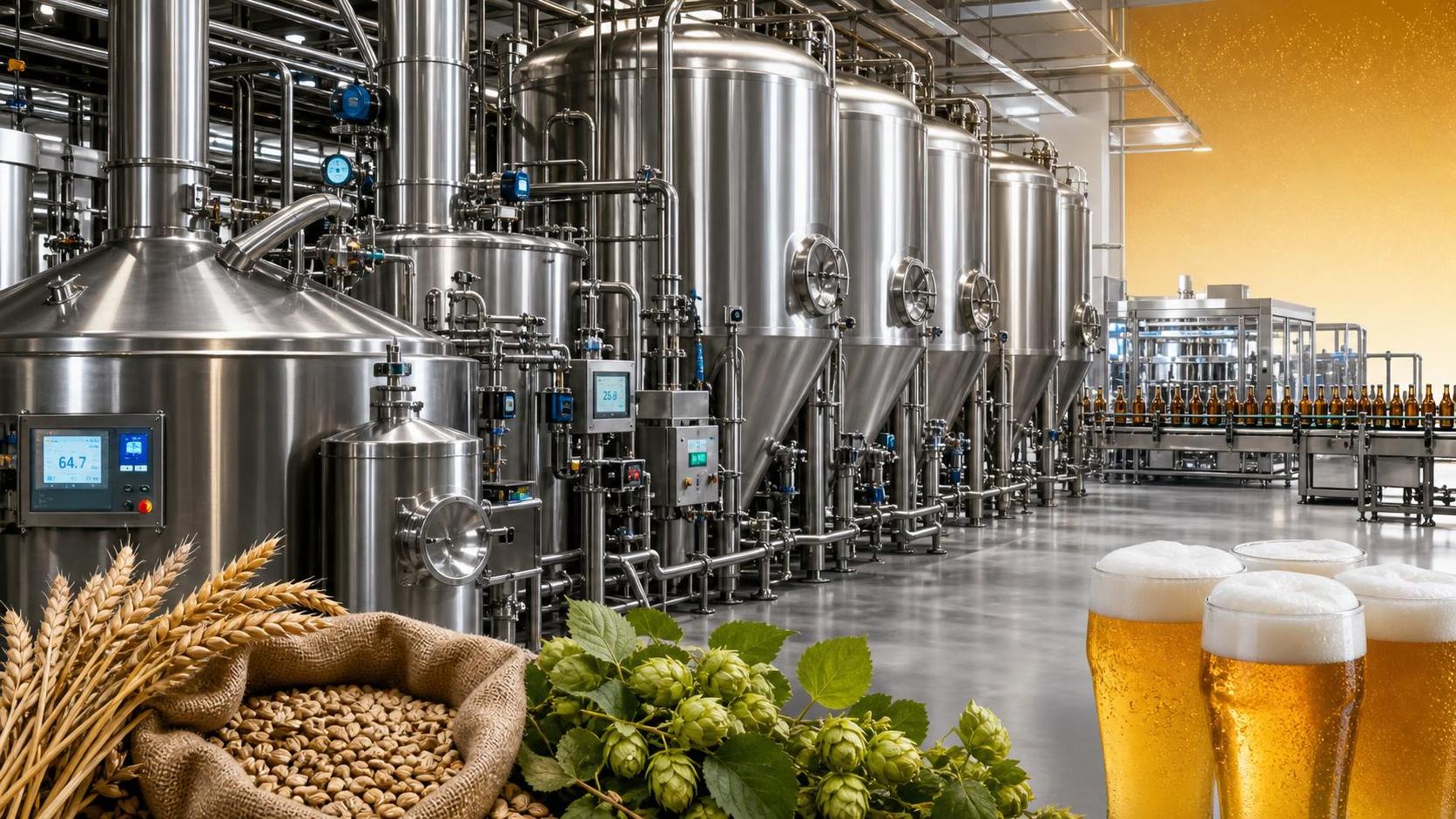
Quality variation in large scale beer production is rarely caused by one obvious failure. More often, it develops through a series of small shifts: a malt delivery with different modification, a yeast crop that has lost vitality, a cleaning cycle that leaves a trace of residue, a filling line operating outside its normal pressure window, or pallets held too long in a warm distribution center.
At small volumes, experienced brewers may identify and correct variation through direct observation. In high-output operations, however, production is distributed across many tanks, shifts, suppliers, utilities, packaging formats and logistics partners. The central challenge is not simply producing beer that meets specification at release. It is maintaining the intended sensory profile, microbiological stability and package performance from brewhouse to the point of consumption.
For breweries supplying multiple markets, this becomes even more demanding. Product may travel through different climates, retailer storage practices and regulatory environments. A beer that is stable in a domestic cold chain may show different flavor development after extended export transit. Managing variation therefore requires a system that links raw materials, process capability, sanitation, packaging integrity and market feedback rather than treating them as separate departments or isolated test results.
Raw material variation begins before the brew day
Beer recipes may look fixed on paper, but agricultural raw materials are inherently variable. Malt can differ by crop year, growing region, protein content, moisture, extract yield, color, enzyme activity and degree of modification. These differences affect milling behavior, mash conversion, wort viscosity, filtration performance, fermentability and final body. A change that appears minor in a supplier certificate can become significant when the beer is produced at a scale where every deviation is multiplied across thousands of hectoliters.
Hops introduce a similar issue. Alpha-acid levels, oil composition, storage conditions and crop age influence bitterness, aroma and hop flavor stability. Even when purchasing is based on alpha-acid adjustment, the sensory result may not be identical. A bittering addition can be corrected mathematically; the full aroma expression of late hopping or dry hopping cannot always be standardized so easily.
Water is often assumed to be stable because it comes from a controlled municipal or treated supply. Yet changes in alkalinity, hardness, chloride, sulfate, residual disinfectant or seasonal source blending can alter mash pH and flavor balance. Water treatment equipment can also create inconsistency when regeneration schedules, membrane performance, carbon filtration or chemical dosing are not verified against actual brewing requirements.
The practical control point is not merely approving suppliers. Breweries need incoming-material specifications that connect directly to process and sensory risk. Malt acceptance should consider parameters relevant to the beer style and production process, not just general trading grades. Hop contracts should define storage, lot traceability and substitution rules. Water should be monitored at a frequency that reflects local supply volatility. When an alternative raw material is approved, trial results should include fermentation, filtration, sensory and shelf-life effects rather than only brewhouse yield.
Wort production can amplify small process deviations
Milling, mashing, lautering, boiling and whirlpool separation each influence consistency. At industrial scale, automated controls can give a false sense of security. A stable screen display does not guarantee that the process is stable if sensors are drifting, flow meters are poorly maintained, temperature probes are positioned incorrectly, or recipes are being adjusted manually without a clear record.
Mash temperature and time affect enzyme activity and fermentable sugar composition. A small departure can alter attenuation, alcohol level, sweetness and body. Mash pH is equally important because it influences enzyme performance, extraction, wort runoff and later flavor development. If pH correction relies on inconsistent acid dosing or variable water chemistry, the result may be a beer that technically meets alcohol specification but tastes thinner, harsher or less balanced than the reference batch.
Lauter and filtration performance deserve particular attention in high-volume production. Compacted grain beds, poor runoff control or variable grist composition can increase turbidity and carry unwanted compounds forward. Excessive shear, prolonged hot-side exposure and inappropriate sparging can contribute to tannin extraction and astringency. These issues may not always be visible in immediate release samples, especially if carbonation and fresh hop aroma temporarily mask them.
Boil control is another source of cumulative variation. Evaporation rate, steam pressure, kettle fill level and boil intensity affect wort concentration, color formation, volatile removal and bitterness utilization. Where production planning requires frequent volume changes, a recipe designed for one kettle loading may not perform identically at another. The response should be defined process windows, not informal operator correction. Key parameters such as pre-boil gravity, post-boil gravity, pH, evaporation rate, wort color and bitterness should be trended by brand, line and season.
Yeast management is a major determinant of batch-to-batch consistency
Many flavor differences attributed to “fermentation conditions” are actually yeast-management issues. Yeast is a living production input whose behavior changes with generation number, storage time, cropping method, oxygen exposure, contamination history and nutrient availability. Two crops with similar cell counts may ferment very differently if viability, vitality or physiological condition is not comparable.
Underpitching can extend fermentation, increase ester formation and raise the risk of incomplete attenuation. Overpitching may reduce desired flavor expression in some styles and can affect yeast health over repeated generations. Inadequate oxygenation of wort can limit yeast growth and lead to sluggish fermentation, while excessive oxygen introduces separate oxidation risks. The correct target depends on strain, original gravity, wort composition and fermentation regime; a universal oxygen or pitch-rate target is not a substitute for validated brand-specific conditions.
Temperature control is equally important, but the critical issue is often thermal uniformity rather than nominal setpoint. Large cylindroconical tanks can develop gradients, particularly during active fermentation or cooling. Inconsistent cooling-jacket performance, delayed response from control valves, or different fill volumes between tanks can change ester production, diacetyl reduction and maturation time.
A robust yeast program normally includes traceable generation control, routine microbiological examination, viability and vitality assessment, standardized cropping conditions and a defined response when fermentation kinetics fall outside expected limits. Fermentation curves should be treated as predictive quality data, not simply as production records. A deviation in gravity drop, pH profile, temperature response or diacetyl reduction can provide an early warning before sensory defects become obvious.
Microbiological risk is not limited to visibly spoiled beer
Microbial contamination in beer can produce haze, acidity, phenolic notes, sulfur-like aromas, ropey texture, overcarbonation or package gushing. But not every contamination event creates an immediate and dramatic defect. Some organisms grow slowly, remain below detection at release, or become more apparent only after warm storage. This is particularly relevant for low-alcohol beers, fruit-flavored products, sweetened beverages and specialty beers, where reduced alcohol, higher nutrients or post-fermentation additions can create a more favorable environment for spoilage organisms.
The most vulnerable areas are often downstream of pasteurization or final stabilization: bright beer tanks, transfer hoses, valves, fillers, crowning equipment, dry-hop systems, flavor dosing units and sampling points. A brewery may maintain a clean brewhouse while repeatedly seeing isolated contamination because a small dead leg, worn gasket, improperly cleaned valve seat or difficult-to-sanitize connection remains outside the effective cleaning circuit.
Cleaning-in-place programs should be validated for each equipment configuration, not assumed to work because chemical concentration and return conductivity appear normal. Flow velocity, temperature, contact time, mechanical action and soil type all matter. Verification should combine operational data with targeted inspection, ATP or protein checks where appropriate, microbiological swabbing and finished-product testing. Environmental monitoring is most useful when it is risk-based: focusing on filling halls, wet zones, high-touch interfaces and areas where product-contact contamination could occur.
When a contamination trend is found, repeated retesting of finished beer is rarely enough. The investigation should map the process route backward from the affected package or tank, compare unaffected batches, review sanitation records, inspect recent maintenance work and identify whether the pattern follows a specific line, shift, package type, ingredient or transfer path.
Packaging is where quality losses become commercial losses
Beer can leave the bright beer tank in excellent condition and still reach the market with poor flavor or unstable appearance. Packaging introduces oxygen pickup, carbon dioxide loss, microbial exposure, light damage, seam or closure defects and mechanical stress. At large scale, these risks may be intermittent, which makes them difficult to identify through occasional checks.
Dissolved oxygen and total package oxygen are among the most important indicators for flavor stability. Oxygen accelerates staling reactions that can produce cardboard-like, honey-like or dull flavors, reduce hop freshness and change color. The acceptable control limit depends on beer style, package format and intended shelf life, but the principle is constant: measurements must be representative of actual filling conditions. Testing only the first bottles after a line adjustment may miss the oxygen increase that occurs later during extended operation, foam instability or filler bowl fluctuations.
Package integrity is equally important. Crown application, can seam quality, closure torque, container damage and liner compatibility directly affect carbonation retention and oxygen ingress. Can seam evaluation requires trained inspection and calibrated measurement rather than visual judgment alone. For glass bottles, handling damage and micro-cracks can create failures that appear later in distribution. For kegs, valve condition, cleaning validation and returned-container segregation are essential because the container itself is repeatedly reused in a high-risk cycle.
Light exposure should not be overlooked. Clear and green glass provide less protection than brown glass, and hop-derived lightstruck character can develop rapidly under unsuitable retail lighting. If a brand uses light-sensitive packaging, the risk assessment must extend beyond the brewery to display conditions in supermarkets, bars and warehouses.
Distribution conditions can change the product after release
Finished-product release is a checkpoint, not the end of quality management. Temperature abuse during warehousing or transport accelerates flavor aging and can reveal instability that was not evident in fresh samples. Export routes are especially variable: containers may be exposed to high ambient temperatures, port delays, customs holds or long periods in non-refrigerated storage.
Cold-chain management should be based on the actual product and route, not on a generic promise of “cool storage.” Lager, wheat beer, heavily hopped products, low-calorie beers and fruit-flavored beers may have different sensitivity to oxidation, haze formation, flavor fade or refermentation. Route qualification can include temperature data logging, retained samples stored under realistic abuse conditions and comparison of sensory results at defined intervals.
Stock rotation also matters. A brewery can produce fresh beer consistently while distributors unintentionally create variation by mixing production dates, holding slow-moving stock or exposing pallets to direct sunlight. Clear date coding, first-expired-first-out practices, shelf-life communication and market returns analysis are necessary parts of the control system.
Why specification compliance does not always mean flavor consistency
A common operational mistake is to treat a product as consistent because alcohol, bitterness, color, pH, dissolved oxygen and microbiological results fall within limits. These measurements are indispensable, but they do not capture every sensory shift. A beer can remain within analytical specification while developing weaker hop aroma, altered mouthfeel, a slightly rough bitterness or reduced freshness that regular drinkers notice immediately.
The strongest programs connect analytical data with a disciplined sensory process. A trained panel should evaluate reference batches and production samples using a shared vocabulary, controlled sample handling and blind comparisons where possible. Sensory results need to be recorded in a format that can be compared with process, ingredient and packaging data. Over time, this makes it possible to identify relationships that individual tests cannot reveal—for example, a particular hop lot combined with a longer whirlpool residence time, or a slight oxygen increase only on one filler line.
Reference standards are important. Without a clear sensory reference, “acceptable” can gradually drift away from the original brand profile. This is especially risky after recipe reformulation, supplier changes, equipment upgrades or expansion into new production sites.
Building a practical variation-control system
Effective control in large scale beer production is built around critical variation points rather than an endless list of tests. The starting point is to identify which characteristics most affect consumer experience and product safety for each beer type: microbiological stability, bitterness, aroma retention, turbidity, sweetness, carbonation, color, gluten-related claims, alcohol accuracy or shelf-life performance.
Each characteristic should be linked to its likely sources of variation, the process step where intervention is possible, the method of measurement and the escalation action. This is consistent with the preventive logic behind HACCP-based food safety systems, but it should also include quality attributes that may not be formal safety hazards. A line may be hygienically compliant while still producing an inconsistent consumer experience.
Useful controls are those that lead to decisions. Trend charts should distinguish normal process movement from meaningful drift. Change management should cover raw-material substitutions, new flavor additions, modified cleaning chemicals, software updates, packaging changes and maintenance work on product-contact equipment. Complaints should be coded in sufficient detail to identify patterns by market, date code, package format and defect type.
The objective is not to eliminate every natural variation in brewing. Beer remains an agricultural and biological product. The objective is to understand which variation is harmless, which variation signals process drift, and which variation can become a safety, shelf-life or brand-risk event. Breweries that make that distinction early are better positioned to prevent expensive rework, withdrawals, rejected export shipments and loss of consumer confidence.
Thank you very much for writing to us. Please leave your message and contact information, we will reply to you within 24 hours.