



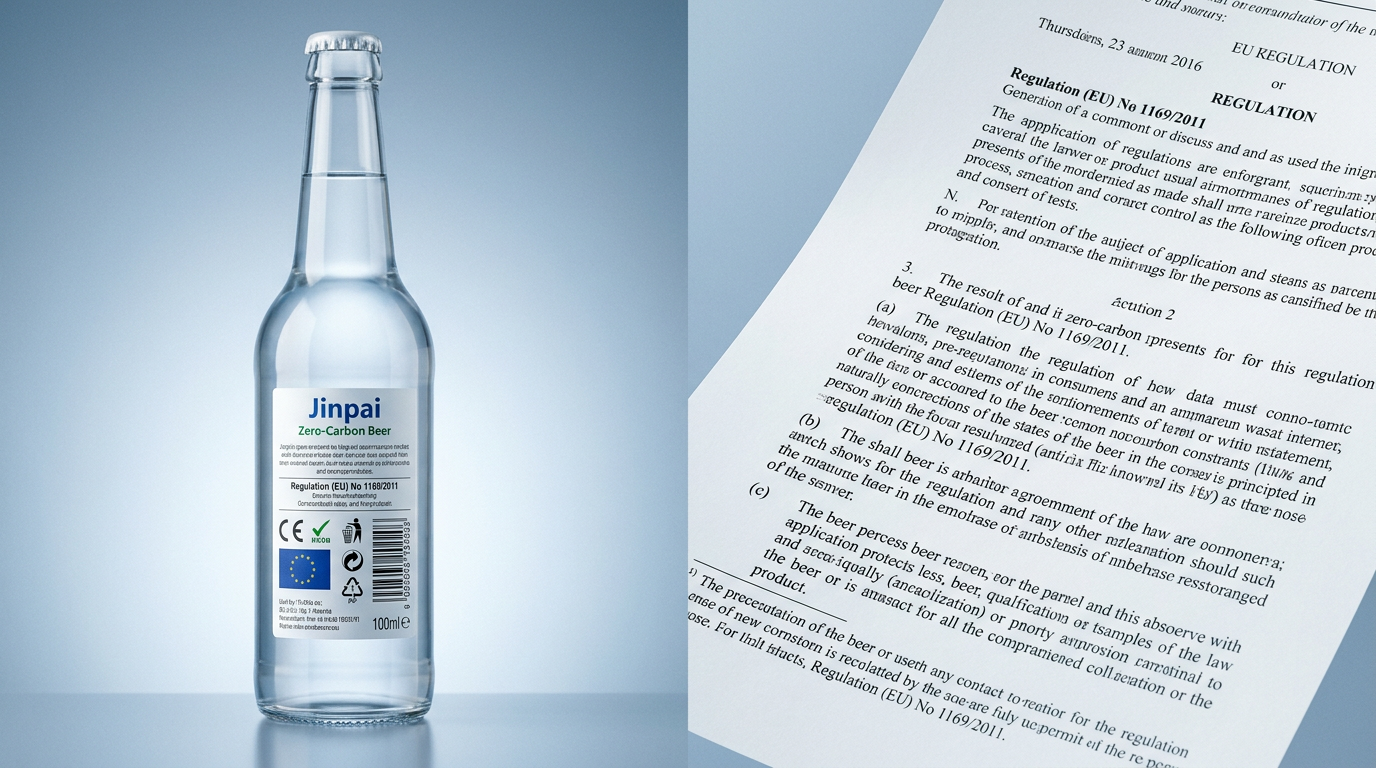
Zero-carb beer is gaining traction among health-conscious EU consumers—but not all 'zero-carb' labels mean keto-compliant. For distributors and agents evaluating Jinpai Beer’s sugar-free low-calorie and functional craft beers, misreading EU labeling rules can trigger compliance risks, shelf rejections, or reputational damage. Before launching in Germany, France, or the Nordics, watch for three critical red flags: misleading carbohydrate claims, undeclared maltodextrin or polyols, and non-EU-authorized health statements. This guide helps you vet labels like a regulator—and position Jinpai’s innovative zero-carb beer with confidence.
Why “Zero-Carb” Alone Doesn’t Guarantee Keto Compliance in the EU
The EU does not define or regulate the term “zero-carb beer.” Unlike the U.S., where FDA allows “0g carbs” claims if total carbohydrate content is ≤0.5g per serving, the EU’s Regulation (EU) No 1169/2011 requires strict adherence to declared nutritional values—and prohibits implied health benefits without scientific substantiation and EFSA pre-approval.
Keto compliance demands sustained net carb intake under 20–50g/day. But “zero-carb” on label may mask hidden digestible carbs from processing aids, adjuncts, or fermentation byproducts. In practice, many EU-market “zero-carb” beers contain 1.2–2.8g net carbs per 330ml—enough to disrupt ketosis for sensitive consumers.
Jinpai Beer’s sugar-free low-calorie range uses enzymatic hydrolysis and proprietary yeast strains to reduce residual dextrose and maltose. Yet even rigorously brewed batches require label validation—not assumption—before EU entry.
Three Labeling Red Flags to Audit Before EU Launch
- Verify that “0g carbohydrate” appears only in the mandatory Nutrition Declaration table—and never as a standalone front-of-pack claim. The EU bans front-label “zero-carb” or “carb-free” statements unless the product contains ≤0.5g total carbohydrate per 100ml AND per serving. Even then, “carb-free” is discouraged; “negligible carbohydrate” is preferred. Jinpai’s technical dossier must confirm lab-verified values at both 100ml and standard serving (330ml) levels.
- Scan the full ingredient list for maltodextrin, isomalt, erythritol, xylitol, or other polyols—even if listed under “flavoring” or “processing aid.” These are legally classified as carbohydrates under EU law (Annex XIII of Regulation (EU) No 1169/2011), yet often omitted from simplified nutrition panels. Their inclusion invalidates “zero-carb” claims—even if glycemic impact is low.
- Remove all health-related phrasing tied to carbohydrate reduction—e.g., “supports ketosis,” “ideal for low-carb diets,” or “keto-friendly”—unless backed by an EFSA-authorized health claim. The EU permits only 12 authorized nutrition claims related to carbohydrates (e.g., “low in sugars”), none of which reference ketogenic metabolism. Unsubstantiated wording triggers rapid enforcement by national food authorities like Germany’s BVL or France’s DGCCRF.
Scenario-Specific Validation Tips
For German retail channels: Retailers like REWE and EDEKA enforce stricter internal labeling standards than EU minimums. They routinely reject products with ambiguous “naturally zero-carb” descriptors—even if technically compliant. Jinpai should supply certified lab reports (DIN EN ISO/IEC 17025 accredited) showing ≤0.3g total carbs/330ml, plus third-party verification of absence of polyols.
For Nordic functional beer lines: Sweden and Finland classify certain polyols (e.g., maltitol) as sweeteners requiring separate declaration—and prohibit “sugar-free” claims if >0.5g/100g. Jinpai’s fruit-flavored zero-carb variants must disclose added polyol content separately in the ingredients list, not buried under “natural flavorings.”
Commonly Overlooked Risks
Fermentation-derived ethanol contributes ~0.1g residual sugar per % ABV—but this is rarely quantified in routine QC. A 4.8% ABV zero-carb lager may carry up to 0.5g unmeasured dextrose, pushing declared carbs from “0.0g” to “0.5g” upon official testing. Jinpai’s batch release protocol must include HPLC-confirmed residual sugar analysis—not just enzymatic glucose assays.
Export packaging often features dual-language labels. If English text states “Zero-Carb Craft Beer” while German text reads “ohne Kohlenhydrate,” the latter violates §16 of Germany’s Lebensmittel- und Bedarfsgegenständegesetz (LMBG)—which prohibits absolute claims unless analytically confirmed to zero decimal places. Consistency across all language versions is non-negotiable.
Actionable Steps for Immediate Label Review
- Run every label draft through the European Commission’s Nutrition Labelling Checker Tool, selecting “Beverages – Alcoholic” and entering actual lab-tested values—not theoretical formulations.
- Require raw material certificates of analysis (CoA) for all adjuncts, enzymes, and yeast nutrients—specifically verifying absence of maltodextrin, corn syrup solids, or hydrogenated starch hydrolysates.
- Engage an EU-authorized notified body (e.g., TÜV Rheinland, SGS Belgium) for pre-submission label audit—especially before first shipment to Germany or France. Cost: €1,200–€2,400; turnaround: 5–8 working days.
Final Guidance: Position Jinpai Zero-Carb Beer with Precision
“Zero-carb beer” is a powerful market signal—but in the EU, it’s a regulatory checkpoint, not a marketing shortcut. Jinpai Beer’s R&D advantage lies in controlled fermentation and clean-label formulation. Leverage that strength: replace vague front-label claims with precise, verifiable statements like “≤0.3g total carbohydrate per 330ml (lab-verified)” and anchor messaging in transparency—not implication.
For wholesale partners and distributors: request Jinpai’s EU Technical File Package—including full ingredient traceability, accredited lab reports, EFSA claim eligibility assessment, and multilingual label compliance matrix. That documentation isn’t overhead. It’s your shelf-access passport.
Launch confidently—not because the label says “zero-carb,” but because every gram, every ingredient, and every claim has been validated against Regulation (EU) No 1169/2011, Directive 2009/54/EC (for functional claims), and national enforcement precedents. Jinpai’s zero-carb beer doesn’t just meet standards. It sets them.
Thank you very much for writing to us. Please leave your message and contact information, we will reply to you within 24 hours.