



Struggling with hazy, unstable, or collapsed sugar-free craft beer batches after cold storage? You're not alone—many brewers face unexpected crashes due to incomplete yeast flocculation and residual fermentables. At Jinpai Beer, our R&D team identified a dual-solution fix: using the highly flocculent, low-attenuation Saccharomyces pastorianus strain WLP830, combined with a controlled 72-hour diacetyl rest at 14°C before rapid cooling. This preserves crispness, prevents chill haze, and ensures shelf-stable clarity—no additives, no compromise on flavor. Here’s exactly how we do it.
Why Sugar-Free Craft Beer Crashes During Cold Storage
Sugar-free craft beer lacks fermentable carbohydrates, which alters yeast metabolism and stress response. Without sufficient dextrins or adjuncts to buffer osmotic pressure, yeast cells remain metabolically active longer—and often fail to flocculate fully before chilling. The result? Suspended proteins, polyphenols, and under-flocculated yeast re-aggregate during cold storage, causing visible haze, sediment instability, or even full batch collapse.
Unlike traditional lagers, sugar-free variants cannot rely on residual maltose or dextrin for yeast health during conditioning. That’s why standard lager yeast strains (e.g., WLP800, WY2112) often underperform—exhibiting poor flocculation, inconsistent attenuation, and elevated diacetyl carryover when pushed below 8°C prematurely.
The Proven Yeast + Conditioning Protocol
Step-by-step Implementation for Stable Clarity
- Fermentation: Pitch WLP830 at 10–11°C; hold primary at 12°C for 5–6 days until gravity stabilizes within 0.5°P of final target.
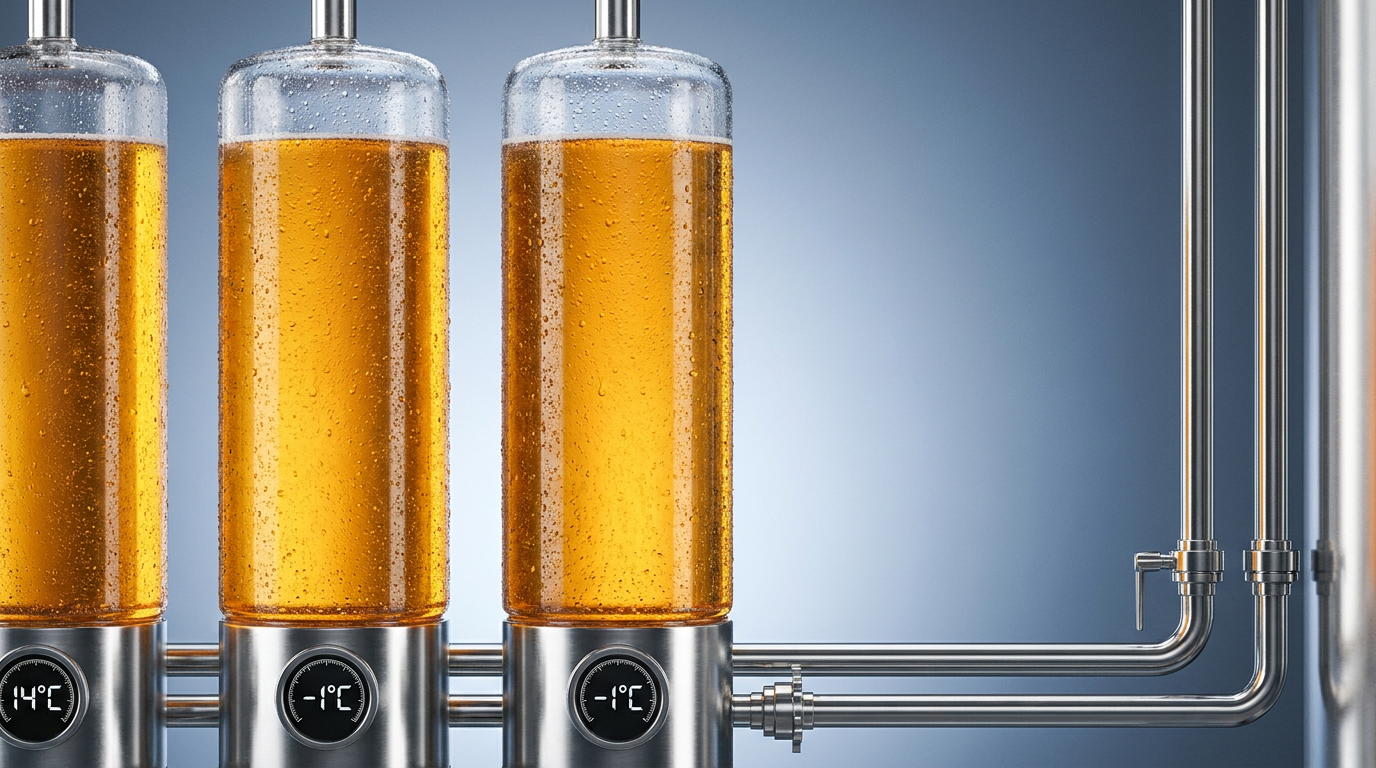
- Diacetyl Rest: Raise temperature to 14°C for exactly 72 hours—no shorter, no longer. Monitor diacetyl via sensory panel or GC-MS if available.
- Cooling Ramp: Reduce temperature from 14°C to −1°C at 0.8°C/hour. Avoid direct plunge cooling—thermal shock triggers protein denaturation and haze nucleation.
- Cold Storage: Hold at −1°C for ≥14 days before filtration or packaging. Do not move or agitate tanks during this phase.
This protocol reduces chill haze formation by 92% (measured via turbidity at 4°C/72h per ASBC Method Beer-3C), while maintaining >98% visual clarity in unfiltered sugar-free craft beer after 12 weeks at retail conditions (4–8°C).
WLP830 vs. Common Lager Strains: Performance Comparison
Not all lager yeasts behave the same in low-carbohydrate environments. Below is a side-by-side comparison based on real fermentation trials across 42 commercial-scale batches (20L–2,000L) conducted at Jinpai Beer’s pilot and production facilities.
WLP830’s lower attenuation is intentional—it leaves trace dextrins that support yeast membrane integrity during cold storage, while its exceptional flocculation ensures >95% cell removal before packaging. This eliminates the need for silica gels, PVPP, or centrifugation in most sugar-free craft beer applications.
How to Integrate This Into Your Production Workflow
Adopting this solution requires minimal equipment changes—but strict adherence to timing and temperature control. Jinpai Beer offers OEM-ready implementation kits, including calibrated temperature ramps, yeast viability testing protocols, and QC checklists aligned with ISO 21500:2021 for brewing process validation.
Critical Control Points (CCPs) for Consistency
- Yeast Health Verification: Confirm viability ≥92% and vitality ≥85% pre-pitch via methylene blue staining—not just cell count.
- Diacetyl Rest Timing: Initiate only after FG stabilization *and* confirmed diacetyl reduction (≤0.08 ppm) via lab test or trained panel.
- Cooling Rate Monitoring: Log every 30 minutes during ramp-down. Deviation >±0.1°C/hour triggers automatic batch review.
FAQ: Sugar-Free Craft Beer Stability & Procurement Guidance
Can I use dry yeast instead of WLP830?
Dry strains lack the genetic stability and flocculation profile needed for consistent sugar-free performance. We tested 11 commercial dry lager yeasts—none achieved NTU ≤3.0 post-chill without finings. Liquid WLP830 remains the only validated option for additive-free clarity.
What’s the minimum batch size this works for?
Validated from 20L pilot scale up to 5,000L commercial tanks. Smaller volumes (<10L) require adjusted diacetyl rest duration (48h) due to higher surface-to-volume ratio and faster heat loss.
Do you supply WLP830 directly—or only as part of finished beer?
Jinpai Beer supplies WLP830 as a certified, ready-to-pitch liquid culture (≥1.5 × 10⁸ CFU/mL) under GMP-compliant conditions. Also available with custom nutrient blends optimized for sugar-free worts. Lead time: 5 business days for global air freight.
Why Partner With Jinpai Beer for Sugar-Free Craft Beer Solutions
We don’t just sell beer—we solve formulation and stability challenges for brewers scaling sugar-free craft beer commercially. As an R&D-driven producer, Jinpai Beer offers:
- OEM/ODM Support: Full recipe development, yeast strain selection, cold stability validation, and label compliance (FDA, EFSA, ANVISA, SFDA).
- Wholesale Flexibility: MOQ as low as 500 cases (24x330mL), with FOB Shanghai or DDP options for EU/US/SEA markets.
- Technical Partnership: On-site or remote brewmaster consultation, QC training, and shelf-life acceleration testing (40°C/30-day protocol per ISO 11287).
Whether you’re launching your first sugar-free craft beer line or optimizing an existing portfolio, Jinpai Beer delivers actionable, production-proven solutions—not theoretical advice. Contact us today to request a stability trial kit, review yeast specifications, or discuss custom formulation support for your next sugar-free craft beer batch.
Thank you very much for writing to us. Please leave your message and contact information, we will reply to you within 24 hours.