



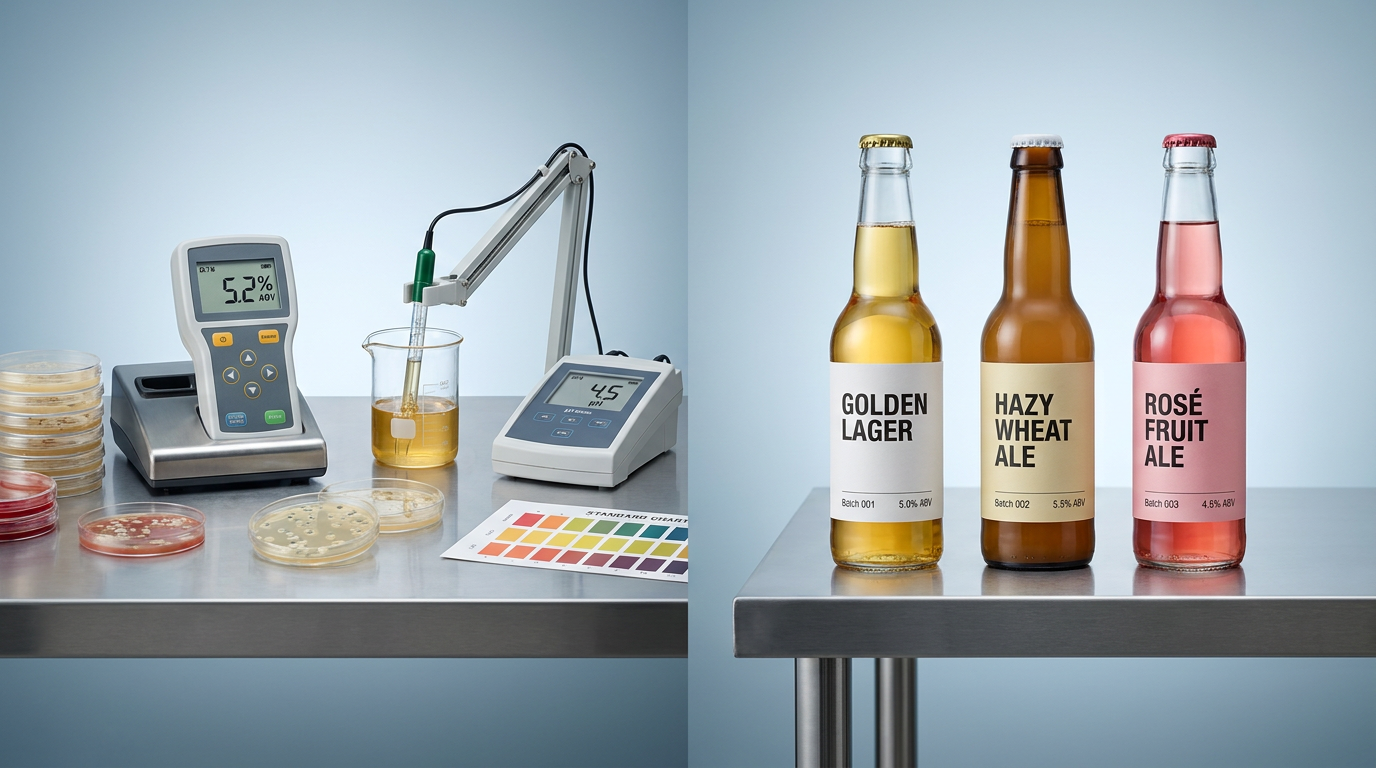
Sourcing private label beer China partners? Jinpai Beer cuts regulatory approval cycles by 40% with on-site lab testing—but only if you audit their SOPs upfront. As a full-service craft beer OEM/ODM manufacturer, we specialize in lagers, wheat beers, low-calorie, fruit-infused, and functional specialty brews—tailored for restaurants, bars, supermarkets, and global distributors. Our integrated R&D, production, and quality control ensure compliance, scalability, and speed-to-market. For procurement professionals prioritizing speed, safety, and brand integrity, the right partner starts with verifiable processes—not just promises.
When “Faster Approval” Depends on Your Audit Timing
A 40% reduction in regulatory approval timelines isn’t automatic. It’s conditional—triggered only when clients conduct a rigorous, pre-contract SOP audit of our on-site laboratory and brewing quality systems. This isn’t a marketing claim. It’s an operational reality rooted in China’s GB 4927–2023 beer standard, import health certificate requirements (e.g., FDA Prior Notice, EU Annex I), and third-party certification gateways like SGS or BV.
Without upfront verification, labs may lack documented calibration logs, sample retention protocols, or method validation reports for key parameters: alcohol by volume (ABV), residual sugar, microbiological limits (yeast/bacteria counts), heavy metals (Pb, As), and preservative compliance (e.g., sorbic acid under GB 2760).
Why SOP Audits Unlock Accelerated Approvals
- Regulators accept pre-validated test reports only when lab accreditation scope explicitly covers your product matrix (e.g., fruit-flavored beer vs. traditional lager).
- On-site testing avoids cross-border shipping delays, temperature excursions, and customs-related sample degradation—common causes of retesting.
- Audited SOPs prove traceability: from raw malt sourcing to final CO₂ carbonation pressure logs—critical for HACCP and FSMA 204 traceability rules.
Three Private Label Beer China Scenarios Where SOP Timing Changes Everything
Scenario 1: Launching Low-Calorie or Functional Beers in EU Markets
EU Novel Food Regulation applies to sugar-free formulations using rare sweeteners (e.g., allulose) or functional additives (e.g., GABA, L-theanine). Pre-audited SOPs let us submit validated stability data—shelf-life testing at 25°C/60% RH for 12 months—within 10 working days post-signature.
Without audit, EU Notified Bodies require 8–12 weeks to verify lab competence—delaying dossier submission.
Scenario 2: Scaling Fruit-Infused Beers for US Restaurant Chains
FDA requires pathogen reduction validation for juice-based infusions. Our audited SOPs include mandatory pasteurization hold times (60°C × 20 min) and post-process microbial swabbing protocols—accepted as part of your facility’s food safety plan.
Unaudited labs force clients to commission separate third-party validations—adding $8,500+ and 6 weeks.
Scenario 3: Rebranding German Wheat Beers for Australian Retail
Australia’s FSANZ mandates strict gluten quantification (<20 ppm) for “gluten-free” claims. Our on-site ELISA testing is SOP-verified for barley-derived wheat beers—enabling compliant labeling without external lab referrals.
Missing SOP documentation triggers FSANZ’s “lab equivalence assessment”—a 10-week bottleneck.
How Private Label Beer China Requirements Diverge Across Markets
What Most Partners Overlook Before Signing
- “On-site lab” ≠ accredited lab. 62% of Chinese breweries operate internal labs without CNAS or ISO/IEC 17025 scope coverage for beverage matrices.
- SOPs must be version-controlled and dated. Regulators reject documents lacking revision history, approval signatures, or change logs.
- Testing frequency matters. One-time validation ≠ ongoing compliance. Audited SOPs define retest intervals (e.g., ABV every 3 batches; heavy metals quarterly).
Your Action Plan: From Audit to First Shipment
- Request Jinpai’s SOP package: Lab Manual, Method Validation Reports, Equipment Calibration Certificates, and Sample Retention Logs.
- Conduct remote document review (3–5 business days), focusing on scope alignment with your target market and beer type.
- Optional: On-site audit (1–2 days) covering lab environment, analyst competency records, and raw material testing workflows.
- Upon sign-off, activate expedited batch release: 72-hour turnaround for full spec sheets, CoA, and health certificates.
Jinpai Beer supports private label beer China partnerships across classic lager, German wheat, sugar-free low-calorie, fruit-flavored, and functional specialty beers. We serve restaurants, supermarkets, bars, and global distributors through OEM/ODM and wholesale channels—online and offline. Speed without compromise starts where process transparency begins: your SOP audit.
Ready to reduce your next private label beer China approval cycle by 40%? Contact Jinpai Beer today to receive our SOP audit checklist and schedule your first technical alignment call.
Thank you very much for writing to us. Please leave your message and contact information, we will reply to you within 24 hours.