



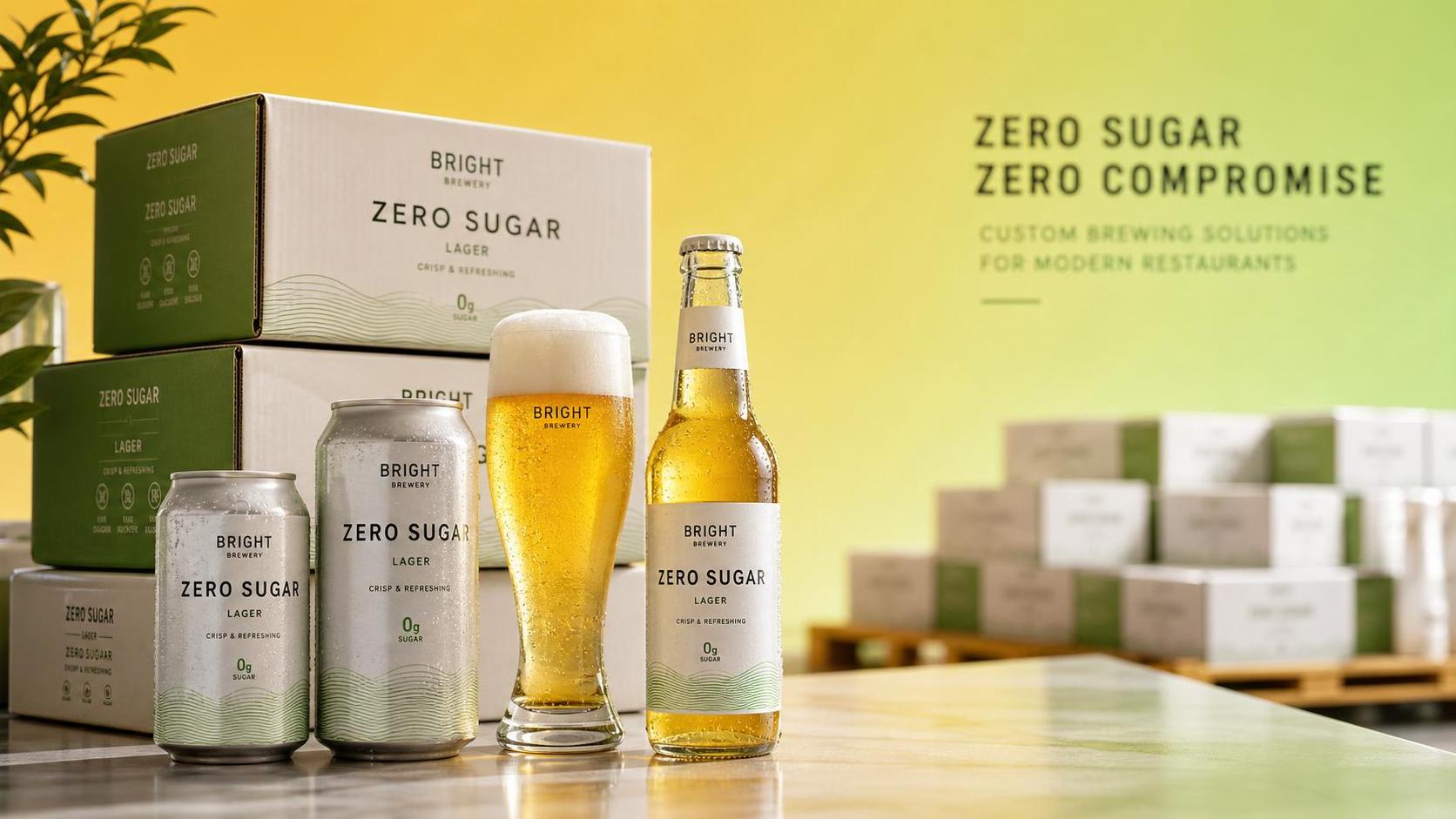
Do Chinese beer factories do sugar-free beer OEM for restaurants? Absolutely—and demand is growing fast as diners seek healthier, low-calorie drink options. For restaurants looking to expand beverage menus with private-label products, Chinese breweries with OEM/ODM capabilities can offer flexible customization, reliable production and market-ready sugar-free beer solutions tailored to different tastes, branding needs and sales channels.
Why restaurants are asking: Do Chinese beer factories do sugar-free beer OEM for restaurants?
The short answer is yes, but the better question is how to find a factory that can turn a restaurant concept into a stable, scalable product. In food and beverage purchasing, private-label beer is no longer limited to large retail chains.
Restaurants now want differentiated drinks that match healthier dining trends, support brand storytelling and improve beverage margins. Sugar-free beer fits this shift because it addresses calorie concerns without forcing operators to leave the beer category.
For many buyers, the challenge is not whether Chinese factories can produce it. The challenge is whether the brewery can support recipe development, flavor positioning, packaging, compliance documents and delivery timing for restaurant channels.
- Restaurants need beverages that align with menu identity, such as light dining, modern Asian cuisine, steakhouse concepts or casual social venues.
- Purchasing teams often face unclear selection standards when comparing sugar-free beer, low-carb beer and low-calorie beer options.
- Operators may have limited budgets for first orders, so flexibility in MOQ, sampling and packaging matters.
- Fast launch schedules create pressure on recipe approval, label design and export coordination.
This is where an experienced craft beer manufacturer such as Jinpai Beer becomes relevant. The company works across R&D, production and distribution, and offers OEM/ODM, wholesale supply and custom solutions for restaurants, bars, supermarkets and other retail channels.
What does sugar-free beer OEM for restaurants usually include?
When buyers ask, “Do Chinese beer factories do sugar-free beer OEM for restaurants?”, they are usually referring to more than brewing. They want a complete service package that reduces launch risk and shortens the path to market.
Core OEM/ODM service scope
- Formula development, including target taste, alcohol level, bitterness, mouthfeel and calorie positioning.
- Packaging customization, such as cans, bottles, carton configuration and private-label artwork adaptation.
- Production planning based on trial orders, seasonal campaigns or multi-location restaurant rollouts.
- Documentation support for ingredient disclosure, shelf-life information and export-related paperwork according to destination market needs.
- Channel matching, whether the beer is for dine-in service, takeaway bundles, retail shelf placement or online sales.
A capable supplier should also understand that restaurants often need a beverage with repeatability. A one-time good sample is not enough. Consistency across batches is critical for brand reputation and customer experience.
Which restaurant scenarios are best suited to sugar-free beer?
Not every venue needs the same sugar-free beer profile. The most effective OEM strategy starts with the serving scenario, menu style and target guest expectations.
The table below helps restaurant buyers compare how sugar-free beer can be positioned across different operating models. This is often the practical answer behind the search query, “Do Chinese beer factories do sugar-free beer OEM for restaurants?”
The right style depends on guest profile and serving occasion. A sugar-free beer for table service in a premium restaurant may need stronger branding and aroma complexity, while a chain format may prioritize smooth drinking and batch stability.
How to evaluate a Chinese brewery for restaurant sugar-free beer OEM
If you are comparing suppliers, avoid making decisions on price alone. The best procurement results usually come from a balanced review of product fit, technical support, commercial flexibility and execution reliability.
Key evaluation points
- Check whether the brewery already develops multiple beer categories. A wider product portfolio often signals stronger formulation capability and more practical customization options.
- Ask about sugar-free low-calorie beer experience specifically, not just general beer production capacity.
- Review sample turnaround time and how recipe revisions are handled after tasting feedback.
- Confirm packaging formats and whether the supplier can match your on-premise or retail-after-dining sales model.
- Understand export readiness, including documentation support and labeling coordination for your destination market.
Jinpai Beer’s product range is useful here. Beyond classic lager and German wheat, it also offers sugar-free low-calorie beer, fruit-flavored beer and functional specialty beers. That breadth can help restaurant buyers create a beverage line instead of sourcing one single SKU in isolation.
What should buyers compare before placing an OEM order?
When asking whether Chinese beer factories do sugar-free beer OEM for restaurants, buyers should compare suppliers using practical operating criteria. The table below can serve as a first-round procurement checklist.
A strong supplier should be willing to discuss these points early. If a brewery cannot explain its process clearly, restaurant buyers may face delays, product mismatch or avoidable packaging errors later.
Sugar-free beer vs conventional beer OEM: what changes for restaurants?
Sugar-free beer OEM is not just a new label on a standard lager. It changes consumer perception, menu wording and quality expectations. Buyers should understand the commercial difference before finalizing a concept.
Main decision differences
- Flavor balance becomes more important because diners often expect clean, refreshing drinking without a thin aftertaste.
- Menu messaging must be careful and compliant, especially when discussing sugar-free, low-calorie or functional characteristics.
- Guest education may be needed in some markets where sugar-free beer is still less familiar than light beer.
- Packaging design often benefits from a cleaner, more premium visual identity tied to wellness and modern lifestyle cues.
For restaurants, the upside is strong. A house-label sugar-free beer can create menu distinction, encourage trial among health-conscious guests and support higher perceived value than a standard third-party commodity beer.
Cost, MOQ and alternatives: how should buyers plan?
Budget is one of the biggest pain points in beverage procurement. Restaurants want customization, but they also need manageable inventory and clear margin potential. That is why MOQ structure and packaging choices should be discussed at the start.
Practical budget planning tips
- Start with a pilot order if you are testing a new private-label concept in one city or one restaurant group.
- Use standard packaging formats first if you want to control development cost and launch faster.
- Compare OEM against direct wholesale only after defining branding goals. Wholesale may be simpler, but it does not build your own beverage asset.
- Consider a phased SKU strategy, beginning with one sugar-free lager and later expanding into fruit-flavored or specialty beer if response is positive.
Because Jinpai Beer offers both OEM/ODM and wholesale supply, buyers can explore more than one route. A restaurant may begin with standard products for speed, then move into custom sugar-free beer once demand and positioning are validated.
What about standards, labeling and export readiness?
Compliance is often overlooked during early product discussions, yet it can affect launch timing more than recipe development. For export-oriented restaurant groups or distributors, sugar-free beer OEM should include a review of destination-market labeling and documentation needs.
Items commonly reviewed during compliance checks
- Ingredient declarations and alcohol-related labeling required by the destination market.
- Shelf-life display, storage guidance and packaging traceability information.
- Claim wording around sugar-free or low-calorie positioning to avoid non-compliant marketing language.
- Shipping documents and carton marks needed for customs clearance and distribution handling.
A brewery with international channel experience is better positioned to coordinate these details. That matters for restaurant groups expanding across borders or for distributors supplying hospitality clients in multiple markets.
FAQ: common questions behind “Do Chinese beer factories do sugar-free beer OEM for restaurants?”
How should a restaurant choose between OEM and ODM?
Choose OEM when you already have a clear concept, recipe direction or packaging brief. Choose ODM when you need the factory to propose a more complete ready-to-market solution. Many restaurant buyers prefer a hybrid model: factory-led formulation with brand-led packaging decisions.
Is sugar-free beer suitable for all restaurant menus?
Not always. It performs best where guests value lighter drinking, calorie awareness or modern beverage choices. Fast-casual concepts, premium casual restaurants, hotel dining and contemporary bar-restaurants often see a stronger fit than highly traditional formats.
What should buyers focus on during sample evaluation?
Taste alone is not enough. Review carbonation, finish, aroma retention, compatibility with core dishes, packaging feel and whether the product still performs well at the actual serving temperature used in your restaurant.
How long can a private-label restaurant beer project take?
The timeline depends on recipe complexity, packaging customization, artwork confirmation and shipping destination. A straightforward project with standard packaging usually moves faster than a fully customized launch with multiple revisions and country-specific label adaptation.
Why choose us for sugar-free beer OEM for restaurants?
Restaurants and beverage buyers need more than a production line. They need a manufacturing partner that understands flavor positioning, channel requirements and launch practicality. Jinpai Beer combines craft beer R&D, production and distribution with flexible OEM/ODM and wholesale support.
Our portfolio covers classic lager, German wheat, sugar-free low-calorie beer, fruit-flavored beer and functional specialty beers. This helps restaurant clients build a complete beverage strategy, from entry-level house beer to higher-margin signature products.
What you can consult with us
- Product selection for restaurant concepts, whether you need a clean sugar-free lager or a more differentiated craft-style profile.
- Packaging and private-label options suited to dine-in, takeaway retail or mixed-channel sales.
- Sampling arrangements, recipe adjustment direction and launch planning based on your target market.
- Lead time discussion, order planning and scalable supply for single-site restaurants or chain expansion.
- Documentation and labeling coordination for export-related or cross-border supply needs.
If you are actively evaluating whether Chinese beer factories do sugar-free beer OEM for restaurants, the next step is not generic inquiry. It is a focused discussion on flavor targets, packaging format, sample support, delivery schedule and destination-market requirements. That is where a workable project begins.
Thank you very much for writing to us. Please leave your message and contact information, we will reply to you within 24 hours.