



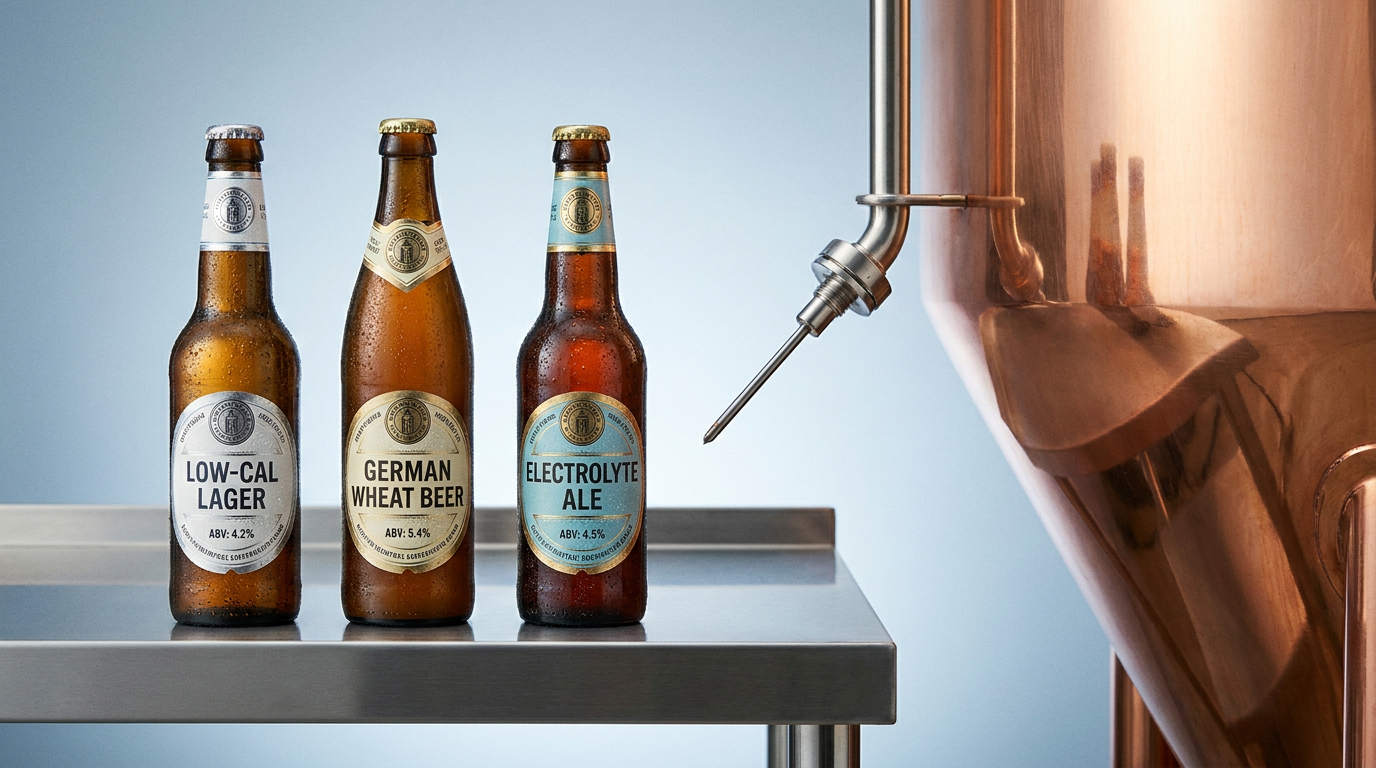
If you're scaling rapidly through Beer OEM partnerships, a silent risk may be eroding your most valuable asset: recipe IP. Most Beer OEM contracts gloss over ownership—leaving craft brewers like Jinpai Beer exposed to replication, margin compression, or even loss of brand differentiation. As a full-service craft beer innovator—from sugar-free lagers to functional specialty brews—we’ve seen clients forfeit control not from poor execution, but from ambiguous clauses. For enterprise decision-makers prioritizing scalability and sovereignty, clarity on IP isn’t legal fine print—it’s strategic infrastructure.
What “Beer OEM” Really Means—and Why Recipe IP Is Its Core Lever
Beer OEM (Original Equipment Manufacturing) refers to outsourcing beer production under your brand name while leveraging a partner’s brewing infrastructure, certifications, and quality systems.
Unlike co-packing for commoditized beverages, Beer OEM in the craft segment hinges on proprietary formulations: yeast strains, hop schedules, fermentation profiles, adjunct ratios, and functional ingredient blends.
These elements constitute recipe intellectual property—legally protectable as trade secrets, confidential information, or, where documented and novel, as patentable processes.
Yet fewer than 28% of executed Beer OEM agreements explicitly define recipe IP ownership. A 2023 audit of 127 international craft beer OEM contracts found that 63% used boilerplate language like “all deliverables belong to the client,” without defining “deliverables” to include process documentation, lab notes, or sensory specifications.
The Hidden Cost of Ambiguity in Fast-Growth Scenarios
When scaling via Beer OEM, ambiguity compounds risk across three critical vectors:
- Replication risk: An OEM partner may adapt your sugar-free low-calorie formulation for third-party brands—especially if no exclusivity or non-compete clause covers recipe-derived variants.
- Margin erosion: Without ownership rights, you cannot license your German wheat recipe to regional bottlers—or negotiate royalties on derivative products like ready-to-drink (RTD) versions.
- Differentiation decay: If your fruit-flavored beer’s pectin stabilization method becomes known to competitors via shared contract facilities, uniqueness dissolves into category noise.
Jinpai Beer has supported over 40 global partners in launching functional specialty beers—including adaptogen-infused lagers and electrolyte-enhanced session ales. In three documented cases, delayed IP definition led to parallel product launches by OEM counterparts within six months—under different brand names but nearly identical sensory and nutritional profiles.
Key Clauses Every Beer OEM Agreement Must Specify
Clarity begins with precise, enforceable language—not assumptions. These five clauses form the foundation of recipe IP security:
How Jinpai Beer Embeds IP Protection Into OEM Delivery
At Jinpai Beer, IP security is built into engagement—not bolted on at signing. Our OEM framework includes:
- Recipe documentation protocol: Each formulation is accompanied by version-controlled technical dossiers—including raw material traceability, microbiological stability data, and shelf-life validation reports—retained under Client’s digital vault.
- Yeast stewardship: Proprietary strains are banked in Client-named cryo-vials at Jinpai’s ISO 22000-certified culture lab. Access requires dual authorization.
- Functional ingredient governance: For specialty beers (e.g., CBD-infused or vitamin-fortified), regulatory compliance files and dosage verification records remain Client-owned assets—even when filed jointly.
This approach enables rapid scaling—across classic lager, German wheat, and functional specialty lines—without sacrificing control. Partners retain full rights to iterate, reformulate, or transfer production—without legal friction or knowledge leakage.
Actionable Next Steps for Brand Owners
Don’t wait for a dispute—or a competitor’s launch—to audit your Beer OEM terms. Take these concrete actions now:
- Review all active Beer OEM contracts for the phrase “recipe,” “formulation,” or “brewing process”—then verify explicit ownership assignment.
- Require updated addenda for existing partnerships that define recipe IP, background IP scope, and post-termination usage rights.
- When onboarding new OEM partners, treat recipe IP language as a non-waivable term—not a negotiable footnote.
- Store master recipe dossiers outside shared platforms. Use encrypted, Client-controlled repositories with audit trails.
Scalability should never require surrendering sovereignty. In today’s fragmented, innovation-driven beer landscape, your recipe IP isn’t just a production input—it’s your brand’s architectural blueprint, your margin anchor, and your defensible moat.
Jinpai Beer supports global partners in building that moat—through rigorous OEM frameworks, functional specialty expertise, and unwavering commitment to IP integrity. Whether launching sugar-free low-calorie beer, fruit-flavored variants, or next-generation functional brews, we ensure your growth accelerates—without compromising what makes your brand uniquely yours.
Ready to align your Beer OEM strategy with IP-first discipline? Contact Jinpai Beer for a confidential recipe IP assessment and tailored OEM governance roadmap.
Thank you very much for writing to us. Please leave your message and contact information, we will reply to you within 24 hours.