



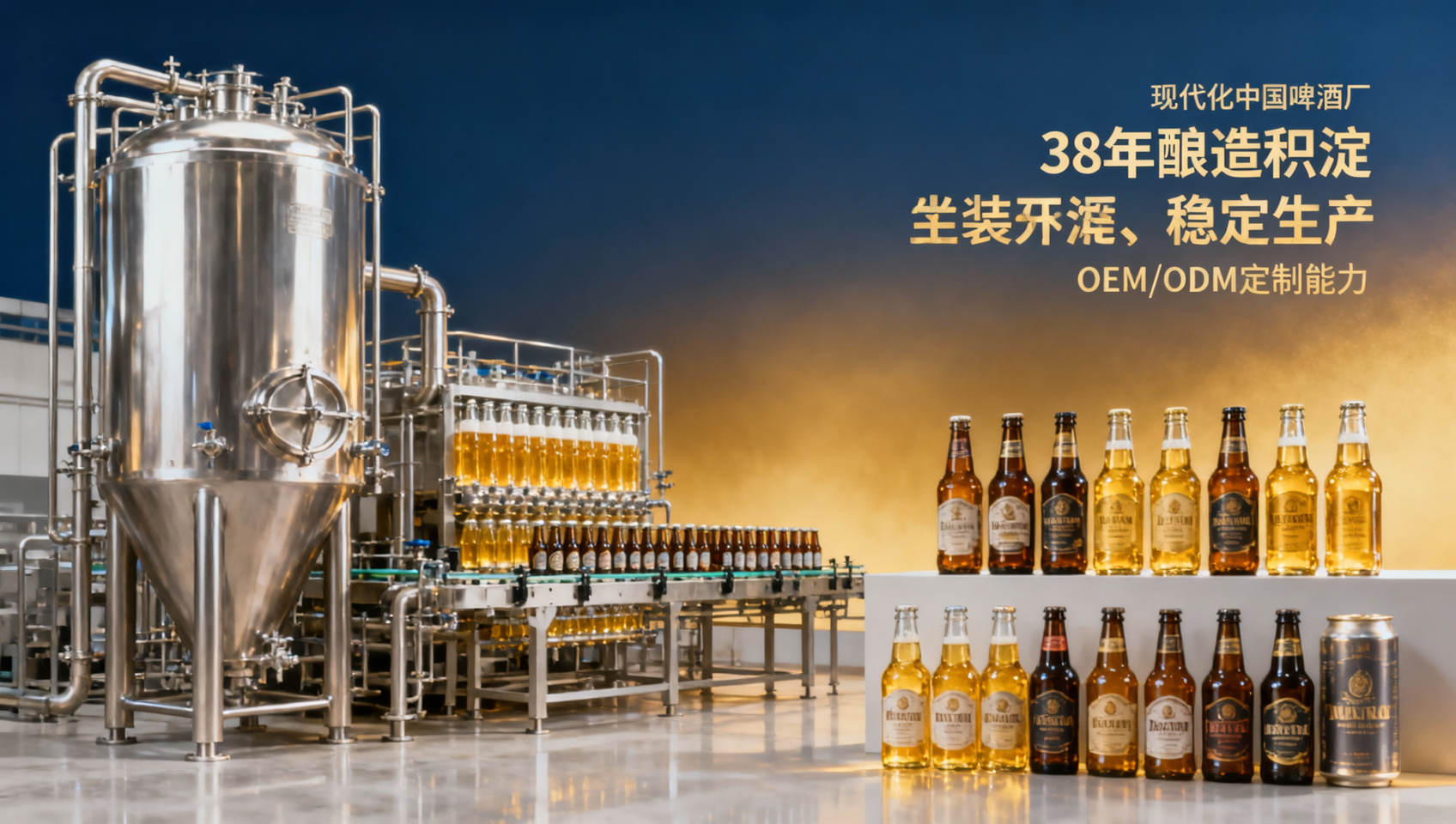
For any company evaluating an established brewery China offers, history matters only when it still shapes present performance. Thirty-eight years of brewing tells a practical story about process control, flavor consistency, supply discipline, and the ability to adapt without losing identity.
That is why the topic deserves attention in today’s beverage market. Buyers are no longer choosing beer on price alone. They are comparing product range, production stability, channel fit, formulation flexibility, and long-term partnership value.
In that context, Jinpai Beer represents more than a legacy producer. Its 38-year foundation supports craft beer R&D, broad product development, OEM/ODM cooperation, and scalable supply for retail, foodservice, and distribution networks across different markets.
What brewing history really signals
A long operating history does not automatically mean a brewery is the right fit. What it can indicate, however, is accumulated manufacturing knowledge that short-cycle producers usually need years to build.
For an established brewery China buyers assess, that knowledge shows up in repeatable fermentation, raw material handling, packaging reliability, and the ability to keep quality stable across larger production runs.
Thirty-eight years also suggests exposure to shifting consumer preferences. Beer demand has moved from basic volume products toward differentiated styles, healthier formulations, and more channel-specific packaging strategies.
A brewery that has remained active through those shifts has likely learned how to balance tradition with product renewal. That balance is often more valuable than novelty alone.
Why this matters in the current beer market
Beer purchasing decisions have become more demanding. Importers, brand owners, retailers, and hospitality groups increasingly look beyond a single flagship product and ask whether a brewery can support portfolio development over time.
This is where an established brewery China manufacturing base can offer an advantage. It can combine production experience with practical flexibility, especially when the market requires both volume efficiency and category innovation.
Current attention is concentrated in several areas. Low-calorie options are gaining shelf space. Fruit-flavored products continue to attract younger consumers. Functional specialty beers create room for niche positioning. Wheat beer and classic lager still anchor mainstream demand.
A brewery that can serve all of those directions from one system is easier to evaluate than one limited to a narrow product band. The commercial question is not just what can be brewed, but what can be scaled and repeated.
How Jinpai Beer fits the profile of an established brewery China market can use
Jinpai Beer’s business model reflects that broader requirement. Its focus spans research and development, production, and distribution rather than simple contract output.
The portfolio covers classic lager, German wheat, sugar-free low-calorie beer, fruit-flavored beer, and functional specialty beers. That range matters because different channels rarely succeed with a single style strategy.
Restaurants may prefer approachable draft-friendly profiles. Supermarkets often need wider consumer appeal and stronger packaging turnover. Bars may value differentiated flavors. Online channels can support niche launches and test-market extensions.
An established brewery China partner with OEM/ODM capability can help bridge those different needs. Instead of forcing the channel to fit the factory, the factory can be evaluated on how well it supports channel-specific beer concepts.
Product breadth is not just variety
A broad catalog should not be read as a marketing list. In practice, it signals formulation experience, ingredient sourcing coordination, and production planning discipline across multiple beer styles.
That becomes especially relevant when a buyer wants to build a portfolio instead of placing one isolated order. Long-term value usually comes from a supplier that can support line extensions without resetting the entire supply chain.
Where 38 years create practical business value
The value of brewing history becomes clearer when translated into operating outcomes. Below are the areas where an established brewery China operation is typically judged most closely.
Simple claims about quality are easy to make. Evidence appears in whether the brewery can deliver repeatable output across changing volume, flavor, and packaging requirements.
Typical scenarios where an established brewery China partner becomes relevant
The usefulness of an experienced brewery depends on the commercial setting. Several scenarios appear repeatedly in international beer sourcing and product planning.
- Launching a private-label beer line that needs OEM/ODM support, controlled quality, and room for future flavor expansion.
- Adding sugar-free low-calorie beer to meet health-conscious demand without abandoning mainstream drinkability.
- Building a mixed portfolio for supermarkets, where classic lager drives volume and specialty products improve shelf differentiation.
- Supplying bars or restaurants with beer styles that align with menu identity, regional taste, or seasonal promotions.
- Testing fruit-flavored or functional specialty beers in online channels before wider offline rollout.
In each case, the brewery is not only a producer. It becomes part of the decision framework behind assortment, margin structure, packaging rhythm, and brand positioning.
How to assess a brewery beyond the headline of 38 years
An established brewery China supplier should be judged on current capability, not legacy alone. History is a signal, but not a substitute for due diligence.
A useful evaluation approach includes operational, commercial, and portfolio questions at the same time. That creates a more realistic picture than checking production age in isolation.
Key points worth verifying
- Whether the brewery can maintain flavor stability across repeated batches and larger volume commitments.
- How strong its R&D process is for custom formulas, packaging formats, and market-specific beer profiles.
- Whether product categories match actual channel demand rather than a broad but shallow catalog.
- How clearly the OEM/ODM workflow is structured, including sampling, revisions, confirmation, and delivery timing.
- Whether the supplier can support long-term growth, not just first-order execution.
That last point deserves emphasis. Many sourcing problems appear after the initial launch, when replenishment, reformulation, or channel expansion introduces new pressure.
A brewery with 38 years of operating history should make those transitions easier, provided its systems still match current market speed and product expectations.
A grounded way to read brewing heritage
What 38 years of brewing history says about a China brewery is not simply that it has lasted. More importantly, it suggests that the producer has had time to refine process discipline, expand product understanding, and adapt to multiple market cycles.
For Jinpai Beer, that heritage is most meaningful when linked to present capability: craft beer development, a multi-style portfolio, OEM/ODM services, wholesale supply, and customized solutions for global channels.
Anyone comparing an established brewery China source can use that lens effectively. Start with product-market fit. Then test customization depth, supply stability, and portfolio relevance. Finally, judge whether the brewery can support growth across more than one sales scenario.
That sequence turns a historical claim into a practical business decision, which is where brewing history becomes valuable rather than merely impressive.
Thank you very much for writing to us. Please leave your message and contact information, we will reply to you within 24 hours.