



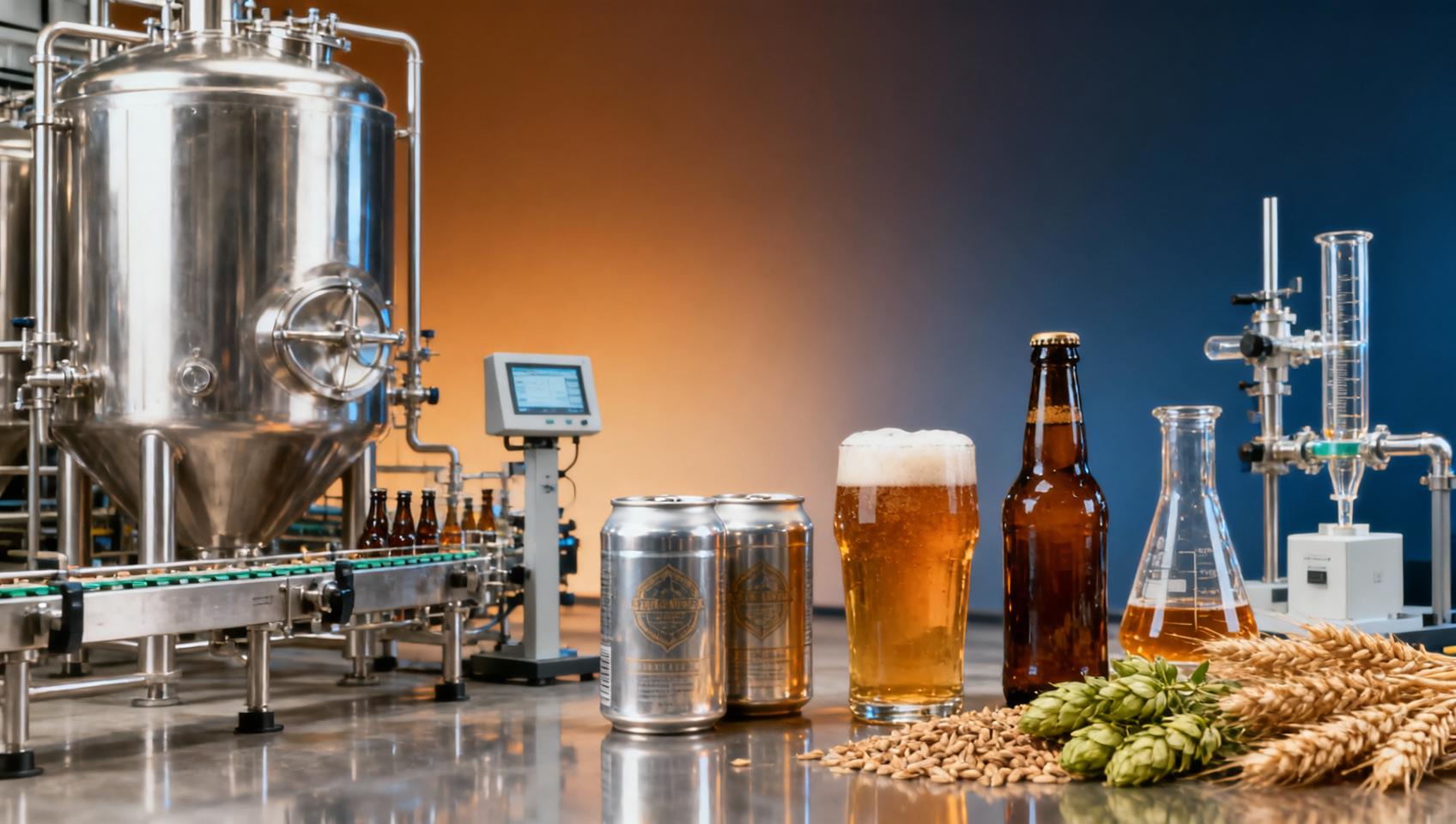
Why does craft beer contract brewing need a stricter pre-signing review?
A contract can define price and volume, but it does not guarantee stable beer quality.
That is why craft beer contract brewing should be checked as a quality system, not only as a supply arrangement.
In practical terms, the main risk is not one bad batch. It is repeated variation that slowly damages brand trust.
Flavor drift, package leakage, microbiological instability, and incomplete records usually appear before larger commercial problems.
For beer sold across restaurants, supermarkets, bars, and retail channels, consistency matters as much as creativity.
This becomes even more important when the portfolio includes lager, wheat beer, sugar-free products, fruit styles, or functional specialty beers.
Different recipes bring different process risks, shelf-life limits, and labeling obligations.
A reliable craft beer contract brewing partner should therefore prove control over raw materials, brewing steps, sanitation, packaging, and release records before any signature.
The most useful approach is simple: verify the system behind the beer, then verify the beer itself.
What should be checked first: recipe fit or factory capability?
Start with capability.
A recipe may look promising on paper, but craft beer contract brewing fails when the plant cannot repeat it under real production conditions.
The first question is whether the brewery can handle your product style at commercial scale.
For example, classic lager needs disciplined fermentation control and clean flavor management.
German wheat depends on yeast performance and stable ester balance.
Fruit-flavored beer raises concerns about ingredient dosing, sweetness stability, and contamination risk.
Low-calorie or sugar-free beer often requires tighter control of attenuation, body, and final taste.
A useful review includes the following checks:
- Brewhouse size and batch flexibility for pilot, trial, and mass production
- Fermentation capacity and temperature control accuracy
- Capability to manage specialty ingredients without cross-contamination
- In-house or validated external lab testing for alcohol, pH, extract, bitterness, and microbiology
- Documented change control when recipe adjustments are needed
If the brewery supports OEM or ODM programs, ask how product transfer is managed between development and full release.
That handoff is often where hidden quality gaps appear.
How deep should raw material and traceability checks go?
Deeper than many buyers expect.
In craft beer contract brewing, traceability is not just a compliance formality. It is the basis for root-cause analysis.
If haze, gushing, off-flavor, or poor foam appears, the team must trace the issue quickly to malt, hops, yeast, adjuncts, water treatment, or packaging material.
Ask for supplier approval criteria and incoming inspection standards.
Check whether lot numbers are linked to each brew, filtration step, and final package code.
For specialty beers, review how sensitive ingredients are stored and tested.
Fruit inputs, botanical extracts, sweeteners, and functional additions may carry higher microbial or labeling risks.
Water should also be treated as a critical ingredient, not a background utility.
Mineral profile, filtration, sanitation, and monitoring frequency can directly affect flavor and stability.
Before signing, many teams use a quick judgment table like this:
When a craft beer contract brewing partner can trace one packaged unit back to one brewing lot and one material chain, control is usually stronger.
Which process controls reveal whether the brewery is truly stable?
Stability is easier to judge through records than through presentations.
Ask to review actual production documents from recent batches, with sensitive pricing removed if needed.
In craft beer contract brewing, the key point is whether critical parameters are defined, measured, and acted on.
The most relevant controls usually include mash temperature, original gravity, fermentation curve, yeast pitch rate, dissolved oxygen, carbonation, and package fill accuracy.
Do not stop at target values.
Check the action limits, deviation handling, and batch disposition rules.
A good brewery will show what happens when data moves outside tolerance.
Need-to-see items often include:
- Standard operating procedures for brewing, fermentation, filtration, and packaging
- Calibration records for meters, thermometers, pressure devices, and lab instruments
- Trend charts for critical points, not only single batch snapshots
- Sensory evaluation method with trained panel or defined release criteria
- Retention sample policy for complaint investigation
This matters even more when products are exported or distributed through multiple channels.
Longer logistics chains expose weak process control very quickly.
Are sanitation and packaging checks really separate issues?
They are connected more closely than they seem.
Many failures in craft beer contract brewing appear in packaged beer, but the root cause starts with cleaning discipline.
Review CIP procedures, chemical concentration verification, contact time, rinse validation, and environmental hygiene controls.
If the brewery cannot prove cleaning effectiveness, package quality claims lose meaning.
Packaging itself deserves a separate technical review.
Cans, bottles, crowns, ends, labels, and cartons all affect shelf life and market complaints.
The most common checks are oxygen pickup, seam or closure integrity, leakage rate, code readability, and transit resistance.
For fruit or specialty beer, refermentation risk should also be evaluated.
This is one area where a site audit often tells more than a specification sheet.
Look for hygiene zoning, operator behavior, line clearance practice, and how nonconforming packaging is isolated.
If shelf-life claims are important, ask whether stability studies match the real package format and distribution temperature.
What compliance documents should be reviewed before signing?
The exact list depends on market and product style, but several records are consistently important.
Craft beer contract brewing should never move forward on verbal assurance alone.
Ask for business licenses, food production permits, recent audit reports, laboratory capability records, and complaint or recall procedures.
If export markets are involved, labeling review and destination-market compliance should be checked before artwork approval.
That point is often missed with low-calorie, sugar-free, flavored, or functional claims.
Pay attention to claim substantiation, ingredient declarations, allergen statements, nutrition format, and alcohol disclosure rules.
Some teams also overlook contract language around quality release authority.
Before signing, clarify who approves the first article, who releases each batch, who owns retained samples, and how claims are investigated.
Where an established producer supports global OEM or ODM beer programs, these responsibilities should be written into the operating framework, not left informal.
What mistakes cause the biggest problems after the contract is signed?
The first mistake is judging a brewery only by tasting samples.
A good sample does not prove that craft beer contract brewing will remain stable over twelve months and several sales channels.
The second mistake is ignoring scale-up risk.
Pilot beer and commercial beer can differ in bitterness extraction, attenuation, aroma retention, and package oxygen.
Another frequent issue is weak communication during change events.
Supplier substitutions, yeast changes, line changes, or revised pasteurization settings should trigger formal review.
More commonly, problems grow because no one defines acceptable variation in advance.
A practical final checklist should include:
- Approved specification for flavor, appearance, microbiology, and package performance
- Trial production review before routine manufacturing
- Agreed shelf-life validation and storage conditions
- Change notification rules with timing and approval path
- Complaint handling timeline and corrective action ownership
In the end, strong craft beer contract brewing decisions are built on evidence.
The best next step is to turn these checks into a scored audit sheet, compare candidate breweries against the same criteria, and confirm which risks are acceptable before production begins.
That process takes time, but it is far less costly than fixing instability after the beer is already in the market.
Thank you very much for writing to us. Please leave your message and contact information, we will reply to you within 24 hours.