



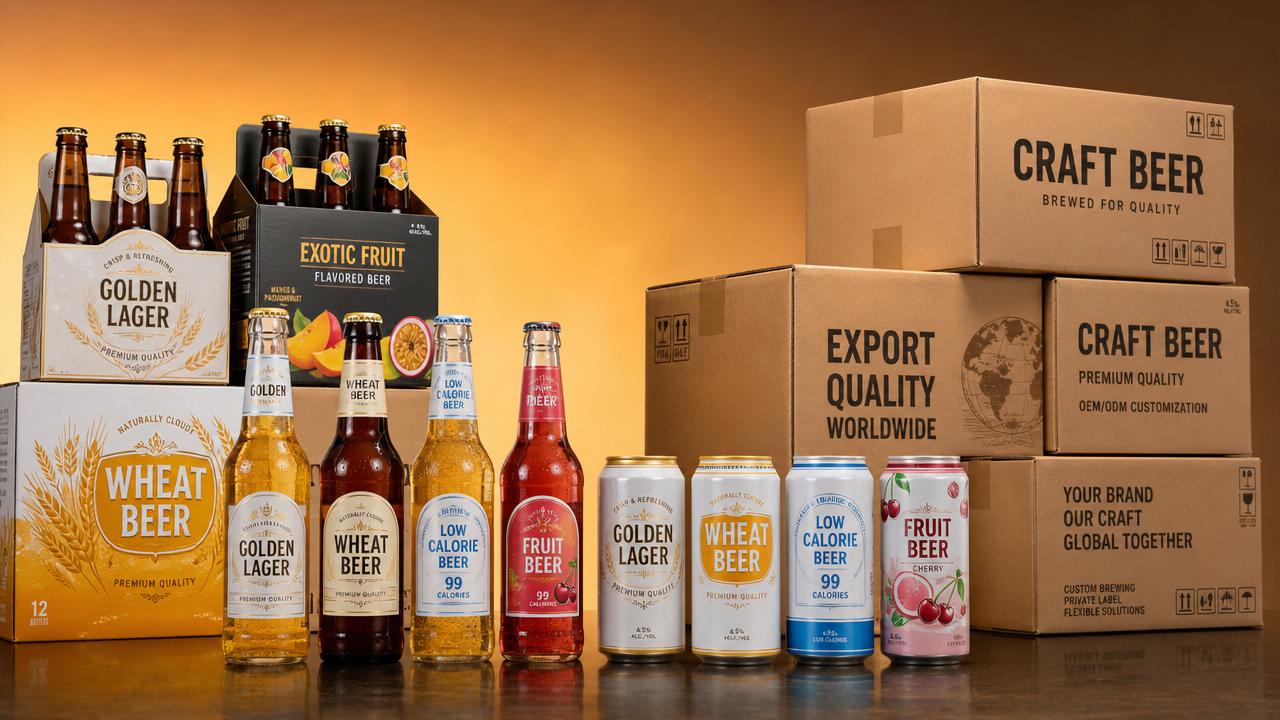
Choosing the right supplier can define the success of your beverage business. If you are seeking Your Partner for Craft Beer, it is essential to evaluate product range, customization capability, quality control, supply stability and global service support before signing any deal. For business decision-makers, asking the right questions early helps reduce risk, improve market fit and build a long-term partnership that supports sustainable growth.
In the craft beer category, a supply agreement is more than a price discussion. It affects brand positioning, sales velocity, packaging flexibility, shelf performance, and your ability to respond to changing consumer demand within 2–8 weeks rather than 2–3 quarters. For procurement teams, category managers, and commercial evaluators, the right partner should help balance flavor innovation with dependable execution.
Jinpai Beer operates across R&D, production, and distribution of craft beer, with offerings that include classic lager, German wheat, sugar-free low-calorie beer, fruit-flavored beer, and functional specialty beers. The company also supports OEM/ODM, wholesale supply, and customized solutions for restaurants, supermarkets, bars, and multi-channel retail programs. Before signing any agreement, however, buyers should still ask practical, measurable questions. That due diligence is what turns a supplier into Your Partner for Craft Beer.
What Business Buyers Should Evaluate First
The first stage of supplier evaluation should focus on 5 core areas: product fit, production capability, quality control, logistics reliability, and service responsiveness. If one of these areas is weak, the total cost of partnership often rises through delayed launches, stock gaps, or reformulation cycles. A low quoted unit price can quickly become expensive if replenishment takes 45–60 days when your channel needs 21–30 days.
1. Product Range and Market Fit
A broad portfolio matters because different channels sell different beer styles at different speeds. Bars may prioritize tap-friendly classics and rotating seasonal flavors, while supermarkets may favor stable, repeatable SKUs with clear labeling and strong shelf appeal. If you are assessing Your Partner for Craft Beer, ask whether the supplier can support at least 3–5 commercially distinct style groups rather than offering only one flagship line.
Jinpai Beer’s range covers classic lager, German wheat, sugar-free low-calorie beer, fruit-flavored beer, and functional specialty beers. That range is relevant for buyers testing multiple consumer segments: mainstream drinkers, calorie-conscious shoppers, younger flavor-driven consumers, and retailers seeking differentiated seasonal promotions. The practical question is not just “What products do you have?” but “Which products are proven to fit my channel, price band, and audience?”
Questions to ask on assortment
- How many year-round SKUs versus limited-release SKUs can you supply consistently?
- Which formats are available: bottle, can, draft, or mixed retail pack?
- Can recipes be adjusted for local taste preference, sweetness level, or alcohol positioning?
- What is the typical timeline for sample development: 7 days, 14 days, or longer?
2. Customization Capability for OEM/ODM Projects
For many importers and private-label operators, customization is the difference between margin pressure and brand control. A capable OEM/ODM supplier should be able to support recipe alignment, packaging artwork coordination, pack configuration, and market-specific claims within a structured process. Buyers should expect at least 4 stages: brief confirmation, sample development, packaging review, and pilot order validation.
Customization should also be commercially realistic. Ask about minimum order quantity by SKU, whether mixed-SKU production is possible, and how label changes affect lead time. For example, a supplier that accepts one flavor but not a mixed 3-SKU trial may slow down new market entry. In many beverage programs, being able to test 2–3 styles in one launch cycle reduces market risk significantly.
The table below outlines the key factors buyers should compare before approving a craft beer supply partner.
For decision-makers, the key takeaway is that a suitable craft beer supplier must perform across several linked functions, not only brewing. If a partner can offer style diversity but cannot support packaging adaptation or predictable replenishment, the partnership may still fail commercially.
How to Assess Quality Control and Product Consistency
In beer supply, quality is not a slogan. It is a repeatable outcome shaped by raw material control, brewing discipline, filling accuracy, packaging inspection, and storage management. Commercial buyers should ask how consistency is maintained from batch 1 to batch 50, especially when scaling from a pilot order to regular wholesale volume.
Batch stability matters more than a successful sample
Many supply problems begin after approval of the first sample. The sample may be acceptable, but later batches vary in carbonation feel, color appearance, aroma intensity, or sweetness balance. For private-label buyers, even a small shift can trigger retailer complaints or poor repeat purchase. A serious evaluation should include questions about batch records, in-process checks, and how non-conforming goods are handled.
Ask practical questions such as: how often are production checks performed during a run, what packaging inspection points are reviewed before shipment, and what shelf-life guidance is recommended for different styles? Fruit-flavored and functional specialty beers, for instance, may need tighter monitoring around flavor stability than a standard lager sold in faster-turn channels.
Packaging quality is part of beverage quality
For restaurants, bars, supermarkets, and e-commerce distributors, packaging is both a protective system and a selling tool. Buyers should review can or bottle integrity, seal reliability, transport suitability, carton strength, and labeling accuracy. An attractive craft beer can still underperform if outer cartons fail during transit or retail barcode placement creates inbound receiving issues.
Minimum quality review checklist
- Confirm flavor profile consistency across at least 2 sample batches.
- Check packaging format compatibility with your retail or horeca channel.
- Review shelf-life guidance and recommended storage conditions.
- Request a clear complaint-response and replacement process.
- Verify how shipment lots are identified for traceability.
These 5 checks help buyers move from subjective tasting to a more controlled supply assessment. If you are looking for Your Partner for Craft Beer, consistency should be measurable in process terms, not only described in sales language.
Supply Stability, Lead Times, and Global Service Support
A strong beer program can lose momentum quickly when stock arrives late. For importers and retail distributors, supply stability should be assessed through production scheduling, order coordination, packaging readiness, and export support. Typical beverage procurement planning often works in cycles of 30, 60, or 90 days, so suppliers must align with real replenishment patterns rather than broad promises.
What to ask about lead time
Lead time should be broken into at least 4 stages: sampling, packaging confirmation, production, and shipment arrangement. A supplier may deliver samples in 7–14 days but require 4–6 weeks for customized production after artwork confirmation. Buyers should also ask whether peak season affects the schedule, and whether rolling forecast orders can secure capacity in advance.
For multi-channel businesses, global service support is another key filter. If products are sold both online and offline, packaging standards, pack durability, and after-sales communication become even more important. A supplier serving bars, supermarkets, and retail chains should understand that each channel has different order frequency, promotional planning, and packaging damage tolerance.
The following table helps procurement teams compare supply execution factors that directly affect launch speed and ongoing inventory health.
The most dependable supply partners are those that provide visibility, not just product. Buyers should look for a process that explains milestones, confirms packaging readiness, and flags risks early enough to protect the launch calendar.
Signs of a scalable global partner
- Ability to serve both online and offline distribution models.
- Experience supporting restaurants, supermarkets, bars, and retail chains.
- Structured communication during sampling, production, and shipment stages.
- Willingness to discuss replenishment planning, not only the first order.
This is where Jinpai Beer’s multi-channel orientation is commercially useful. A supplier working across wholesale supply, OEM/ODM, and customized solutions is often better positioned to support varying pack strategies and channel-specific demand patterns.
Commercial Terms, Risk Control, and Long-Term Partnership Value
The final decision should not be based only on product quality and capacity. Procurement teams also need to examine how the partnership works commercially over 6–12 months. This includes price structure, sample policy, packaging revision process, reorder flexibility, issue resolution, and communication speed. A craft beer supplier becomes truly valuable when it helps lower operating friction across the full business cycle.
Avoid the most common buying mistakes
One common mistake is choosing a supplier on flavor alone without validating supply readiness. Another is approving a product concept without checking whether your target channel can support the packaging size, case count, or shelf turnover rate. A third is failing to define who handles artwork changes, approval delays, and complaint follow-up. These gaps often appear after launch, when correction costs are higher.
To reduce risk, buyers should document at least 4 commercial control points before signing: confirmed SKUs, packaging specification, lead-time expectation, and after-sales response process. Even simple alignment in these areas can prevent weeks of avoidable delay.
Questions that reveal long-term partnership potential
Commercial and operational questions
- Can the supplier support both entry-level volume and future premium line extensions?
- How are repeat orders prioritized after the initial launch?
- What happens if a market trial requires packaging or flavor adjustment after 60–90 days?
- Can customized solutions be tailored for horeca, retail, and private-label programs separately?
- Is there a defined response window for urgent quality or delivery issues?
These questions help distinguish a transactional seller from Your Partner for Craft Beer. The right supplier should be able to support brand growth, not just fulfill a single purchase order.
Why a diversified beer portfolio supports conversion
A portfolio that includes classic and innovative styles gives buyers more room to build a balanced product mix. For example, classic lager can provide stable turnover, German wheat can add premium depth, sugar-free low-calorie beer can target health-aware shoppers, and fruit-flavored or functional specialty beers can support campaigns, gifting, or seasonal promotions. In practical retail terms, a 3- to 5-SKU lineup often performs better than a one-style launch because it reaches more consumption occasions.
For distributors and agents, this also creates negotiation flexibility across channels. A bar program may require stronger differentiation, while a supermarket account may need reliable core styles with easier repeat purchase logic. Working with a supplier that understands both sides helps improve sell-in and sell-through at the same time.
Final Checklist Before You Sign the Deal
Before contract approval, decision-makers should complete one last review. Confirm that the supplier can provide the right beer styles for your market, adapt packaging where needed, maintain product consistency across batches, and support lead times that match your inventory cycle. Also ensure there is a clear communication path for samples, production, shipment, and post-delivery issues.
If your business is looking for Your Partner for Craft Beer, focus on practical alignment: assortment breadth, OEM/ODM flexibility, quality discipline, supply stability, and channel-aware service support. Jinpai Beer’s capabilities in craft beer R&D, production, wholesale supply, and customized solutions make it relevant for distributors, agents, supermarkets, restaurants, bars, and private-label buyers seeking long-term cooperation.
A well-chosen supplier helps you launch faster, control risk better, and build a stronger beverage portfolio over time. Contact us today to discuss your target market, request a customized craft beer solution, or learn more about wholesale and OEM/ODM cooperation options.
Thank you very much for writing to us. Please leave your message and contact information, we will reply to you within 24 hours.