



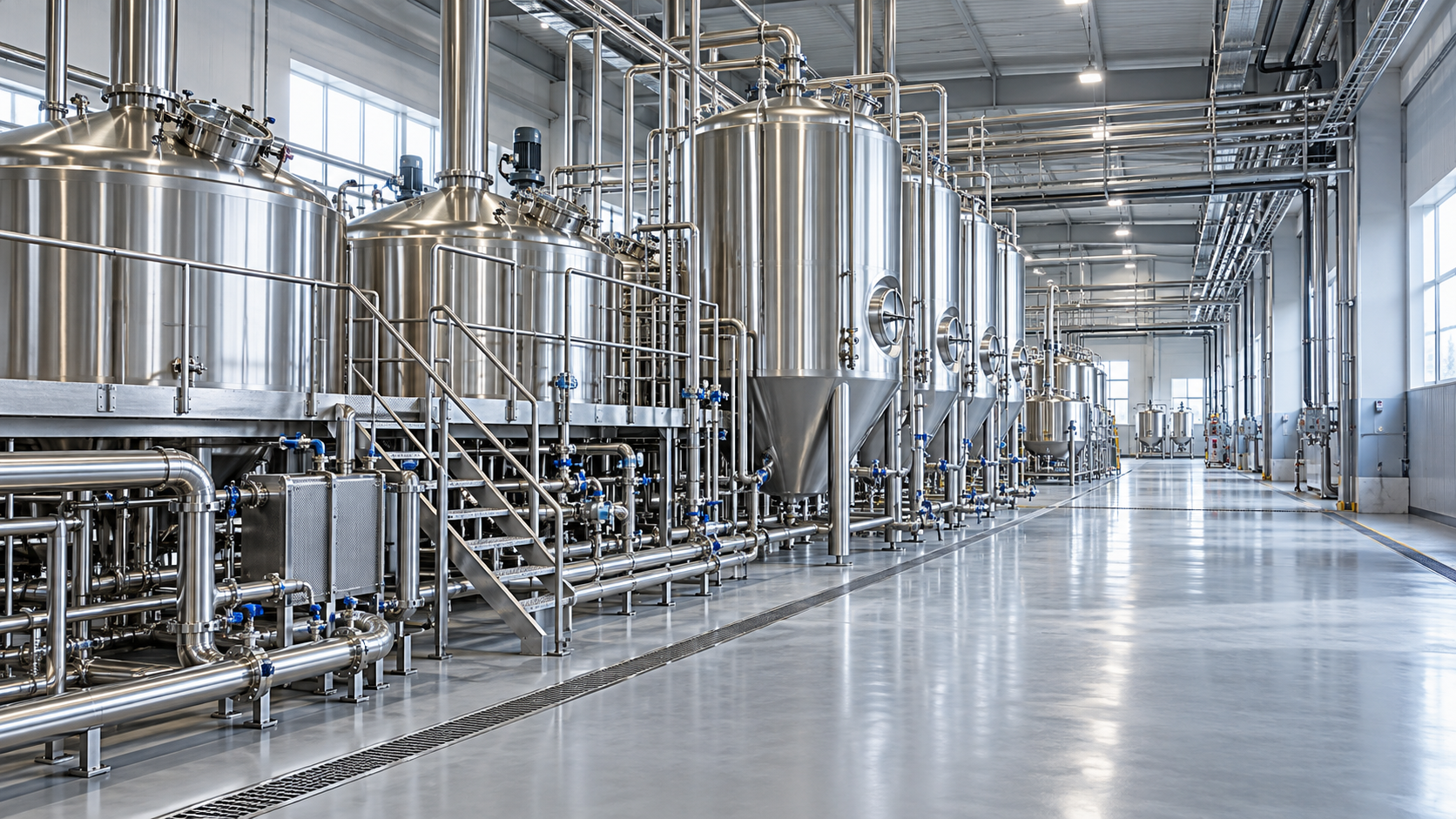
A beer factory is a production facility that converts brewing ingredients into beer, then prepares it for storage and distribution. Also called a brewery, it brings together ingredient handling, brewing, fermentation, conditioning, packaging, and supporting services. Its defining feature is a connected process: each area receives material from an earlier stage and delivers it in a controlled condition to the next.
The size and arrangement vary. A small brewery might combine several activities in one room, while a larger plant separates them into dedicated departments. Some breweries send beer elsewhere for packaging. What matters is how the production functions connect, because a large brewhouse alone does not establish how much finished beer a facility can consistently produce.
Following the Flow Through a Beer Factory
The main production route runs from ingredient storage to milling, mashing, wort separation, boiling, cooling, fermentation, conditioning, and packaging. Wort is the sugar-containing liquid extracted from brewing materials; it becomes beer through fermentation. Alongside this route, water treatment, refrigeration, cleaning systems, and quality control support multiple stages at once.
A practical layout keeps dusty grain handling away from exposed beer and clean packaging materials. It also gives ingredients, waste, personnel, and finished products sensible routes through the building. Short pipe runs can simplify transfers and cleaning, but access for maintenance and separation of incompatible activities remain important.
Ingredient Storage and Milling: Preparing a Consistent Starting Point
Malt and other brewing grains enter through the receiving area and remain in dry storage until needed. Moisture, pests, damaged packaging, and incorrect ingredient identification can undermine production before brewing begins. Hops need protection from heat and oxygen, with storage conditions matched to their form and supplier instructions. Yeast requires controlled handling that preserves its health and limits contamination.
The mill breaks malt kernels open so water can reach the starch inside. For systems that separate wort through a grain bed, the husk should remain sufficiently intact to help form a filter. An excessively fine crush can slow runoff; a coarse crush can leave extract behind. The appropriate setting therefore relates to both the malt and the separation equipment.
Grain dust also affects the room itself. Dust extraction, suitable equipment, and housekeeping address combustible dust hazards and prevent debris from spreading into cleaner production areas. Milling belongs upstream of brewing, but it has different environmental requirements from the wet processing spaces nearby.
The Brewhouse: Turning Grain into Wort
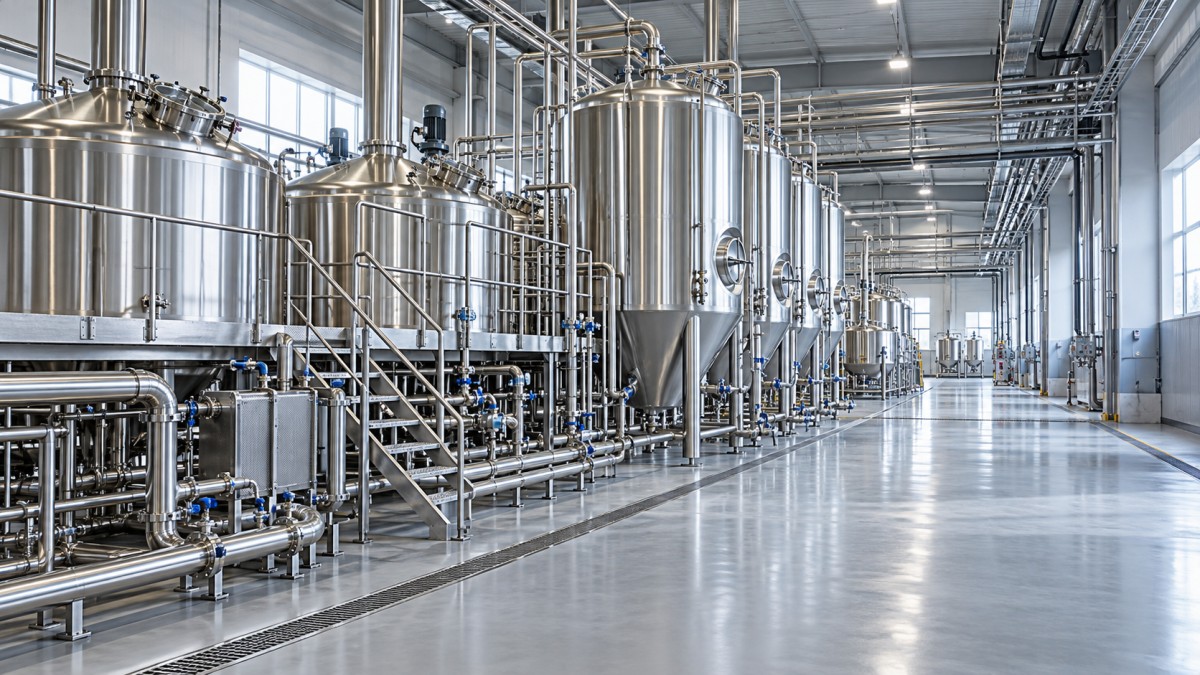
The brewhouse produces wort with the composition needed for fermentation. Its vessels often appear to define the brewery, although several distinct operations occur within them. Smaller systems combine functions in shared vessels; larger installations frequently use separate equipment to support overlapping batches.
Mashing and Wort Separation
During mashing, crushed malt mixes with brewing water under controlled temperature conditions. Malt enzymes break starch into sugars and other carbohydrates. The temperature profile, duration, ingredient mix, and mash chemistry influence how much of the resulting extract yeast can ferment. This helps explain why beers with similar starting sugar concentrations can finish with different sweetness and body.
The liquid then separates from the grain, commonly in a lauter tun or mash filter. In a lauter tun, the grain bed acts as a filter, and additional water rinses out soluble extract. Faster runoff is not automatically better: excessive flow can compact the bed and restrict drainage. Separation also affects wort clarity and the amount of extract recovered.
Spent grain leaves the process here. Its removal needs a practical route that avoids obstructing brewing or carrying wet organic material through clean production zones.
Boiling, Hop Addition, and Cooling
The kettle boils wort to develop the required bitterness from hop compounds, drive off unwanted volatile substances, and reduce the microbial load. Hop timing changes the result: additions intended for bitterness receive different treatment from those intended to retain delicate aroma. Evaporation also changes wort concentration, so a recipe cannot be transferred between systems solely by copying ingredient quantities.
After boiling, a whirlpool or another separation method removes much of the hop material and coagulated protein. A heat exchanger then cools the wort to the temperature required by the selected yeast. From this point onward, sanitary handling becomes especially important because the wort no longer has a later brewing boil to correct contamination.
Controlled oxygen addition before or during yeast pitching supports yeast growth. Oxygen introduced into finished beer has a different effect and accelerates flavor deterioration. The same substance therefore serves different purposes at different stages.
Fermentation and Conditioning: Managing Yeast, Time, and Temperature
In the fermentation area, yeast converts fermentable sugars into alcohol and carbon dioxide while producing compounds that shape aroma and flavor. Tank temperature, yeast condition, pitching quantity, wort composition, and pressure influence this activity. Temperature-controlled vessels remove the heat generated during fermentation and keep the process within the intended operating range.
A fermentation tank is also a pressure-containing vessel with valves, cooling jackets, sampling points, and cleaning connections. Its useful capacity depends on working volume and the space required for foam and gas handling. Nominal tank size alone does not reveal how much beer it holds during a particular fermentation.
Fermentation progress is tracked through measurements such as density, temperature, and sensory observations. A quiet airlock or reduced gas flow does not establish completion. Density trends show whether extract consumption has stabilized, while additional checks establish whether the beer is ready for the next stage.
Conditioning gives yeast and beer time to reach the desired flavor and physical stability. Yeast can reduce fermentation by-products such as diacetyl when conditions permit. Cooling encourages yeast and other suspended material to settle. Some facilities condition beer in the fermentation vessel; others transfer it to separate tanks.
Tank residence time often limits production capacity. A brewhouse might produce several batches quickly, but those batches still occupy fermentation and conditioning space until ready. Longer maturation schedules reduce the number of batches each tank can accommodate over a given period, even when the brewing equipment remains available.
Preparing Beer for Packaging
After fermentation and conditioning, the next operations depend on the intended beer. Filtration or centrifugation removes suspended material when greater clarity or a particular stability profile is required. Unfiltered wheat beer and deliberately hazy styles follow different targets, so visual clarity alone is not a universal measure of quality.
Carbonation is adjusted or retained according to the process. Dissolved carbon dioxide, beer temperature, and tank pressure must work together: beer that warms or loses pressure during transfer releases gas more readily, creating foam and making filling difficult. A bright beer tank often provides a controlled holding point between beer preparation and packaging, although some breweries package directly from suitable fermentation vessels.
Stabilization also varies. Some beers receive pasteurization; others rely on filtration, hygienic filling, and defined storage conditions. These approaches require different equipment and process controls. A product name or beer style alone does not establish which route a factory uses.
Packaging: Protecting the Beer During Filling and Sealing
The packaging area turns prepared beer into sealed cans, bottles, or kegs. Its equipment handles container preparation, filling, closure, inspection, coding, and secondary packing. Each format brings distinct requirements: cans rely on correctly formed seams, bottles require suitable closure application, and reusable kegs need an effective internal washing and sanitation cycle.
Oxygen pickup is a major concern during transfers and filling. Purging containers and lines, maintaining suitable filling conditions, and controlling foam help limit exposure. Dissolved oxygen in the incoming beer and oxygen remaining in the package headspace both contribute to total package oxygen. Measuring only the beer before filling leaves part of the packaging performance unexamined.
A sealed container can still have a closure defect. Seam inspection, closure checks, fill-volume verification, and leak testing address different failure modes. A package that looks acceptable externally does not necessarily have a reliable seal.
Packaging speed must also match beer supply, refrigeration, container handling, and downstream packing. Frequent stops can increase losses and disturb filling conditions. A filler’s rated speed therefore describes one machine under specified conditions, rather than the sustained output of the entire factory.
The Systems That Keep Production Running
Water, Heat, and Refrigeration
Water serves as an ingredient, cleaning medium, and heat-transfer resource. Treatment depends on the incoming supply and the intended use. Brewing water needs suitable sensory and chemical characteristics, while utility circuits have their own requirements. Hardness, alkalinity, and disinfectant residues affect brewing in different ways and should not be treated as one general measure of water quality.
Steam or another heating system supplies the brewhouse and selected cleaning operations. Refrigeration cools wort, controls fermentation, chills beer, and supports cold storage. Demand often overlaps. A cooling system that handles one operation comfortably can struggle when several tanks require cooling while wort is also passing through the heat exchanger.
Cleaning and Waste Handling
Clean-in-place systems circulate cleaning solutions through tanks and pipework without routine dismantling. Their effectiveness depends on chemical concentration, temperature, contact time, and adequate mechanical action. A tank spray device and a long pipe circuit present different cleaning challenges; running the same cycle everywhere does not establish equal results.
Cleaning removes soil, while sanitation reduces microorganisms on already cleaned surfaces. Valves, gaskets, dead-end sections, and poorly drained connections deserve attention because residues can remain where circulation is weak. Some components require dismantling or separate cleaning.
Waste handling includes spent grain, surplus yeast, packaging waste, and wastewater. Collecting concentrated solids separately reduces unnecessary loading on drains and treatment systems. Drain placement and floor design also affect whether production areas stay accessible and clean during washdown.
Quality Control Connects the Production Areas
Quality control follows beer through the factory, with measurements selected for each stage. Ingredient checks support recipe consistency; wort measurements confirm the result of brewing; fermentation records show yeast performance; and packaging checks assess the beer as it will leave the site. Microbiological testing and sensory evaluation answer questions that routine instrument readings alone cannot resolve.
The sampling location matters. An acceptable result from a conditioning tank does not prove that a transfer hose, filler, or package introduced no problem afterward. Comparing samples across these points helps locate where a deviation began. Batch identification links those findings to ingredients, tanks, process records, and packaged stock.
Finished beer then moves into storage under conditions suited to its processing and intended shelf life. Heat exposure and extended holding can change flavor even after successful brewing and filling. Dispatch completes the production route, but the condition of the beer at that point reflects decisions made throughout the facility.
Thank you very much for writing to us. Please leave your message and contact information, we will reply to you within 24 hours.