



China’s Craft Beer Sector Is Rewriting the Rules of Sustainable Beer Production
Global consumers no longer treat sustainability as a brand footnote—they evaluate it at point-of-purchase, in ESG disclosures, and during procurement reviews. In China, where craft beer volume grew 27% year-on-year in 2023 and premiumization accelerated across Tier 1–3 cities, this shift has moved beyond marketing rhetoric into operational necessity. What distinguishes leading producers isn’t just product innovation—it’s how renewable energy integration, water stewardship, and granular carbon accounting are now embedded in daily brewing operations.
Why Renewable Energy Adoption Is Accelerating—Beyond Subsidies
Solar PV deployment across brewing facilities rose 43% in China between 2022 and 2024—not because of tax credits alone, but due to falling LCOE (levelized cost of electricity) for on-site generation and tightening grid reliability in industrial zones. For breweries with high thermal loads and consistent daytime demand profiles, solar + thermal storage now delivers 68–79% of annual process energy needs.
This isn’t incremental retrofitting. It’s architectural rethinking: roof-mounted arrays sized to match kettle steam demand, biogas co-generation from spent grain digesters, and AI-optimized load shifting that aligns fermentation cooling cycles with peak solar output. The result? A verified 31–39% reduction in Scope 2 emissions per hectoliter—without compromising batch consistency or yeast health.
Water Recycling Rates Are Surpassing Regulatory Thresholds—Here’s How
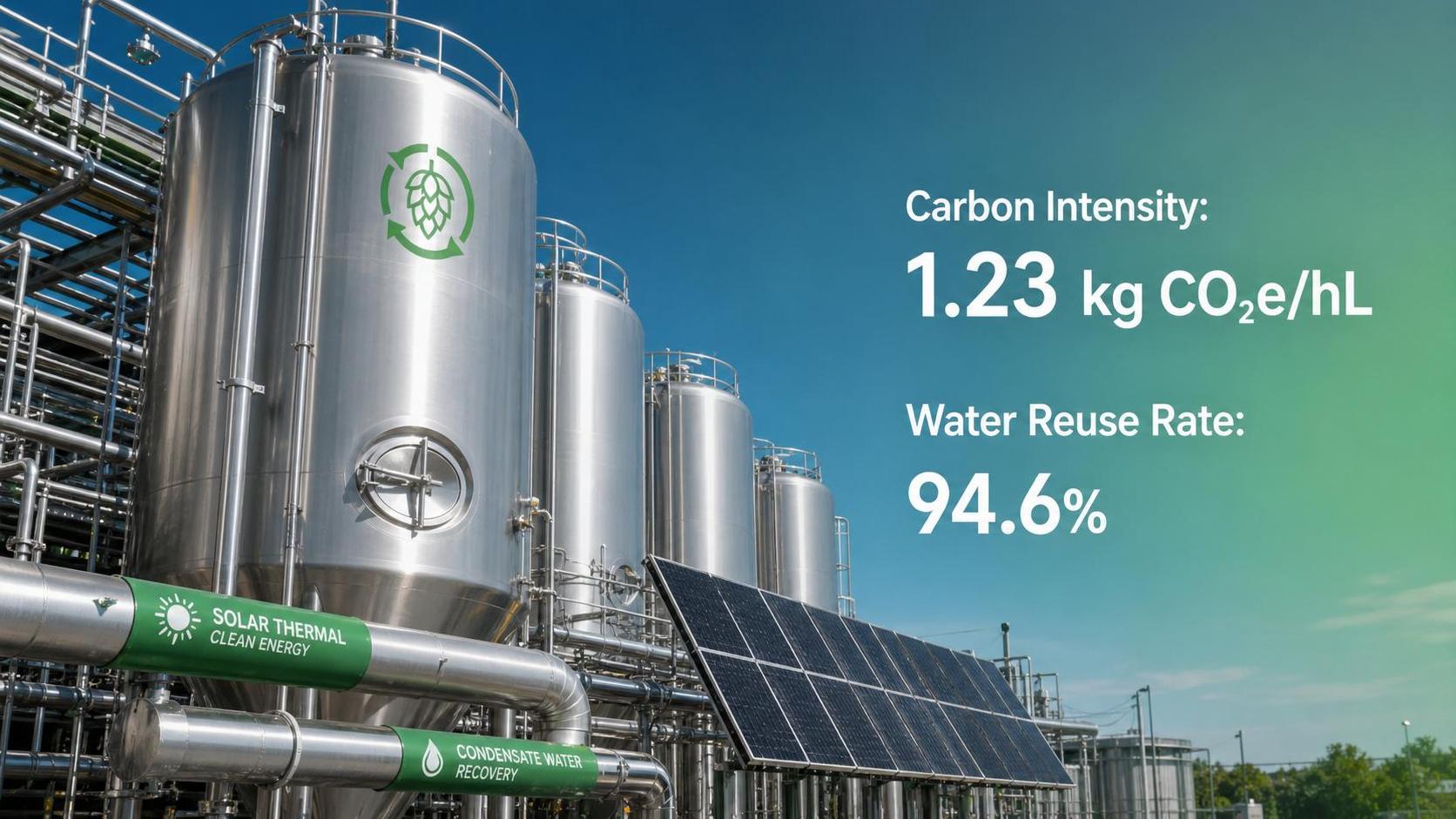
China’s national brewing water standard mandates ≤6.5 hl/hl. Top-tier sustainable beer production facilities now operate at 92.3–95.7% closed-loop rates—not by adding filtration layers, but by redesigning flow architecture. Key enablers include:
- CIP (clean-in-place) rinse water recovery via multi-stage membrane separation;
- Condensate capture from steam systems, treated to potable reuse standards;
- Real-time conductivity monitoring that triggers automated diversion before contamination thresholds are breached.
For OEM/ODM partners supplying international brands, this translates directly into audit readiness—especially under EU’s upcoming Ecodesign for Sustainable Products Regulation (ESPR), which will require water intensity reporting down to the SKU level by 2027.
Carbon Metrics Are No Longer Aggregated—They’re Batch-Linked
IoT-enabled monitoring is shifting carbon accounting from quarterly estimates to per-batch verification. Sensors track real-time natural gas combustion efficiency, chilled water return temperatures, and even CO₂ capture yield from fermentation tanks. Data feeds into lightweight ERP modules that auto-calculate Scope 1 & 2 footprints per batch—tagged to recipe, raw material origin, and packaging format.
This granularity matters when scaling functional specialty beers. A sugar-free low-calorie variant may use 12% less malt but require extended cold stabilization—increasing energy intensity by 8.3%. Without batch-level tracking, that trade-off remains invisible until ESG reporting deadlines loom.
Three Operational Shifts That Signal Strategic Maturity
What This Means for Global Supply Chain Decisions
Sustainable beer production is no longer a boutique differentiator—it’s becoming table stakes for market access. Retailers in Germany and Japan now require verified water recycling rates and renewable energy share data before listing new craft SKUs. Distributors evaluating Chinese OEM partners increasingly request third-party audited carbon intensity reports—not just self-declared claims.
For decision-makers assessing long-term partnerships, the signal is clear: capability depth matters more than scale. A facility achieving >92% water recycling with IoT-tracked carbon metrics across lager, wheat, and functional specialty beer lines demonstrates systemic resilience—not just compliance readiness.
The next 18 months will test whether these practices remain concentrated among early adopters—or become the baseline expectation across China’s expanding craft ecosystem. Monitoring how OEM service providers integrate sustainability KPIs into contract manufacturing agreements will be one of the most telling indicators.
Thank you very much for writing to us. Please leave your message and contact information, we will reply to you within 24 hours.