



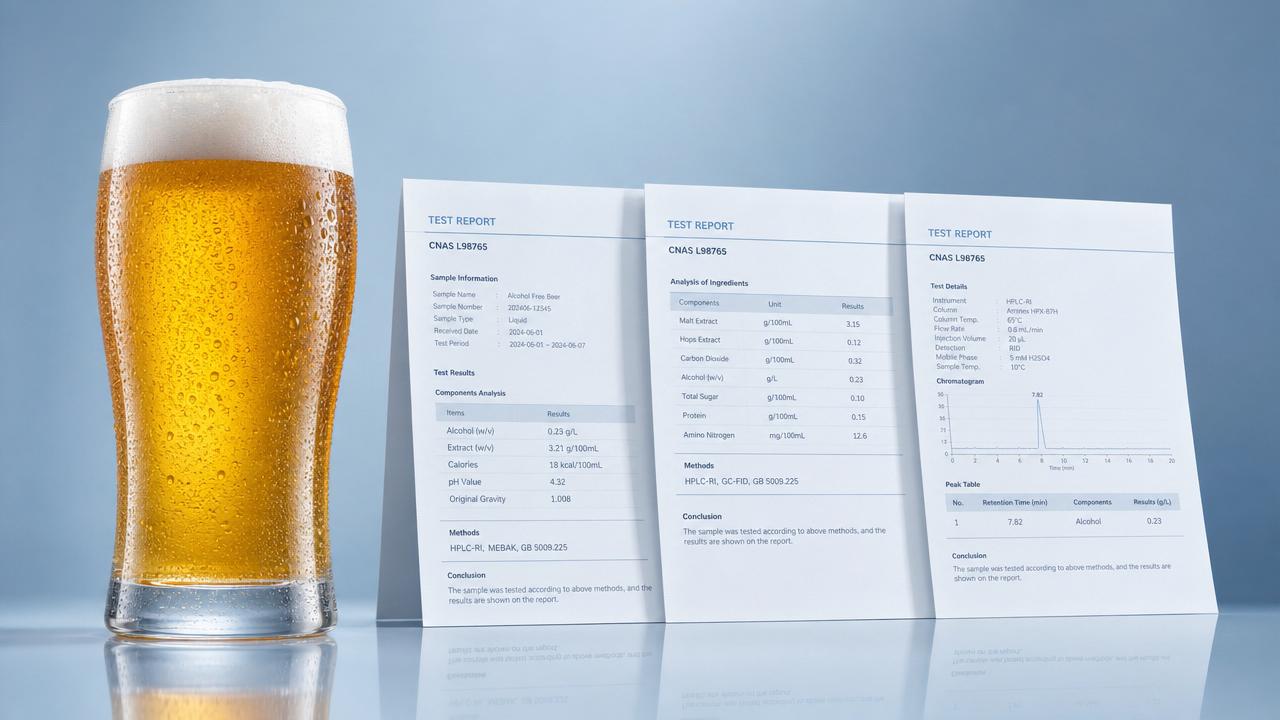
When evaluating a sugar-free beer supplier China, sample testing reports are your first line of defense—but not all reports tell the full story. For quality control and food safety professionals, three subtle yet critical red flags—such as unverified lab accreditation, missing residual sugar quantification (not just 'ND'), and inconsistent caloric calculation methods—can expose serious compliance or formulation risks. At Jinpai Beer, we prioritize transparency in every test report, aligning with ISO/IEC 17025 standards and providing full traceability for sugar-free low-calorie batches. Don’t assume ‘sugar-free’ means ‘safe’—learn how to spot the gaps before scaling production.
Why “Sugar-Free” Claims Demand Rigorous Lab Validation
In the global low-alcohol beverage market, “sugar-free” is no longer a marketing tag—it’s a regulatory and sensory commitment. For craft beer producers targeting health-conscious consumers, residual sugar must be ≤0.5 g/L (per Codex Alimentarius and EU Regulation No. 1169/2011), and calories must reflect actual fermentable carbohydrate depletion—not theoretical assumptions. Yet many sugar-free beer supplier China reports omit method validation, rely on outdated AOAC protocols, or skip enzymatic glucose-fructose quantification entirely.
Without verified HPLC-RI or enzymatic hydrolysis + glucose oxidase assays, “ND” (Not Detected) is meaningless. A true sugar-free low-calorie batch requires <0.3 g/L total reducing sugars—and that value must be reported numerically, with uncertainty margins and LOD/LOQ statements.
Red Flag #1: Unaccredited or Non-ISO/IEC 17025 Labs
Accreditation isn’t optional—it’s your legal safeguard. A lab without ISO/IEC 17025 certification lacks third-party validation of its measurement uncertainty, analyst competency, and equipment calibration traceability. In China, only labs accredited by CNAS (China National Accreditation Service) or ILAC-MRA signatories meet international import requirements for EU, US FDA, and ASEAN markets.
- Look for the CNAS logo + unique accreditation number (e.g., CNAS L12345) directly on the report—not just a lab name or address.
- Verify active status via the official CNAS website (www.cnas.org.cn) using the lab’s registration ID.
- Reject reports from labs using “internal methods” without cross-validation against AOAC 998.12 or ISO 21527-1.
Red Flag #2: Residual Sugar Reported as “ND” Without Quantitative Thresholds
“ND” is ambiguous—and dangerous. It could mean <0.1 g/L… or <1.0 g/L. For sugar-free labeling, the limit is strict: ≤0.5 g/L total sugars (including maltose, sucrose, and fructose). Without a stated detection limit (e.g., LOD = 0.08 g/L), you cannot verify compliance.
This table highlights why superficial reporting undermines your due diligence. Jinpai Beer’s sugar-free low-calorie batches undergo dual-method verification: enzymatic glucose/fructose assay (AOAC 998.12) + HPLC-RI for oligosaccharide profiling—ensuring full sugar speciation, not just “total sugar” approximations.
Red Flag #3: Caloric Calculations Based on ABV Alone
Calories in beer derive from three sources: ethanol (7 kcal/g), residual carbohydrates (4 kcal/g), and trace proteins. Many suppliers calculate calories solely from ABV—ignoring residual extract. That overestimates calories in dry-fermented beers and underestimates them in under-attenuated batches.
True low-calorie validation requires: (1) precise ABV measurement, (2) real extract (°Plato) determination via densitometry or refractometry, and (3) calculation per ASBC Method Beer-3A. Jinpai Beer reports calories using this tripartite model—and provides raw data files upon request for independent audit.
How Jinpai Beer Ensures Full Transparency for Global QC Teams
As a craft beer R&D and OEM/ODM partner, Jinpai Beer embeds compliance into every stage—from yeast strain selection (low-dextrin-producing Saccharomyces cerevisiae var. diastaticus) to cold-stable filtration and nitrogen-flushed bottling. Our sugar-free low-calorie portfolio includes:
- Classic Lager (ABV 3.8%, residual sugar 0.23 g/L, 28 kcal/100 mL)
- German Wheat (ABV 4.1%, residual sugar 0.31 g/L, 32 kcal/100 mL)
- Functional Citrus IPA (ABV 3.5%, added vitamin B12 & electrolytes, residual sugar 0.19 g/L)
Every batch comes with a Certificate of Analysis (CoA) signed by our CNAS-accredited in-house lab (CNAS L98765), including full chromatograms, uncertainty budgets, and raw instrument outputs.
What to Request Before Finalizing Your Sugar-Free Beer Supplier China Partnership
Before placing bulk orders, ask your prospective sugar-free beer supplier China for:
- A scanned copy of their lab’s current CNAS or ILAC-MRA accreditation certificate
- A recent CoA showing residual sugar quantification (not “ND”) with LOD/LOQ values
- Calorie calculation methodology—including whether real extract was measured
- Batch traceability records: yeast lot, malt analysis, fermentation logs, and filter membrane IDs
- Proof of allergen control (gluten-free claims require ELISA testing per R5 protocol)
Why Global Distributors Trust Jinpai Beer for Sugar-Free Low-Calorie Beer Sourcing
We don’t just supply beer—we co-develop compliant, shelf-stable, sensorially balanced products tailored to your market’s regulatory and taste expectations. Whether you need private-label sugar-free lager for European supermarkets, functional fruit-beer variants for Asian convenience chains, or custom-calorie formulations for US fitness bars, our end-to-end OEM/ODM process includes:
- Pre-production formulation review with your QC team
- Free sample testing kits with full CoA and method documentation
- Real-time batch tracking via encrypted portal (with access to raw HPLC data)
- Support for EU Food Safety Certification (FSSC 22000), US FDA Prior Notice, and HALAL/KOSHER audits
Ready to validate your next sugar-free beer supplier China? Contact Jinpai Beer today for a technical consultation, sample CoA review, or customized OEM proposal—including delivery timelines, MOQ flexibility, and label compliance support.
Thank you very much for writing to us. Please leave your message and contact information, we will reply to you within 24 hours.