



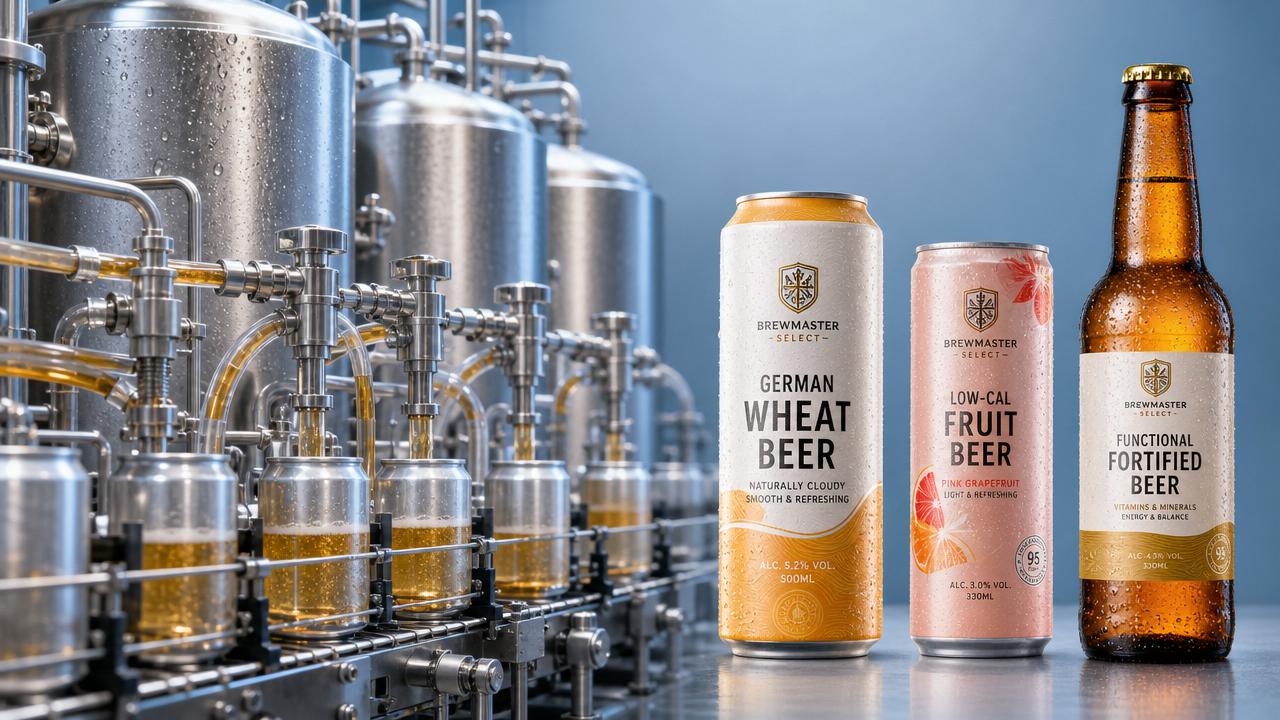
For project managers overseeing brewery expansions or product launches, craft beer contract brewing presents a strategic crossroads: outsource production to third parties—or scale in-house with proven capacity, quality control, and agility. At Jinpai Beer, we bridge this gap with end-to-end R&D, flexible OEM/ODM capabilities, and integrated production of diverse craft styles—from German wheat to functional low-calorie variants. This article examines why, for many growth-focused teams, in-house craft beer contract brewing delivers superior speed, consistency, and ROI—especially when aligning with global distribution partners across bars, supermarkets, and e-commerce channels.
What Is Craft Beer Contract Brewing?
Craft beer contract brewing refers to the arrangement where a brand develops recipes, branding, and market strategy—but relies on an external facility to brew, package, and sometimes distribute its beer.
Traditionally, this model served startups lacking capital for brewhouses. Today, it spans from micro-labels to established brands testing seasonal releases or regional SKUs.
However, “contract brewing” is not monolithic. Two distinct operational paths exist: true third-party outsourcing versus integrated in-house contract brewing—where the contract partner owns full production infrastructure, quality systems, and formulation expertise.
Why In-House Craft Beer Contract Brewing Is Gaining Momentum
Market signals point to a quiet but decisive shift toward vertically aligned contract brewing partnerships. Key drivers include:
- Supply chain volatility—especially for specialty malts, hops, and functional ingredients
- Rising consumer expectations for batch-to-batch flavor fidelity in fruit-flavored beer and German wheat styles
- Shorter time-to-shelf windows for low-calorie and sugar-free low-calorie beer due to stability constraints
- Regulatory complexity in multi-country labeling, alcohol-by-volume (ABV) compliance, and allergen declarations
- Growing demand for co-developed functional specialty beers—e.g., adaptogen-infused or vitamin-enriched variants
Comparative Advantages: Outsourced vs. Integrated Production
The table below highlights operational differentiators that define performance in modern craft beer contract brewing:
Where In-House Craft Beer Contract Brewing Delivers Measurable Impact
Three high-impact application areas demonstrate tangible ROI:
- Speed-to-market for limited editions: Fruit-flavored beer variants launch in ≤22 days from approval—not 10–14 weeks typical with fragmented outsourcing.
- Consistency across geographies: German wheat batches brewed for EU, APAC, and LATAM markets maintain identical clove/banana ester profiles via shared yeast propagation protocols and fermentation telemetry.
- Functional specialty beer scalability: Sugar-free low-calorie beer and adaptogen-fortified lines achieve >92% yield retention at 20,000-L scale—without off-notes or haze—due to proprietary cold-stabilization and dry-hopping integration.
Strategic Considerations Before Committing
Selecting the right craft beer contract brewing partner requires evaluating beyond capacity and cost:
- Confirm end-to-end ownership of critical control points: raw material sourcing, wort production, fermentation, filtration, carbonation, and packaging.
- Verify sensory panel certification and documented threshold testing for key off-flavor compounds (DMS, acetaldehyde, diacetyl).
- Assess traceability: batch-level ingredient logs, CIP cycle records, and environmental monitoring data must be auditable in real time.
- Review IP protection frameworks—especially for proprietary yeast strains or functional ingredient blends used in specialty beers.
Next Steps for Global Partners
Jinpai Beer supports rapid, compliant scaling for craft beer brands targeting international retail, HoReCa, and direct-to-consumer channels.
We invite qualified partners to request:
- A no-cost technical consultation covering recipe feasibility, regulatory alignment, and minimum order thresholds
- Access to our digital batch portal—live tracking of fermentation progress, QC results, and logistics status
- Sample kits including classic lager, German wheat, sugar-free low-calorie beer, and two functional specialty beer options
No exclusivity clauses. No long-term volume commitments. Just scalable, certified, and responsive craft beer contract brewing—engineered for growth, not just output.
Contact Jinpai Beer today to initiate your first co-developed batch—and experience how in-house craft beer contract brewing transforms strategic flexibility into measurable commercial advantage.
Thank you very much for writing to us. Please leave your message and contact information, we will reply to you within 24 hours.