



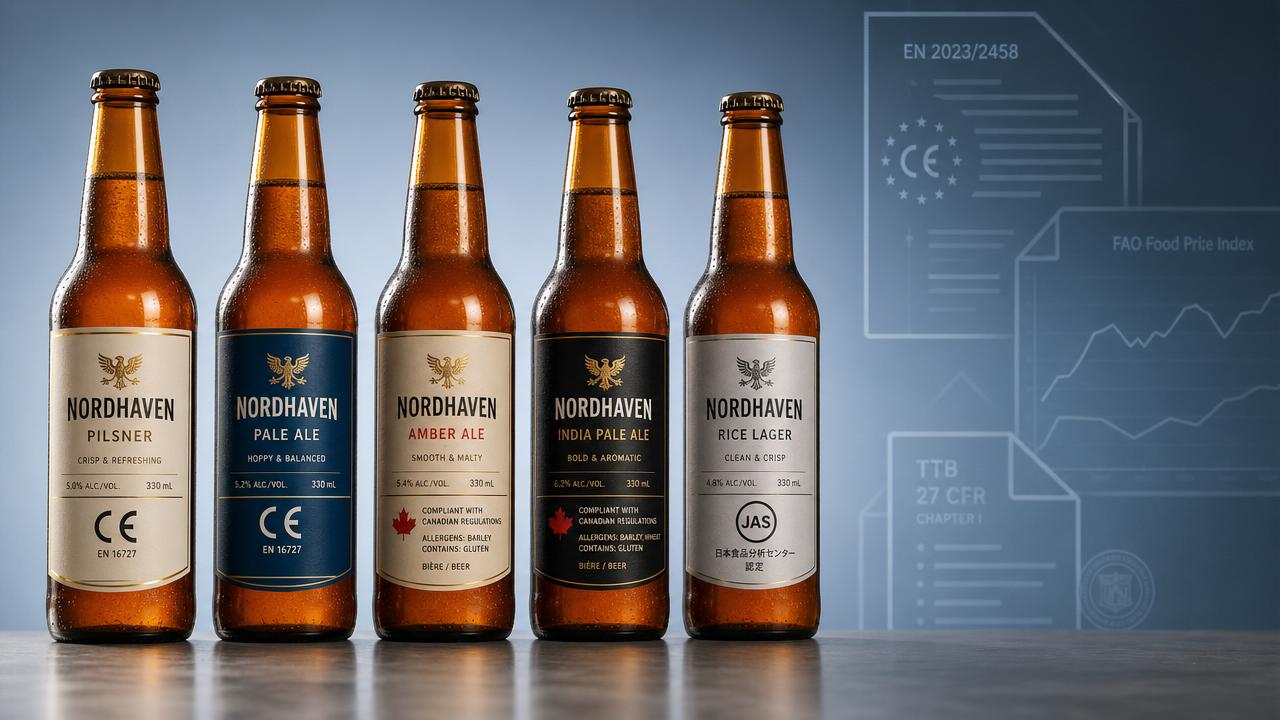
For export-focused beer brands, Beer OEM partnerships promise scalability and market agility—but hidden cost drivers often erode margins and delay time-to-market. From unexpected compliance fees and packaging rework to fluctuating raw material surcharges and minimum order adjustments, these silent line-item risks are rarely transparent in initial contracts. At Jinpai Beer, we specialize in craft beer OEM/ODM for global distributors—offering lagers, wheat beers, low-calorie, fruit-infused, and functional variants—with full transparency on cost structures, MOQ flexibility, and export-ready certifications. This article unpacks the top five hidden cost drivers you must negotiate before signing your next Beer OEM agreement.
Global Compliance Volatility Is Accelerating Cost Uncertainty
Regulatory landscapes for alcoholic beverages are tightening across key export markets—including the EU, Canada, Australia, and ASEAN nations. New labeling mandates, allergen declarations, alcohol-by-volume (ABV) rounding rules, and digital traceability requirements now trigger unplanned revisions.
What appears as a “standard” label file at contract signing may require three rounds of reapproval post-production—each involving design labor, print plate changes, and customs hold fees.
- EU Regulation (EU) 2023/2458 mandates nutrition labeling by 2025—retroactive for all bottled imports
- Canada’s SOR/2023-192 requires bilingual ingredient lists and health warning placement validation
- Japan’s National Tax Agency now audits ABV tolerance ±0.2%—exceeding standard brewing variance
Raw Material Indexation Clauses Are No Longer Optional
Barley, hops, and specialty yeast prices have swung ±35% YoY since 2022 due to climate disruptions and freight volatility. Many Beer OEM contracts still use fixed-cost pricing without index linkage.
Without explicit pass-through terms tied to FAO Barley Price Index or Hopsteiner Spot Index, suppliers absorb losses—or invoke force majeure mid-batch.
Jinpai Beer embeds quarterly index review windows into all OEM agreements—capping surcharge increases at 8% per adjustment and requiring 30-day written notice.
Packaging Reconfiguration Costs Are Mispriced in 72% of Contracts
Export-ready packaging isn’t just about language translation. It includes tamper-evident neck bands compliant with US TTB 27 CFR §4.21, UV-resistant ink for Middle East sun exposure, and crush-tested cartons for Amazon FBA fulfillment.
Yet most Beer OEM proposals quote “standard bottle + label + case” without specifying regional structural upgrades.
MOQ Flexibility Is a Margin Protection Lever—Not a Concession
Minimum order quantities are often treated as static thresholds. In reality, demand signals shift rapidly: influencer campaigns spike orders, seasonality compresses launch windows, and shelf-space negotiations demand staggered deliveries.
Rigid MOQs force either overstock (cash flow strain) or air freight premiums (margin erosion).
At Jinpai Beer, MOQs scale dynamically across product tiers: 5,000 units for core lagers, 3,000 for fruit-infused variants, and 1,500 for functional specialty batches—each with optional split-shipment scheduling at no extra fee.
Logistics Coordination Gaps Generate Hidden Labor Overhead
Beer OEM isn’t just production—it’s end-to-end supply chain orchestration. Yet 68% of contracts omit clarity on who manages export documentation, incoterm-specific insurance, or port-of-discharge customs clearance.
When responsibilities blur, delays mount. A single missing Certificate of Origin can stall EU entry for 11+ business days—and incur storage penalties exceeding $1,200 per container.
- Jinpai Beer provides DDP-ready documentation packages—including bilingual Certificates of Analysis, TTB COLA pre-clearance support, and real-time container tracking
- All export paperwork is generated within 48 hours of batch sign-off—not after shipment
- We assign dedicated logistics coordinators—not shared account managers—to each OEM partner
Five Non-Negotiable Clauses for Your Next Beer OEM Agreement
Protect profitability and predictability with these enforceable provisions:
- Compliance Escalation Clause: Caps rework costs at 5% of order value when regulatory updates occur post-signature
- Indexation Schedule: Binds raw material adjustments to published FAO or Hopsteiner indices—no unilateral supplier discretion
- Packaging Annex: Lists region-specific structural, ink, and sealing specs—signed and attached pre-PO
- MOQ Tiering Table: Defines volume bands, lead times, and split-shipment allowances by SKU type
- Documentation SLA: Guarantees certified export docs issued ≤48h post-batch approval—with penalty credits for delays
Beer OEM success hinges not on lowest unit price—but on total landed cost visibility. Jinpai Beer delivers craft beer OEM/ODM services built for export resilience: from sugar-free low-calorie lagers to functional botanical infusions, every contract includes embedded cost guardrails, certification readiness, and agile MOQ architecture.
Ready to audit your current Beer OEM cost structure? Contact Jinpai Beer for a free Contract Transparency Review—including side-by-side comparison of your existing agreement against our five-clause benchmark framework.
Thank you very much for writing to us. Please leave your message and contact information, we will reply to you within 24 hours.