



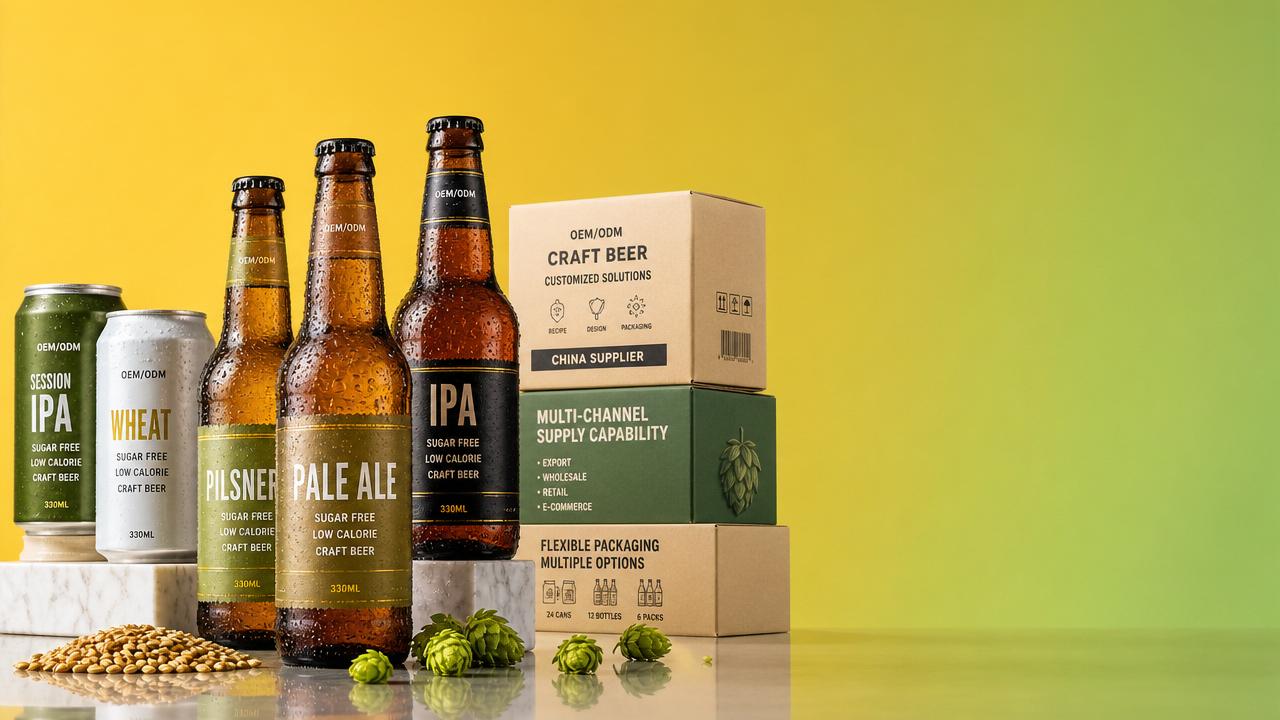
As demand for healthier alcohol options accelerates, choosing a reliable sugar-free beer supplier China is becoming a strategic priority for distributors, agents and import partners planning for 2026. From low-calorie positioning to OEM/ODM flexibility and channel-ready product portfolios, the right supplier can help you capture emerging market signals and build stronger growth across retail, supermarket, bar and hospitality segments.
For B2B buyers in the beverage industry, the opportunity is not only about adding another SKU. It is about aligning with a category that fits changing consumer preferences, stricter shelf competition, and faster product rotation cycles. A capable Chinese supplier can support private label development, stable batch production, and multi-channel packaging strategies that help distributors prepare for 2026 with lower execution risk.
Jinpai Beer operates across R&D, production, and distribution of craft beer, with a portfolio that includes classic lager, German wheat, sugar-free low-calorie beer, fruit-flavored beer, and functional specialty beers. For importers, supermarket suppliers, bar wholesalers, and regional agents, this breadth matters because channel demand rarely depends on a single style. It often depends on a mix of 3 to 5 product lines that serve different price points and consumption occasions.
Why sugar-free beer is becoming a stronger demand signal for 2026
The rise of sugar-free beer is closely linked to how consumers now evaluate alcoholic drinks. Buyers increasingly compare calorie levels, ingredient transparency, and drinking occasion suitability before making a repeat purchase. For distributors, this means the category is no longer a niche trial product. In many markets, it is moving into the mainstream low-calorie and better-for-you segment within 12 to 24 months.
Health-positioned alcohol is reshaping shelf decisions
Retailers and importers are under pressure to improve assortment efficiency. A sugar-free beer supplier China can support this by offering products that fit modern label expectations without abandoning beer flavor and drinkability. In practice, a distributor may test 2 packaging formats, 3 flavor directions, or 2 alcohol levels to identify the best-performing combination for local stores, bars, and convenience channels.
In supermarket and chain retail settings, products that communicate sugar-free and low-calorie positioning often benefit from easier category storytelling. This does not guarantee instant sales, but it can improve first-trial conversion when compared with standard lager lines that lack a clear functional message. For agents planning 2026 portfolios, message clarity is now almost as important as price competitiveness.
Three practical demand drivers to watch
- Consumers aged 25 to 40 are more likely to compare alcohol options by calorie and sugar content.
- On-trade venues such as bars and hotels increasingly want 1 to 2 healthier beer options on the menu.
- Private label buyers need differentiated SKUs that can launch within one seasonal planning cycle, often 8 to 16 weeks.
The table below outlines how sugar-free beer typically compares with adjacent beer segments from a distributor perspective. These are practical market positioning differences rather than fixed industry rules, but they help buyers map channel fit more accurately.
The key takeaway is that sugar-free beer works best when treated as part of a structured portfolio, not as a stand-alone novelty. A distributor that combines sugar-free beer with classic and flavored lines can cover more use cases, reduce listing risk, and improve the chances of a successful launch across 2 to 4 sales channels.
How to evaluate a sugar-free beer supplier China for distribution success
Selecting the right supplier requires more than tasting samples. A serious B2B review should consider product consistency, packaging flexibility, lead time, documentation support, and the supplier’s ability to serve both OEM/ODM and wholesale business models. For 2026 planning, buyers should evaluate at least 4 dimensions before moving into commercial negotiation.
1. Portfolio depth and formulation range
A supplier with only one sugar-free beer option may limit your ability to adapt by market. Different regions often require different bitterness levels, alcohol percentages, and packaging styles. In real projects, buyers commonly compare 2 to 3 sample formulas before confirming the first order. This is especially important when the target channel includes supermarkets, chain stores, and bars with distinct customer profiles.
2. OEM/ODM capability and packaging response speed
For agents building local brands, packaging flexibility can decide whether a launch hits the season or misses it. A supplier should be able to discuss can formats, bottle options, label compliance, and brand design coordination in a clear timeline. Typical early-stage projects may require 2 to 4 weeks for design confirmation and another 3 to 6 weeks for production scheduling, depending on order size and packaging complexity.
3. Stable supply for mixed-channel demand
A distributor may need one product line for retail and another for on-trade. That means the supplier should not only produce sugar-free beer, but also support broader assortment planning. Jinpai Beer’s product range across craft beer styles gives buyers more flexibility to build mixed shipments, which can be useful when testing a market with 1 container or when expanding to 3 regional channels at the same time.
4. Commercial communication and long-term support
Response speed matters in B2B beverages. Delays in formula confirmation, artwork review, or shipping coordination can push launches into the wrong quarter. Buyers should ask about sample lead times, production windows, export support, and after-sales communication routines. A practical benchmark is whether the supplier can provide structured feedback within 24 to 72 hours during active project development.
The checklist below can help importers and agents compare potential partners more objectively when reviewing a sugar-free beer supplier China.
A supplier that performs well across these four areas is usually better equipped to support scale-up. This matters when your first test order succeeds and you need repeat production with only minor adjustments in packaging, carton language, or product mix.
Operational factors distributors should discuss before placing orders
Even strong products can fail if execution details are weak. For beverage importers and regional partners, operational clarity is one of the biggest risk-control tools. Before confirming a supplier, buyers should discuss at least 5 practical areas: sample process, MOQ, lead time, packaging confirmation, and channel positioning.
Sample and approval workflow
A structured workflow often starts with requirement alignment, then sample selection, then packaging discussion, commercial review, and final order planning. In many beverage projects, 5 steps are enough to move from initial inquiry to production booking. Problems usually occur when artwork, flavor expectations, and carton details are handled too late.
Suggested 5-step process
- Define target market, sales channel, and sugar-free product positioning.
- Request 2 to 3 samples for taste and format comparison.
- Confirm OEM/ODM requirements, label language, and packaging structure.
- Review MOQ, production lead time, and shipment planning.
- Approve final commercial terms and schedule the first batch.
MOQ and mixed-order planning
Distributors often need flexible ordering, especially in a new category. Reasonable MOQ discussions are important because first-cycle orders may focus on testing instead of maximizing volume. Buyers should ask whether mixed SKUs are possible within one shipment and whether different beer styles can be combined. This is especially useful when a market launch includes sugar-free beer, wheat beer, and fruit beer together.
Retail-ready packaging and channel adaptation
The same liquid product may need different packaging logic for different channels. A supermarket buyer may prefer easy-scan shelf packs, while a bar distributor may focus on bottle presentation and serving convenience. E-commerce adds another layer, requiring durable carton protection to reduce breakage during last-mile delivery. A supplier that understands these differences can help improve launch efficiency and reduce repacking costs.
Below is a practical comparison of common operational concerns when working with a sugar-free beer supplier China for 2026 market entry.
What matters most is coordination. A buyer that aligns flavor, pack format, MOQ, and timing early is more likely to avoid the common launch problems of delayed artwork, unsuitable cartons, and weak shelf messaging.
Why broad product capability matters when choosing a long-term partner
Many distributors start with one trending product and later realize they need a fuller assortment to keep customers engaged. This is where a supplier with a wider craft beer portfolio offers an advantage. Beyond sugar-free beer, Jinpai Beer develops and supplies classic lager, German wheat, fruit-flavored beer, and functional specialty beers, which supports multi-segment growth rather than one-off transactions.
One supplier, multiple channel strategies
For restaurants and bars, product variety can improve menu flexibility. For supermarkets, it can create a more coherent brand block on shelf. For importers, it simplifies sourcing and reduces the complexity of managing separate factories for each subcategory. In practical terms, using one supplier for 3 related beer styles can lower coordination workload across sampling, packaging, and shipment planning.
Customized solutions support local market adaptation
Different regions respond to different flavor and branding cues. Some markets prefer clean, minimal packaging and low-calorie claims. Others respond better to craft storytelling or fruit-infused novelty. OEM/ODM capability allows distributors and agents to adjust packaging language, brand identity, and assortment mix without rebuilding the supply chain from the beginning.
Common partner goals for 2026 launches
- Build a healthier beer line for modern retail and e-commerce.
- Add a sugar-free option to hotel, restaurant, and bar beverage programs.
- Create a private label range with 2 to 4 differentiated beer SKUs.
- Secure a long-term wholesale source that can scale with regional growth.
These objectives are easier to achieve when the supplier understands both production and route-to-market requirements. In beverage B2B, execution quality often depends on how well the supplier can translate a buyer’s category plan into a practical product and delivery roadmap.
Common mistakes buyers should avoid in the sugar-free beer category
A fast-growing segment can create pressure to move quickly, but rushed procurement often increases risk. One common mistake is selecting a sugar-free beer supplier China only on initial price. If the formulation is too narrow, the packaging is poorly matched to the channel, or support is inconsistent, the apparent savings can disappear within one sales quarter.
Mistake 1: Treating sugar-free as only a label claim
Distributors should evaluate drinkability, repeat purchase potential, and channel story together. A product may fit a trend on paper but fail to move if the flavor profile does not satisfy mainstream beer drinkers. That is why side-by-side testing with 2 or more options is often a better decision process than approving the first sample.
Mistake 2: Ignoring launch timing and packaging readiness
Beverage launches are calendar-sensitive. Missing a summer retail window or a year-end hospitality program can reduce the impact of even a strong SKU. Buyers should confirm all milestones, from sample review to artwork approval and shipment preparation, before locking in promotional plans.
Mistake 3: Choosing a single-product supplier for a multi-product market
As demand matures, retailers and distributors often ask for line extensions. If your supplier can only deliver one sugar-free product, expansion becomes slower and more expensive. Working with a manufacturer that can support several beer categories gives you a better foundation for repeat business and broader channel penetration.
For distributors, agents, and import partners preparing for 2026, the right sugar-free beer supplier China should deliver more than a trendy product. The supplier should offer dependable production, flexible OEM/ODM support, channel-ready packaging, and a broader portfolio that helps you build a stronger beverage program across retail, bars, restaurants, and supermarkets.
Jinpai Beer supports global partners with craft beer R&D, manufacturing, wholesale supply, and customized solutions across classic lager, German wheat, sugar-free low-calorie beer, fruit-flavored beer, and functional specialty beers. If you are planning new distribution opportunities, private label development, or a healthier alcohol product line for 2026, now is the right time to evaluate samples, discuss packaging options, and map a practical rollout plan.
Contact us today to get customized solutions, review product details, and explore long-term cooperation for your target market.
Related Posts
- ▶ What Makes a Chinese Beer Factory Competitive in Global Contract Brewing? Quality Consistency, Scalability, and IP Protection Frameworks
- ▶ How Chinese Beer Factory Export Performance Differs by Destination: EU Tariff Quotas vs. Southeast Asia Local Content Rules
- ▶ Why Malt Drink Factories Often Underestimate Water Treatment Needs for Beer Production — Hardness, Chlorine, and Silica Implications
Online Message
Thank you very much for writing to us. Please leave your message and contact information, we will reply to you within 24 hours.