



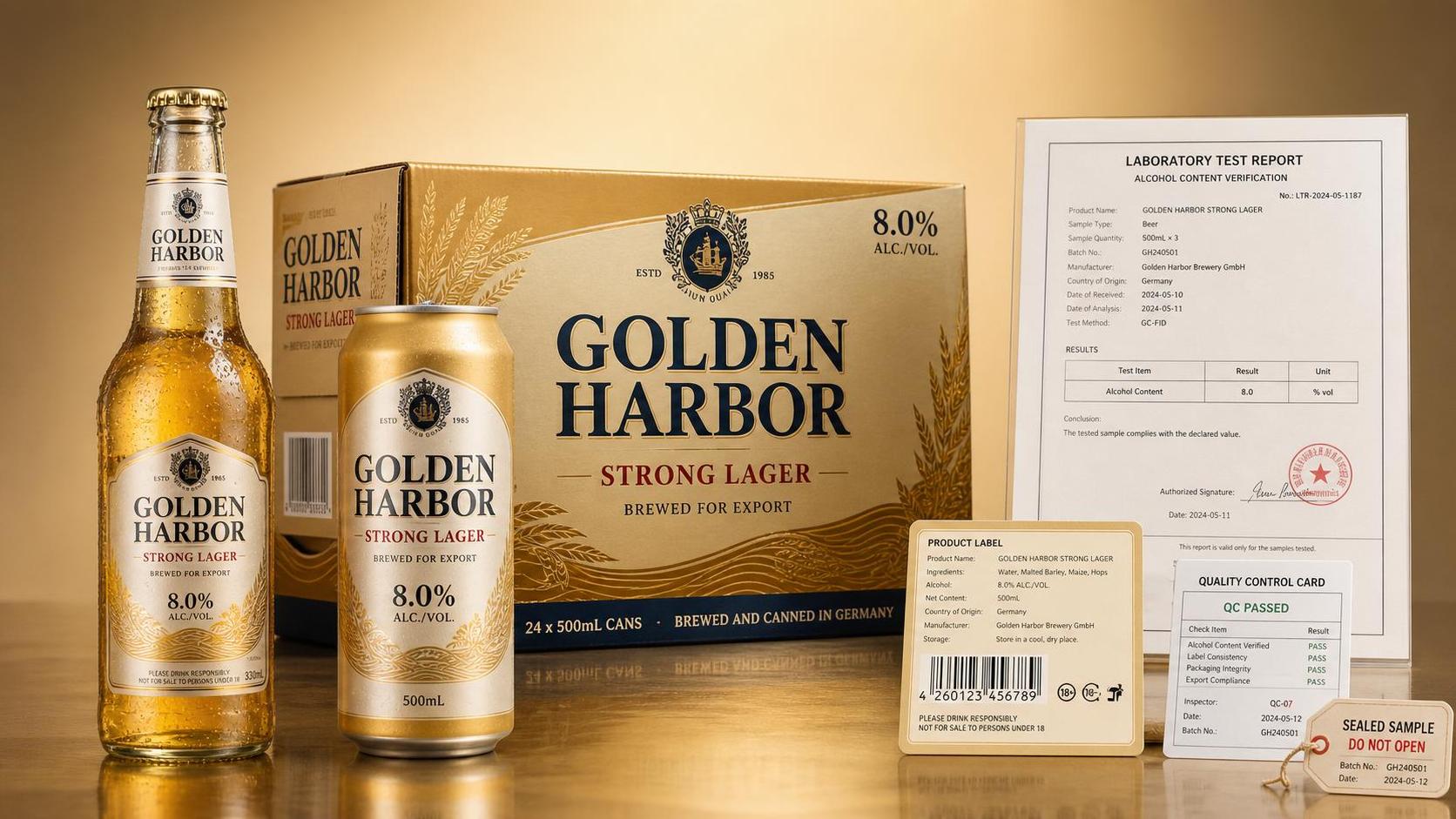
Why do strong lager beer labels need closer compliance review?
Strong lager beer usually sits under heavier scrutiny than standard lager because alcohol content changes both regulatory treatment and consumer risk expectations.
A small labeling error can travel far. It may affect customs clearance, shelf approval, online listing accuracy, and internal release decisions at the same time.
In practical terms, the most sensitive point is ABV. Once the declared strength is wrong, other checks often become unreliable too.
That is why strong lager beer labeling should be reviewed as a control point, not as a late-stage artwork task.
For businesses supplying multiple channels and export markets, this matters even more. A portfolio may include classic lager, wheat beer, low-calorie beer, fruit beer, and functional specialty lines.
When one production system supports OEM, ODM, wholesale, and customized orders, label governance needs to stay disciplined across every SKU.
What exactly should be checked around ABV on a strong lager beer label?
The obvious item is the printed alcohol percentage, but the real check is broader than one number.
ABV verification should connect formulation, lab result, packaging file, and destination-market rule. If one link is missing, the declared value may still be legally weak.
- Confirm the tested ABV matches the final packaged batch, not only the pilot or tank average.
- Check permitted tolerance ranges in the target market.
- Review whether ABV must be shown by volume, by specific wording, or with minimum font size.
- Make sure the same ABV appears on bottle, can, carton, case label, and digital product page.
A common mistake is relying on recipe intent. Strong lager beer may be designed at 7.5%, yet finished product variation can shift it outside the stated claim.
Another issue appears during market adaptation. Some countries accept one decimal style, while others require wording such as “alc./vol.” or equivalent legal text.
If the brand works with global retail and foodservice channels, those details should be approved before mass printing.
A quick judgment table for ABV-related label risks
The table below helps sort routine checks from higher-risk issues that often trigger rework or shipment delay.
Beyond alcohol content, which label items cause the most trouble?
ABV gets most of the attention, but strong lager beer compliance usually fails through a combination of smaller errors.
Ingredient listing is one example. Some formulas include flavoring, sweeteners, or functional additions that change how the product must be described.
Origin claims also deserve care. If brewing, filling, and brand ownership happen in different places, the label should reflect the legal position clearly.
Shelf-life coding, lot traceability, allergen declaration, importer information, and warning statements are frequent pressure points in export projects.
This is especially relevant when strong lager beer moves through supermarkets, bars, restaurants, and cross-border e-commerce at the same time.
More than one channel often means more than one label rule. The risk grows when the same base product is customized for private label customers.
- Check whether “beer,” “lager,” or “strong lager beer” is the compliant product name in that market.
- Review mandatory warnings for alcohol sale, age restriction, or pregnancy notice.
- Verify net content format and barcode linkage to the final label version.
How do market differences change the compliance approach for strong lager beer?
The main shift is that one compliant label does not guarantee another. Strong lager beer can be legally acceptable in one region and noncompliant in the next.
Some markets focus on alcohol declaration tolerance. Others pay more attention to language, health warnings, recycling marks, or importer details.
In actual operations, the safest method is building a market-by-market label checklist before design approval begins.
That checklist should not stay in regulatory files only. Packaging, production, sales support, and digital listing teams all need the same current version.
For a company with broad beer categories and international distribution, centralized review reduces duplication and prevents local edits from creating silent conflicts.
It also helps when customized projects are running in parallel. OEM and ODM orders often move fast, and label timelines can become compressed.
When time pressure rises, old artwork, untranslated warnings, or outdated importer details are more likely to slip through.
What should a market checklist include?
- Legal product name and category wording
- ABV format, tolerance, and display location
- Ingredient, allergen, and additive rules
- Mandatory warnings and age-related statements
- Traceability coding and importer or distributor information
- Artwork language, barcode, and pack-level consistency
Where do strong lager beer labeling mistakes usually start?
They usually begin earlier than expected. The root cause is often poor coordination, not a single technical error.
One team updates formulation. Another team keeps the old ABV on the carton. A third team publishes a different number online. None of those steps looks dramatic alone.
Together, they create a traceability gap that is hard to defend during inspection.
A frequent blind spot is version control. Strong lager beer for one retail chain may share similar branding with a bar channel SKU, yet the label requirements differ.
Another blind spot is assuming standard beer controls are enough. Higher-strength products may trigger stricter attention from regulators, platforms, or importers.
The more reliable approach is to use release gates. No print order, no filling plan, and no shipment booking should move ahead without label sign-off tied to the batch and destination.
What is a practical review process before release or shipment?
A workable process does not need to be complicated. It needs to be disciplined, traceable, and repeatable across all strong lager beer projects.
A short pre-release workflow often performs better than a large policy document that nobody uses during urgent production.
- Lock the approved formula and confirm final tested ABV.
- Match the batch data to label artwork and pack specifications.
- Review market-specific legal text, warnings, and importer details.
- Check all selling formats, including outer carton and online listing.
- Archive the signed version with revision date and shipment reference.
This kind of routine is useful for large-scale supply and for customized orders alike. It keeps strong lager beer labels consistent even when portfolio complexity increases.
Where multiple beer styles are produced under one system, structured review also prevents control habits from weakening on less frequent specialty runs.
What should be done next if label risk is already visible?
Start by separating critical issues from cosmetic ones. ABV mismatch, legal naming errors, and missing mandatory statements should be treated first.
Then trace where the inconsistency exists. It may appear only on e-commerce pages, or it may already affect physical packaging and warehouse stock.
For strong lager beer, the safest next step is a documented review against target-market rules, recent lab data, and the active packaging version.
If products move through international channels, align internal teams and external partners before reprinting or relisting. Partial correction often leaves hidden exposure.
In the end, strong lager beer compliance is less about one label line and more about building a reliable check path from brewing to distribution.
A useful next move is to map each SKU by ABV, market, pack format, and claim set, then create one approval standard for all future releases.
That gives stronger control over risk, shortens review cycles, and makes expansion into new channels much easier to manage.
Thank you very much for writing to us. Please leave your message and contact information, we will reply to you within 24 hours.