



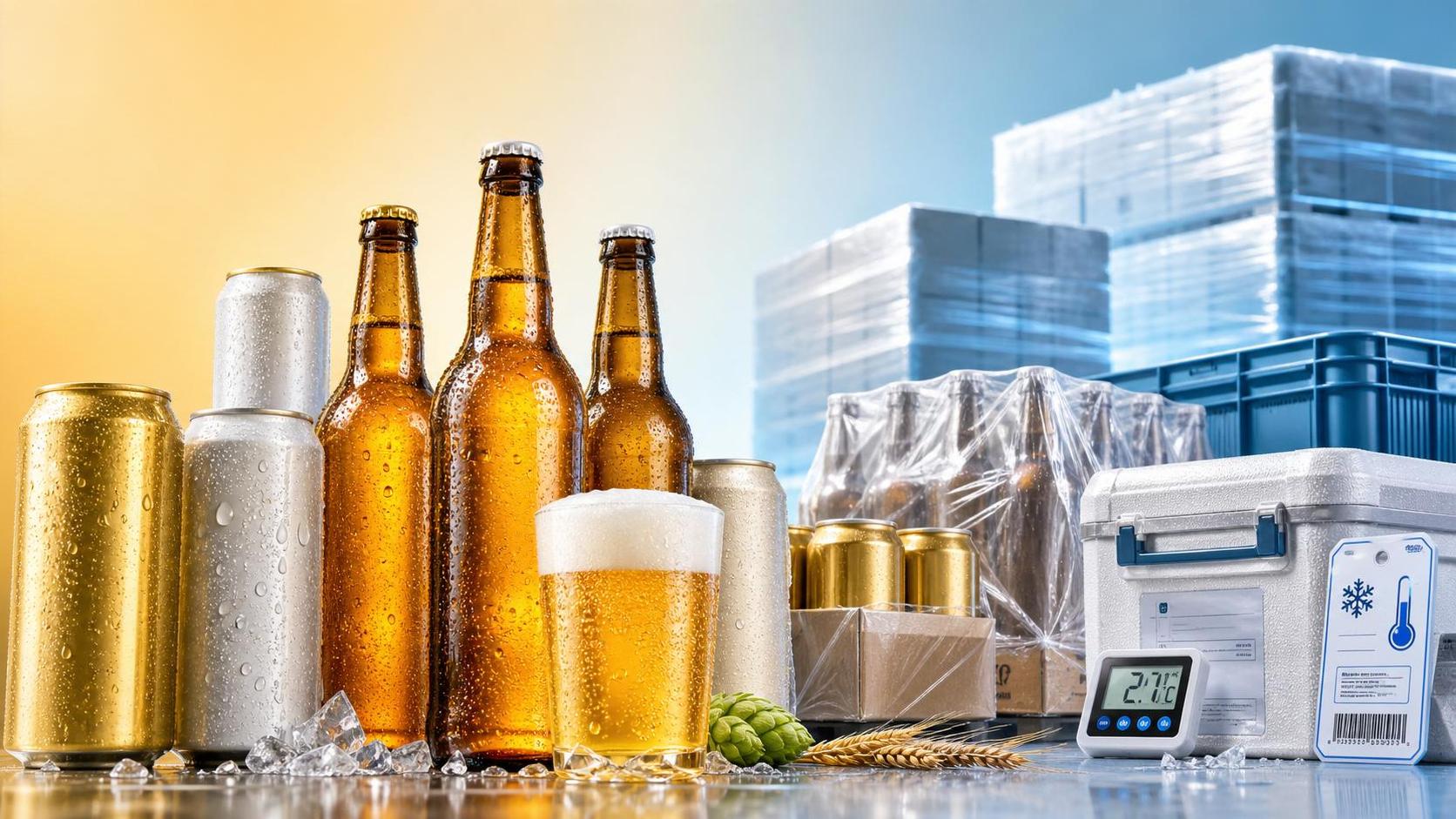
Why does lager beer shelf life vary so much in real distribution?
Lager beer shelf life is rarely defined by a date alone. Freshness changes through production, packaging, storage, transport, and retail handling.
That is why two batches with the same code may perform differently in the market. One keeps a clean profile, while another develops stale notes early.
In practical terms, lager beer freshness depends on oxygen pickup, light exposure, temperature shifts, microbial control, and package stability.
A stable recipe matters, but consistency after filling matters just as much. Shelf life is really the result of a controlled chain, not a single process step.
For breweries serving wholesale and retail channels, this becomes more important. Products move through supermarkets, bars, restaurants, warehouses, and mixed logistics routes.
Jinpai Beer works across classic lager and other craft categories, with OEM and ODM supply models. In that setting, shelf life management must support both flavor and operational reliability.
What actually shortens lager beer freshness first?
The first suspect is usually oxygen. Even small increases after fermentation or during filling can push lager beer toward papery, flat, or dull flavor.
Temperature is the next major driver. Warm storage speeds oxidation, weakens hop expression, and can exaggerate sweetness or harshness.
Light also matters, especially for transparent or green packaging. Lightstruck character can appear quickly and damage the expected clean lager profile.
Less obvious issues come from raw material variability. Malt freshness, hop storage, yeast health, and water consistency all influence how well lager beer holds up over time.
Then there is microbiological risk. Even when spoilage is not visible, low-level contamination may shift flavor, foam, haze, or package pressure during shelf life.
A simple way to frame it is this: freshness loss usually starts with oxygen and heat, but it accelerates when process variation is already present.
A quick judgment table for common shelf life threats
The table below helps compare the most common factors affecting lager beer in production and circulation.
Is packaging more important than recipe when protecting lager beer?
Not always more important, but often more decisive after production. A well-made lager beer can still lose freshness if packaging control is weak.
Cans usually provide strong protection from light and, when properly sealed, reliable barrier performance. Brown glass also performs well, but closure consistency remains critical.
Clear packaging creates a higher light risk unless distribution conditions are tightly managed. That choice may fit branding, but it requires stronger downstream control.
For lager beer supplied into different channels, packaging should match route length, turnover speed, and exposure risk. Short local circulation and export distribution should not use the same assumptions.
This is especially relevant in customized production. When a brewery handles OEM or private-label lager beer, package format is part of shelf life design, not just a commercial decision.
- Check package oxygen performance by format, not only by batch average.
- Review seam or closure data together with sensory retention results.
- Align package choice with export distance, seasonal heat, and retail display conditions.
How should storage and transport be judged before freshness complaints appear?
The common mistake is waiting for sensory complaints. By that point, lager beer freshness has already been lost somewhere in the chain.
A better approach is to evaluate exposure risk earlier. Warehouses, containers, loading docks, and retail back rooms often create the largest temperature spikes.
In actual operations, repeated warm-cool cycles can be more damaging than one short deviation. They speed aging and make product performance less predictable.
For lager beer moving through online and offline channels, route mapping helps. It shows where the beer sits longest and where environmental control is weakest.
This does not require a complex system at first. Start with a few measurable checkpoints and compare them against retain samples.
Useful checkpoints before complaints increase
- Record actual pallet temperatures during summer loading and unloading.
- Review transit duration against promised shelf life in each market.
- Keep market retain samples and compare them with brewery retain samples monthly.
- Check whether fast-turn bars and slow-turn supermarkets show different flavor outcomes.
What are the most common mistakes when estimating lager beer shelf life?
One mistake is treating all lager beer as equally stable. A sugar-free or low-calorie formula may age differently from a classic lager.
Another is setting a shelf life target before confirming distribution conditions. A realistic shelf life should reflect the market route, not only internal lab results.
Some teams rely too heavily on microbiological pass results. That matters, but flavor stability often fails earlier than safety indicators.
There is also a tendency to test only at ambient storage. For lager beer, accelerated and abuse-condition reviews can reveal hidden weaknesses faster.
The final mistake is separating production review from channel feedback. Complaint patterns, return data, and distributor observations often show shelf life stress before formal failure.
Quick FAQ signals worth reviewing
So what is the best way to set a reliable shelf life for lager beer?
The strongest method combines lab data, sensory review, packaging checks, and real channel simulation. Shelf life should be evidence-based and market-specific.
Start with a stable brewing baseline. Then confirm low oxygen packaging, closure integrity, microbial control, and retain sample performance over time.
After that, test lager beer under realistic storage conditions. Include the routes that matter most, especially export lanes, summer transport, and slower retail turnover.
For breweries supplying multiple product types, the process should be repeated by formula and package. What works for classic lager may not fit fruit beer or functional specialty lines.
A practical framework usually includes these steps:
- Define the target flavor window for lager beer, not just the legal sale period.
- Set acceptance limits for oxygen, package integrity, and microbiology.
- Validate storage assumptions with real transport and warehouse data.
- Review market feedback against retain samples on a fixed schedule.
In the end, lager beer shelf life is strongest when recipe control, filling precision, and distribution discipline support each other. That is what keeps freshness credible across retail and wholesale channels.
The next useful step is to map where freshness risk is highest in your current chain, then compare that risk against package type, route time, and actual storage exposure.
Thank you very much for writing to us. Please leave your message and contact information, we will reply to you within 24 hours.