



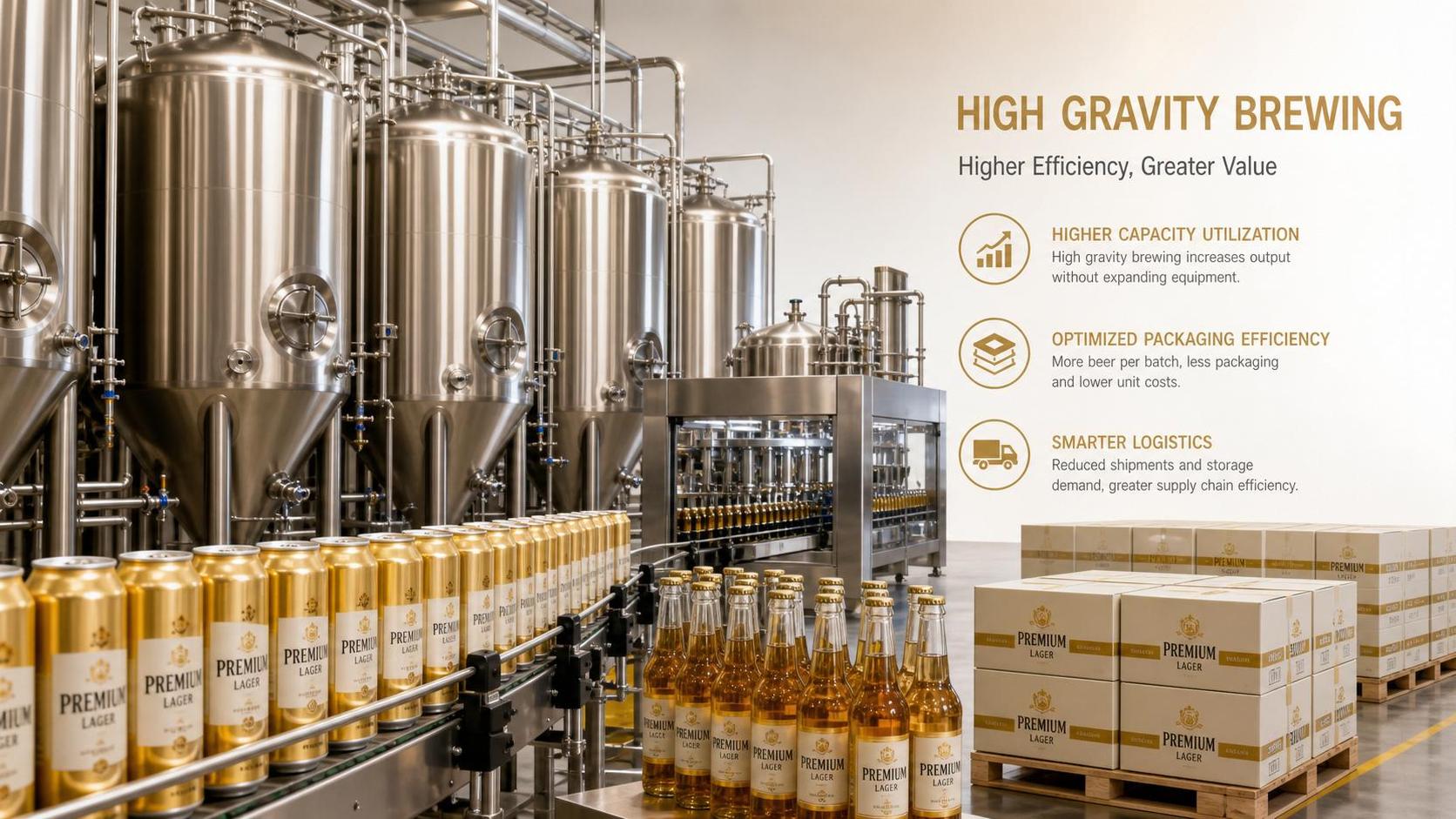
High-Gravity Lager Cost Savings: Where the Margins Improve
For finance decision-makers, High-gravity lager delivers more than brewing efficiency. It creates visible cost advantages across production, logistics, packaging and working capital.
By producing more beer from the same equipment, breweries can lower unit cost without expanding physical assets. That changes the margin equation quickly.
This matters even more when energy prices, freight rates and retail competition remain volatile. Buyers need savings that are measurable, repeatable and operationally realistic.
In practical sourcing terms, High-gravity lager can support better gross margin, stronger pricing flexibility and more efficient use of production capacity.
The key is knowing exactly where the savings come from, what assumptions must hold, and how to evaluate supplier capability before making a commitment.
Why High-Gravity Lager Changes the Cost Structure
High-gravity lager is brewed at a higher original extract, then adjusted to final strength later. That simple shift changes asset utilization in a meaningful way.
Instead of filling tanks with lower-strength beer from the start, breweries push more extract through the same brewhouse and fermentation system.
From a cost perspective, this raises output per batch. It also spreads fixed costs over a larger saleable volume.
That includes depreciation, labor scheduling, utilities baseline and facility overhead. When utilization improves, margin improvement often appears before revenue growth does.
This is why High-gravity lager is often discussed in procurement and sourcing reviews, not only in technical brewing conversations.
The Core Financial Logic
- More saleable volume from existing tanks and lines
- Lower fixed cost per liter
- Reduced packaging and freight cost per unit of alcohol output
- Better production flexibility during seasonal peaks
- Potentially lower capital pressure than capacity expansion
Where High-Gravity Lager Delivers Direct Cost Savings
The margin benefit of High-gravity lager is not theoretical. It usually shows up in four areas that can be modeled with real purchasing data.
1. Production Efficiency
Higher-gravity brewing increases output from the same brew length. The result is more finished beer without a matching increase in plant time.
In real operations, this can reduce the effective cost of tank occupancy, labor allocation and batch changeovers.
2. Packaging Cost per Saleable Volume
When output rises from the same process footprint, packaging assets are used more efficiently. That improves cost recovery on cans, bottles and filling lines.
For private label buyers and contract brands, High-gravity lager can improve the economics of each packaged unit shipped to market.
3. Logistics and Freight
More concentrated production can reduce transport cost per effective output, especially in bulk supply, OEM and cross-border distribution arrangements.
This becomes more attractive when freight is a large share of landed cost. Even modest efficiency gains can protect margin.
4. Capital Efficiency
A major advantage of High-gravity lager is postponing new equipment investment. Better use of current assets often beats immediate expansion.
For buyers evaluating contract production, this often means access to scalable volume without paying for someone else’s near-term capacity build.
A Simple Margin View Buyers Can Use
A useful procurement question is not whether High-gravity lager is cheaper in theory. It is whether the savings survive after adjustment, packaging and quality control.
That requires a full landed-cost comparison. Looking only at raw brewing cost is too narrow.
The biggest gains usually appear when volume is meaningful, demand is stable and supplier execution is mature. Without those conditions, savings may narrow.
What Can Reduce the Savings
High-gravity lager is financially attractive, but only when quality and process control stay consistent. Poor execution can erase the margin benefit.
Flavor and Consistency Risk
If the supplier lacks process expertise, dilution and flavor balance may become uneven. That can lead to customer complaints or repeat-order loss.
Utility Assumptions
Some buyers assume every High-gravity lager program cuts energy cost automatically. In reality, savings depend on brewhouse design, filtration and cold-chain handling.
Specification Misalignment
A low-cost quote means little if the final beer profile misses the intended market. Reformulation later can add hidden cost and delay launch timing.
This is why cost review should sit beside sensory review, shelf-life validation and channel fit, not replace them.
How to Evaluate a High-Gravity Lager Supplier
In actual procurement work, supplier selection determines whether High-gravity lager improves margin or simply shifts risk into operations.
A capable partner should show more than price. They should show process discipline, production range and commercial flexibility.
- Clear data on original gravity, yield and final product consistency
- Experience across lager, wheat, low-calorie and specialty beer categories
- OEM and ODM capability for private label or regional customization
- Stable packaging formats for supermarkets, bars and retail channels
- Documentation that supports export, wholesale and long-term supply planning
Jinpai Beer operates across R&D, production and distribution, with a portfolio that covers classic lager, German wheat, sugar-free low-calorie beer, fruit beer and functional specialty beers.
For buyers comparing supply models, that range matters. It supports channel diversification without fragmenting vendor management.
It also helps when a High-gravity lager program needs OEM, wholesale volume and tailored packaging under one operating framework.
When High-Gravity Lager Makes the Most Financial Sense
Not every project captures the same value. The strongest margin improvement usually appears in a few common business situations.
- Volume-led retail programs where unit economics matter more than niche positioning
- Export or cross-regional supply where freight efficiency affects landed cost
- Private label beer projects that need competitive pricing with stable quality
- Capacity-constrained periods when asset utilization is more valuable than expansion
- Multi-channel distribution where one supplier must support several pack and flavor strategies
From a financial review standpoint, High-gravity lager is often less about chasing the lowest invoice price and more about improving total delivered margin.
That distinction matters because the cheapest option on paper may cost more after freight, line inefficiency or product inconsistency are included.
A Practical Decision Framework
Before approving a High-gravity lager sourcing plan, focus on a short set of commercial checks that connect directly to margin.
- Compare total landed cost, not only ex-factory price
- Test whether flavor consistency matches the target market
- Confirm packaging formats align with channel requirements
- Review supplier flexibility for OEM, ODM and wholesale scaling
- Model savings under realistic freight, utility and volume assumptions
High-gravity lager works best when procurement, operations and commercial teams use the same cost model and the same product targets.
When that alignment exists, the savings are easier to verify and easier to defend internally.
For businesses seeking scalable beer supply, better asset efficiency and stronger cost control, High-gravity lager is a practical lever worth evaluating with an experienced production partner.
Thank you very much for writing to us. Please leave your message and contact information, we will reply to you within 24 hours.