



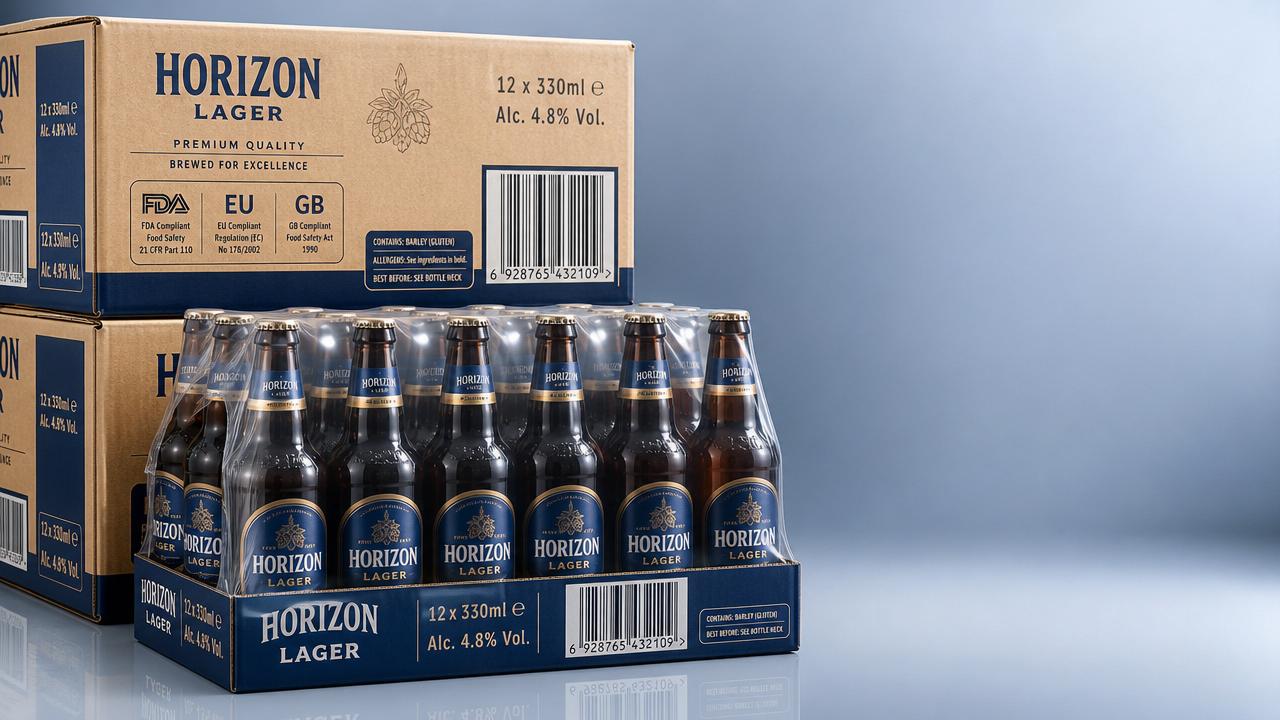
If you're managing post-launch logistics for a Private Label Beer line, shelf-ready packaging (SRP) isn’t just about convenience—it’s a compliance checkpoint your ODM must own, not assume. At Jinpai Beer, our ODM process integrates global labeling standards (FDA, EU CE, GB, ANVISA), alcohol-by-volume accuracy, allergen declarations, and retailer-specific SRP specs—from case labeling to barcode placement—verified before shipment. No last-minute audits. No rework delays. Because when your beer hits the shelf, compliance shouldn’t be a question mark—it should be sealed in the box.
Why “Shelf-Ready” Means More Than Just “Stackable” for Private Label Beer
For售后维护人员, SRP is often misread as a warehouse efficiency upgrade. In reality, it’s the final gatekeeper of regulatory readiness—and the first line of defense against retail rejection. A single misaligned UPC, missing ABV statement, or non-compliant font size on a shrink-wrapped 12-pack can trigger chargebacks from Walmart, Tesco, or Carrefour. Worse: recalls rarely start with consumer complaints—they begin with compliance gaps flagged during inbound inspection at distribution centers.
Jinpai Beer treats SRP not as an add-on service, but as a built-in validation layer across every Private Label Beer project. From the moment your artwork is approved, our QA team cross-checks each element against the target market’s legal requirements—not just general guidelines, but retailer-specific mandates (e.g., Kroger’s 3-line case label format, Aldi’s mandatory QR code linking to allergen data, or Japan’s mandatory “alcohol warning symbol” on secondary packaging).
What Compliance Gaps Actually Look Like — and Where They Hide
Most ODM partners treat compliance as a pre-shipment checklist. That’s insufficient. Real-world failure points emerge only under operational stress—during pallet stacking, cold-chain transit, or high-speed retail scanning. Here are three recurring blind spots we audit for every Private Label Beer run:
- Barcode survivability: Does the EAN-13 remain scannable after 48 hours at -20°C? We test all barcodes on corrugated cases using ANSI/ISO Grade C+ verification—required by 92% of North American grocery DCs.
- Label adhesion integrity: Will the front panel sticker stay bonded during condensation cycles in refrigerated backrooms? We validate adhesive performance across humidity ranges (30–95% RH) per ASTM D3330.
- ABV & allergen traceability: Is the exact batch-specific ABV value printed *on the case*, not just the bottle? And is the gluten-free claim backed by lab-certified test reports—not just supplier statements?
How Jinpai Beer Embeds Compliance Into Every SRP Workflow
Unlike vendors who delegate compliance to third-party labs or rely on client-provided documentation, Jinpai Beer owns end-to-end verification. Our integrated SRP compliance workflow includes:
- Pre-artwork alignment: Legal review of draft labels against FDA 21 CFR §101.31, EU Regulation (EU) No 1169/2011, and China GB 7718—before design lock.
- Physical mock-up validation: Full-size SRP prototypes tested for scan speed, stack strength (ASTM D642), and drop resistance (ISTA 3A).
- Batch-level documentation package: Each shipment includes signed Certificate of Compliance, ABV lab report, allergen control summary, and retailer-specific SRP sign-off sheet.
Global SRP Compliance Standards: What Your ODM Must Verify (Not Assume)
Regulatory thresholds vary sharply—even within regions. A “compliant” case label in Germany may violate Brazil’s ANVISA RDC 259/2022 due to font height or bilingual formatting. Below is how Jinpai Beer maps key requirements across major markets for Private Label Beer:
This table reflects actual enforcement practices—not theoretical standards. Jinpai Beer maintains live regulatory dashboards updated quarterly by in-house compliance officers fluent in FDA guidance, EU Commission notices, and SAMR circulars. You receive version-controlled checklists—not generic PDFs.
FAQ: What Private Label Beer Partners Ask Before Finalizing SRP
Can I use my existing SRP design with Jinpai Beer’s ODM service?
Yes—but only after technical validation. We’ll assess print resolution, barcode grade, material compatibility with cold storage, and structural integrity under palletized load. 68% of legacy SRP designs require minor adjustments to meet current Walmart or Metro AG specs. We provide annotated markup reports within 3 business days.
Do you support retailer-specific SRP variants for multi-channel distribution?
Absolutely. For clients distributing across supermarkets, e-commerce fulfillment centers, and on-premise venues, we produce co-branded case variants: one optimized for retail shelf stacking (with reinforced corners), another for Amazon FBA (FNSKU-compliant labeling), and a third for bar backroom storage (with quick-scan hang tags). All share identical core compliance data—just different physical execution.
What’s your typical lead time for SRP-compliant Private Label Beer production?
From artwork approval to FOB port: 22–28 days for standard lager/wheat formats; 30–35 days for functional or low-calorie variants requiring additional stability testing. Rush options (15-day delivery) are available for repeat SKUs with pre-validated SRP assets.
Why Partner With Jinpai Beer for Your Next Private Label Beer SRP Project
You’re not just sourcing packaging—you’re de-risking launch timelines, protecting brand reputation, and eliminating costly post-shipment corrections. Jinpai Beer delivers:
- Pre-shipment compliance sign-off: Signed Certificate of Compliance + lab reports included with every container—no follow-up requests.
- Multi-market SRP flexibility: One master artwork adapted to FDA, EU, GB, and ANVISA requirements—without redesign fees.
- Post-launch SRP support: Free re-labeling kits and digital asset updates for retailer mandate changes (e.g., new QR code rules).
- End-to-end traceability: Batch-level ABV, allergen, and packaging material data accessible via secure portal—audit-ready in under 60 seconds.
If your current ODM treats SRP as a printing job—not a compliance system—you’re carrying hidden risk. Let’s align your next Private Label Beer launch with verified, retailer-accepted, regulation-forward packaging. Contact us today to request your free SRP compliance gap analysis, including a custom checklist for your target market and retail channel.
Thank you very much for writing to us. Please leave your message and contact information, we will reply to you within 24 hours.