



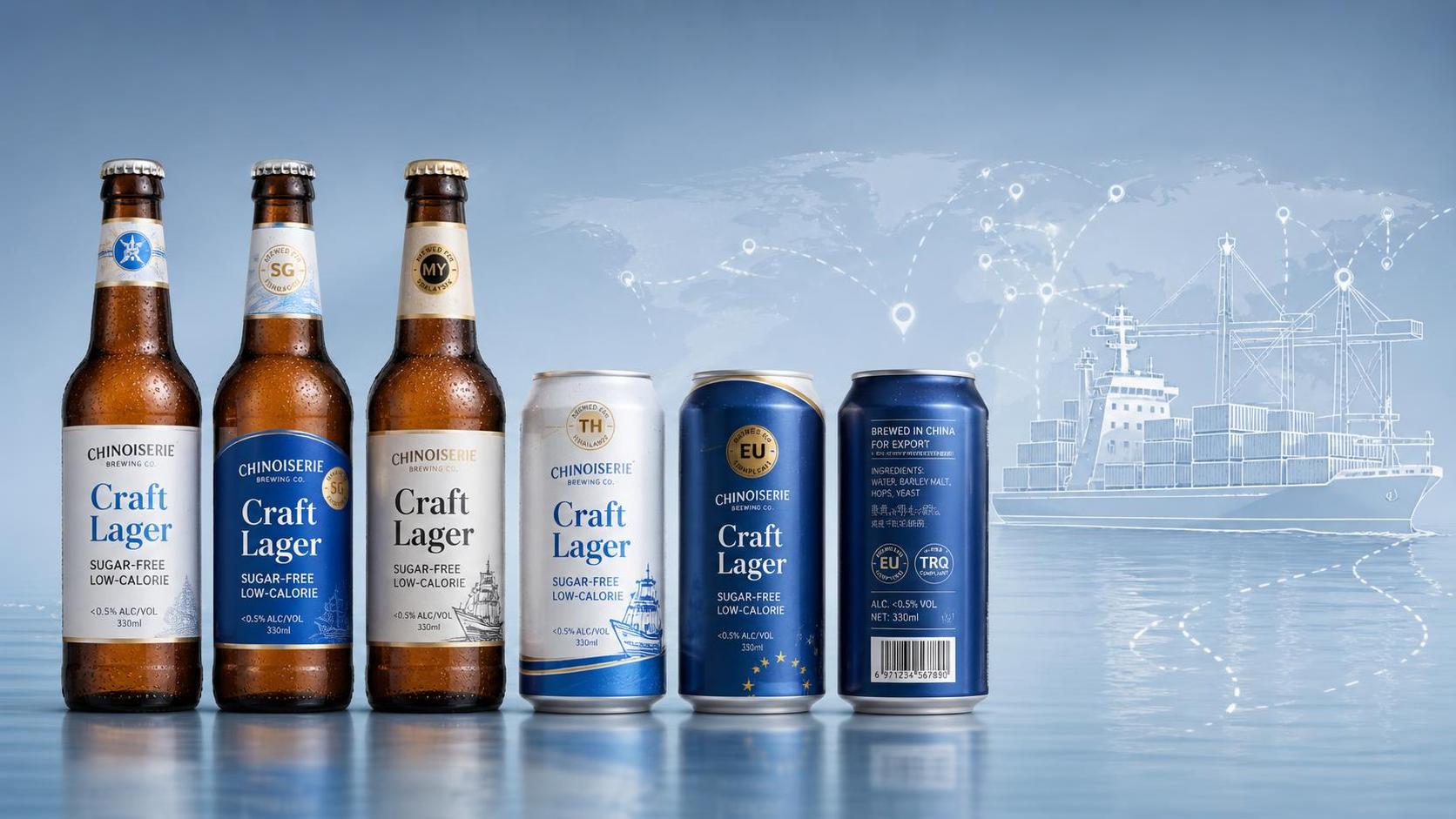
Export performance of a Chinese beer factory is not a uniform metric—it fractures along jurisdictional lines, revealing sharp operational divergences between regions governed by volume-based trade instruments and those enforcing production-localization mandates. In the European Union, access hinges on tariff-rate quotas (TRQs) applied to beer imports under WTO commitments, where volumes up to a threshold enter at 0% duty, while quantities beyond trigger significantly higher tariffs—often exceeding 10%. This creates a hard ceiling on cost-competitive volume deployment. In contrast, Southeast Asian markets—including Vietnam, Thailand, and Indonesia—apply local content rules that rarely appear in customs schedules but operate through domestic excise frameworks, labeling regulations, and distribution licensing conditions. These do not cap volume; instead, they constrain how much value must be added locally before final sale: minimum thresholds for domestic packaging, local ingredient sourcing, or even in-country bottling registration.
The distinction is structural, not semantic. A TRQ is a customs-administered gate: predictable, calendar-driven, and externally visible. Local content rules are embedded in national tax codes and food safety decrees—less transparent, more discretionary, and enforced downstream. For a Chinese beer factory exporting craft lager or sugar-free low-calorie variants, this means EU entry planning centers on quota allocation timing, third-country cumulation options, and annual import license applications filed months ahead of shipment. Southeast Asia demands parallel investment in local compliance infrastructure: registered local entities, licensed bottling partners, and traceable procurement records for hops, malt, or adjuncts sourced within the region—even if only for labeling compliance rather than functional reformulation.
Logistics reveal further asymmetry. EU-bound shipments from China typically move via consolidated container loads to Rotterdam or Hamburg, with customs clearance tied to proof of origin (Form A or REX) and TRQ certificate validation. Delays most often occur during quota exhaustion periods—particularly in Q4, when demand spikes for seasonal lagers—and require real-time monitoring of quota fill rates published by the European Commission. No such centralized dashboard exists for Southeast Asia. Instead, bottlenecks emerge at port-of-entry inspection, where customs may request documentation verifying local content percentages—not as a pre-clearance requirement, but as a post-import audit trigger. This shifts risk from upfront denial to retrospective penalty exposure, including retroactive excise assessments or label rework costs.
Product formulation responds differently across these regimes. In the EU, recipe integrity remains largely unchallenged: German wheat or fruit-flavored beers can enter unchanged, provided labeling meets EU Regulation (EU) No 1169/2011 on food information. Alcohol-by-volume tolerance, allergen declarations, and country-of-origin font sizing are enforceable, but no rule compels reformulation for market access. Southeast Asia introduces material-level friction. Thailand’s excise law, for instance, applies differential rates based on malt content and fermentation method—creating incentive structures that favor certain base recipes over others. Vietnam’s Decree 15/2018/ND-CP requires all imported beer labels to list domestic repackaging facilities, pushing factories toward dual-packaging strategies: one configuration for direct retail sale, another for repackaged distribution via local partners. Functional specialty beers—those with added botanicals or vitamins—face additional scrutiny under ASEAN’s harmonized food additive standards, where permitted substances and maximum usage levels differ from China’s GB standards.
Supply chain visibility requirements also diverge. The EU mandates full traceability only for food safety recalls under Regulation (EC) No 178/2002—not for routine trade. Documentation suffices: batch numbers, production dates, and supplier declarations. Southeast Asia increasingly ties traceability to tax eligibility. Indonesia’s e-BPOM system requires digital submission of raw material origin data for products claiming “local content” status, linking supply chain records directly to excise rate application. This forces Chinese exporters to map not just their own production steps, but upstream tiers of malt suppliers or yeast propagation labs—data many craft-focused breweries do not routinely collect or retain beyond internal quality logs.
Margin sustainability depends less on headline duty rates than on secondary compliance costs. In the EU, these include TRQ administration fees (typically €50–€120 per certificate), third-party origin verification services, and potential storage costs during quota wait periods. In Southeast Asia, recurring expenses accrue from local agent retainers for regulatory liaison, annual facility registration renewals, and periodic audits of local content claims—costs that scale with product SKUs, not shipment volume. A single fruit-flavored beer SKU may trigger separate reviews in three ASEAN countries due to differing definitions of “natural flavor” and “added sugar,” whereas its EU counterpart faces one harmonized standard.
Scalability is thus path-dependent. Growth in the EU follows a step-function curve: steady until quota exhaustion, then abrupt cost inflection. Expansion requires either quota acquisition partnerships (e.g., joint ventures with EU-based importers holding historic allocations) or strategic diversification into non-quota categories like non-alcoholic beer, which falls outside the TRQ scope entirely. Southeast Asia growth is iterative: each new market demands localized operational scaffolding—separate registrations, distinct labeling templates, and calibrated excise calculations—making regional rollout slower per market but less subject to sudden external constraints. Neither path eliminates complexity; they merely relocate it—from border control points to inland regulatory nodes.
Operational resilience emerges not from avoiding regulation, but from designing flexibility into core processes: modular labeling systems capable of rapid field updates, batch-level documentation structured for both EU origin tracing and ASEAN content verification, and formulation protocols that anticipate additive or ingredient substitutions without compromising sensory profile. The divergence between EU tariff quotas and Southeast Asian local content rules does not reflect competing philosophies of trade policy alone—it reveals fundamentally different conceptions of where value addition occurs, and therefore where regulatory authority legitimately resides.
Thank you very much for writing to us. Please leave your message and contact information, we will reply to you within 24 hours.