



What Sets a Truly Competitive Chinese Beer Factory Apart in Global Contract Brewing?
For international distributors, agents, and importers evaluating contract brewing partners in China, the headline question isn’t “Can they brew beer?” It’s: Can they brew your beer—reliably, repeatedly, and without risk—across borders, channels, and calendar years?
Too many procurement conversations begin with cost per hectoliter—and end with batch-to-batch variation, delayed certifications, or an unexpected trademark conflict in a target market. That’s not failure of execution. It’s misalignment of expectations with operational reality. A competitive Chinese beer factory today isn’t defined by scale alone, nor by low labor costs. It’s measured by three interlocking capabilities: quality consistency across geographies and time; scalability that responds to your demand—not just your forecast; and an IP protection framework that operates with legal rigor, not goodwill.
Consistency Isn’t a Feature—It’s the Threshold for Entry
In craft and specialty beer, “consistency” is often mistaken for “sameness.” It’s not. It’s the ability to reproduce sensory profiles, microbiological stability, and physical parameters—within narrow, pre-agreed tolerances—across production runs spanning months or years, under varying ambient conditions and regulatory oversight.
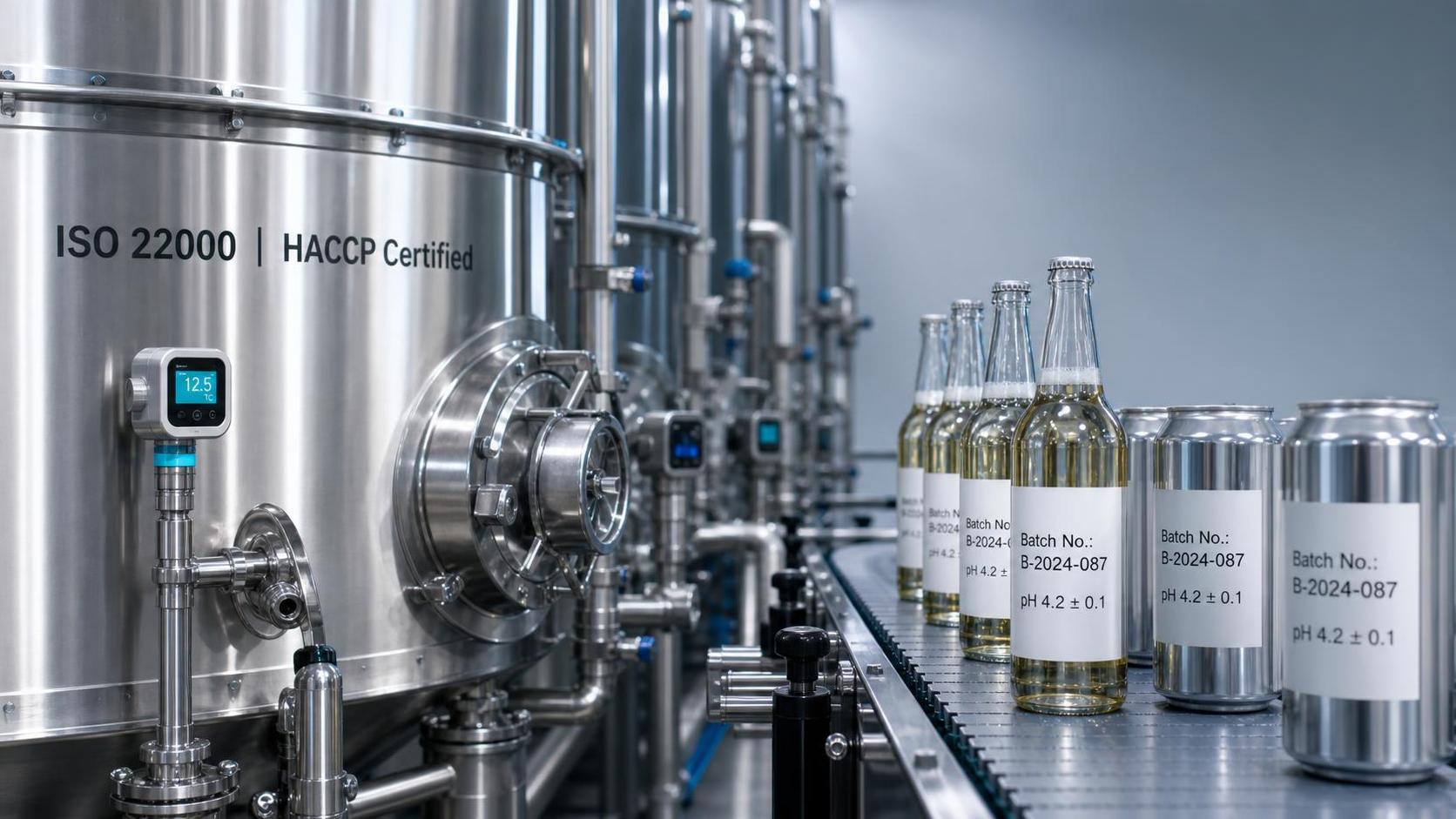
Many Chinese breweries meet national food safety standards (GB 4927, GB 2758), but global distribution demands more: HACCP-certified process control, ISO 22000-aligned documentation, and real-time traceability from malt lot to pallet shipment. More critically, it requires calibrated sensory panels trained against international reference standards—not internal benchmarks. A distributor sending sugar-free low-calorie lager into EU retail chains needs verified residual sugar ≤ 0.5 g/L, not “under 1 gram.” A bar group launching a seasonal fruit sour in Australia needs pH and titratable acidity retested per batch—not assumed from prior runs.
The gap? Some factories treat consistency as a QA checkpoint at the end of the line. The competitive ones embed it upstream—in water chemistry management, yeast propagation protocols, cold-chain validation for finished goods, and raw material qualification that includes third-party heavy metal and pesticide residue testing—not just supplier declarations.
Scalability Must Mean Agility—Not Just Capacity
“We can produce 50,000 HL/year” tells you little about whether a factory can support your launch strategy. What matters is how quickly—and cleanly—they pivot between volumes, formats, and compliance regimes.
Consider this scenario: You pilot a functional ginger-turmeric IPA in Canadian specialty stores (300 cases, 473 mL cans, Health Canada-compliant labeling). Six months later, demand surges—you need 5,000 cases/month, now in 330 mL bottles for UK pubs, with full UKCA marking and allergen statement revisions. Can your partner execute that transition without reformulation, label reprints, or customs hold-ups?
True scalability here means modular production lines (not just shared tanks), flexible packaging partnerships with certified can/bottle suppliers, and regulatory intelligence embedded in their operations—not outsourced to consultants on retainer. It also means inventory buffers calibrated not to annual forecasts, but to your channel-specific lead times: supermarket replenishment cycles differ from e-commerce flash-sale rhythms, which differ again from bar keg turnover.
One red flag: factories that require minimum order quantities (MOQs) tied to annual volume commitments rather than per-SKU run economics. That forces distributors into speculative inventory—or compromises on freshness and shelf-life integrity.
IP Protection Is Not About NDAs—It’s About Architecture
An NDA signed in English and Mandarin is table stakes. What separates reliable partners is how IP is structured into daily operations: from formulation ownership to packaging asset control to export documentation stewardship.
Ask concrete questions:
- Who owns the final recipe file—including process notes, yeast strain identifiers, and water mineralization specs—if collaboration ends?
- Are proprietary flavor compounds sourced under dual-supplier agreements, or does your formula depend on a single vendor the factory controls?
- When labels are printed, who holds the plate masters and digital assets—and are those files stored on servers compliant with your jurisdiction’s data residency rules?
- If a customs authority requests formulation disclosure (e.g., for alcohol duty classification), does the factory share only what’s legally required—or default to full transparency without your written consent?
A robust IP framework treats brand equity as a co-managed asset—not a transactional input. It includes version-controlled master documents, audit trails for any formulation change (even minor pH adjustments), and clear escalation paths if a third party attempts to replicate your product using shared logistics or labeling vendors.
What This Means for Your Next Sourcing Decision
You’re not choosing a brewery. You’re selecting an extension of your own quality, compliance, and brand teams—operating 8,000 km away, under different regulatory pressures, and subject to distinct supply chain frictions.
That shifts due diligence away from factory tours and toward operational interrogation:
- Request batch records—not summaries—for two recent non-identical SKUs (e.g., a hazy IPA and a gluten-reduced lager). Look for deviation logs, corrective actions, and third-party lab reports—not just pass/fail stamps.
- Test their responsiveness to complexity: Ask how they’d handle a last-minute label amendment for a new allergen declaration in Japan—then verify timelines against actual past incidents (not hypotheticals).
- Map their certification ecosystem: ISO 22000 is necessary—but does their BRCGS certification cover packaging? Does their organic certification (if claimed) extend to export markets’ equivalency requirements?
And crucially: assess how they talk about failure. Do they speak in terms of root-cause analysis and systemic correction—or isolated incidents and “unforeseen circumstances”? The former signals institutional learning. The latter, operational fragility.
Jinpai Beer operates within this reality—not as an exception, but as a reflection of evolving industry discipline. Their OEM/ODM work spans German-style wheat beers requiring precise ester profiles, sugar-free variants validated for diabetic associations, and fruit-infused releases where microbiological stability must coexist with volatile aroma retention. Each demands different levers of consistency, different scalability triggers, and different IP boundaries. Their infrastructure reflects that—not as marketing copy, but as documented process design.
For distributors weighing partnerships in Asia, the question isn’t whether Chinese beer factories can compete globally. They already do. The sharper question is whether yours can operate as if your brand’s reputation—and your customers’ trust—depends on every liter shipped. Because in beer, it does.
Thank you very much for writing to us. Please leave your message and contact information, we will reply to you within 24 hours.