



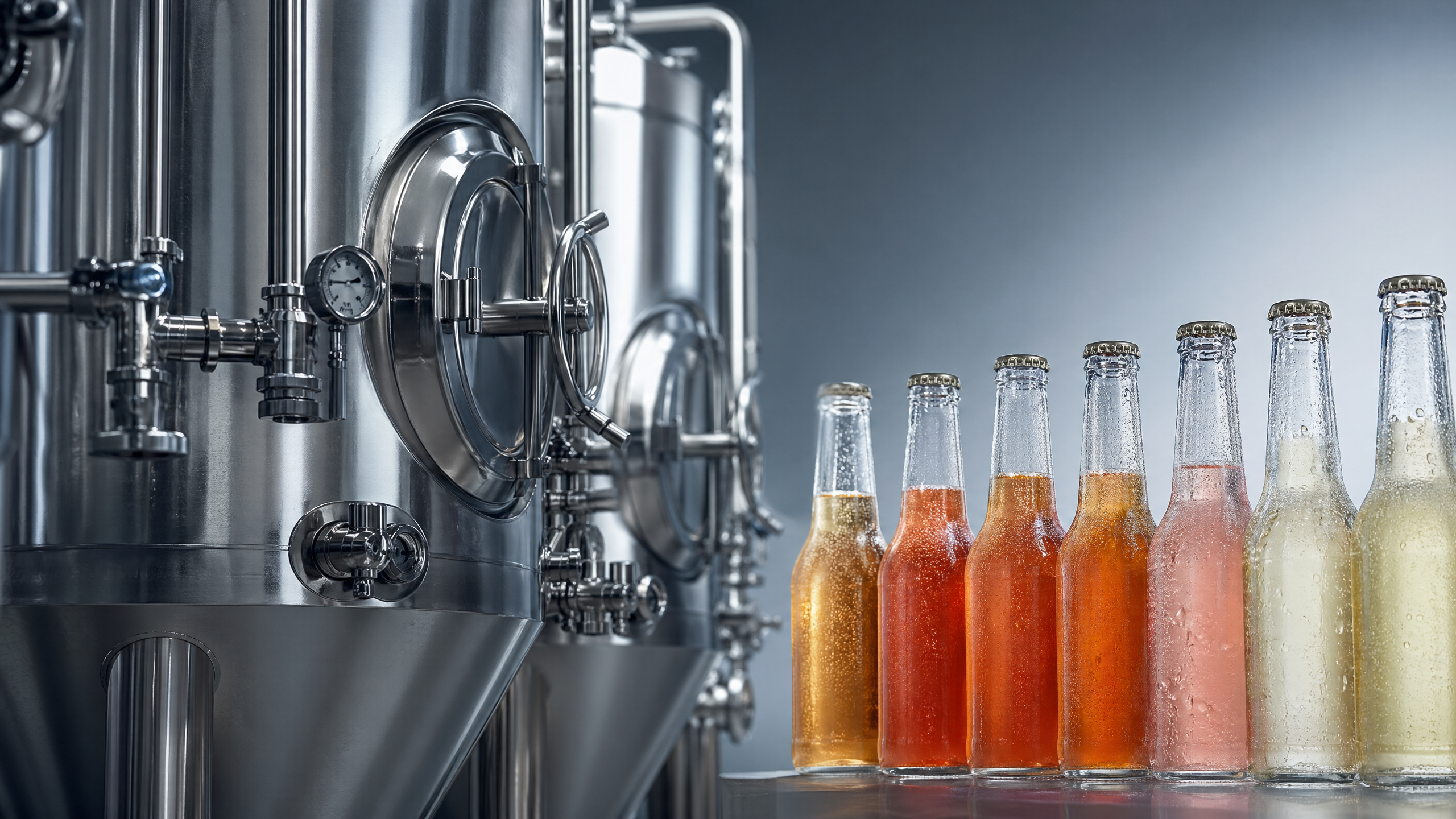
North American brewery beer OEM: When co-packer certifications don’t cover your yeast variant
When sourcing a North American brewery for beer OEM, co-packer certifications often fall short—especially for proprietary yeast strains or functional specialty beers. Jinpai Beer, a full-service brewing partner with expertise in custom beer manufacturing, bridges this gap for global clients: from Asia beer contract manufacturer needs to European craft brewery collaborations, Latin American brewery scalability, and beyond. Our beer ODM and private label beer production support sugar-free, fruit-flavored, and German wheat variants—all backed by rigorous quality control and flexible brewery outsourcing. Ideal for procurement teams, distributors, and enterprise decision-makers seeking certified, compliant, and innovative beer OEM solutions.
Why “Certified Co-Packer” ≠ “Yeast-Variant Ready” — And Why It Matters to Your Procurement Decision
For procurement professionals and enterprise decision-makers evaluating North American beer OEM partners, a common assumption is that “certified co-packer” automatically means “ready for your unique formulation.” In reality, most standard food safety certifications (SQF Level 2, BRCGS, FDA registration) cover process hygiene, allergen control, and traceability—but they say nothing about biological validation of non-standard yeast strains, fermentation kinetics of functional ingredients, or stability testing for novel beer matrices.
This gap becomes critical when you’re scaling a proprietary sour ale with a house-cultured Lachancea thermotolerans strain, launching a probiotic-infused German wheat, or commercializing a low-ABV functional beer with added botanicals. Standard co-packers often decline such projects—or worse, accept them without dedicated strain propagation protocols, leading to batch inconsistency, off-flavors, or shelf-life failure.
Jinpai Beer operates under a different model: we treat yeast not as a commodity ingredient, but as an active R&D variable. Every client’s proprietary strain undergoes a 3-phase validation cycle—lab-scale fermentation profiling, pilot-batch stress testing (temperature, oxygen, pH), and full-scale inoculation protocol development—before production begins. This isn’t an add-on service; it’s built into our OEM/ODM engagement framework.
What You Actually Need in a Brewery Partner (Beyond Paper Certifications)
Based on real-world engagements with distributors across LATAM, APAC, and EMEA, here’s what procurement and business evaluation teams consistently rank as non-negotiable:
- Strain-Specific SOPs: Not just “yeast handling procedures,” but documented, version-controlled protocols for your exact strain—including propagation media specs, pitching rate calibration, and viability monitoring windows.
- Functional Ingredient Compatibility Testing: Especially for sugar-free formulations where alternative sweeteners (e.g., allulose, erythritol) interact unpredictably with yeast metabolism and foam stability. We’ve validated over 17 non-fermentable sweetener systems—and one of our top-performing variants is our Sugar-Free Low-Calorie Beer, designed for clean attenuation and stable carbonation without artificial aftertaste.
- Cross-Region Compliance Mapping: A single batch destined for Canada, Mexico, and Germany requires three distinct labeling frameworks, alcohol-by-volume rounding rules, and additive approvals (e.g., E-numbers vs. GRAS). Jinpai maintains live regulatory dashboards updated quarterly—not just for US FDA, but Health Canada, COFEPRIS, and EU EFSA requirements.
- Scalability Without Reformulation: No “pilot-batch success → full-scale failure” surprises. Our brewhouse is modular (3–30 HL fermenters), allowing seamless transition from 500-case test runs to 5,000-case monthly commitments—without re-optimizing yeast health or filtration parameters.
How Jinpai Supports Global Clients Where Traditional Co-Packers Stop Short
Unlike North American co-packers constrained by legacy equipment and narrow SKU portfolios, Jinpai was built for technical flexibility. We don’t just brew *to* your spec—we co-develop the spec *with* you.
For example: A European craft brand approached us with a wild-fermented Berliner Weisse using a rare Pediococcus damnosus isolate. Their prior US co-packer rejected it due to “unverified microbiological risk.” At Jinpai, we collaborated with their lab to sequence the strain, replicated its acidification profile in our pilot system, and co-authored a pathogen exclusion report accepted by both US FDA and EU authorities. The result? A compliant, scalable, trademarked product now distributed across 12 countries.
Similarly, when a Southeast Asian distributor needed rapid entry into the health-conscious segment, we co-formulated a line of functional specialty beers—including a ginger-turmeric IPA with clinically studied turmeric extract—and handled full regulatory dossier preparation for Singapore’s HSA and Thailand’s FDA. No third-party consultants. No delays.
Making the Right Choice: 3 Questions Your Team Should Ask Before Signing an OEM Agreement
Before committing to any brewery partner—North American or otherwise—ask these questions. If the answer is vague, deferred to “our QA team will advise later,” or lacks concrete examples, proceed with caution:
- “Can you share your last three strain-specific validation reports—and confirm whether those were conducted in-house or outsourced?” (In-house capability = faster iteration, tighter IP control.)
- “How do you handle stability testing for non-traditional beer matrices—e.g., high-fruit-content sours or nitrogenated low-calorie lagers?” (Look for accelerated shelf-life studies at multiple temperatures, not just “6-week ambient hold.”)
- “What’s your average time-to-first-batch for a new yeast variant, and what’s included in that timeline?” (At Jinpai, it’s 14–18 days—from strain receipt to first packaged sample—because fermentation profiling and packaging compatibility are run in parallel, not sequentially.)
In summary: Certification is table stakes. What separates a true strategic OEM partner from a transactional co-packer is the ability to treat your yeast—not as a checkbox—but as the core intellectual property of your beer. Jinpai Beer delivers that capability end-to-end: from strain onboarding and functional formulation to global compliance, scalable production, and long-term partnership infrastructure. For procurement leaders, distributors, and enterprise decision-makers, this means lower technical risk, faster time-to-market, and the confidence to launch innovations—not just imitations.
Thank you very much for writing to us. Please leave your message and contact information, we will reply to you within 24 hours.