



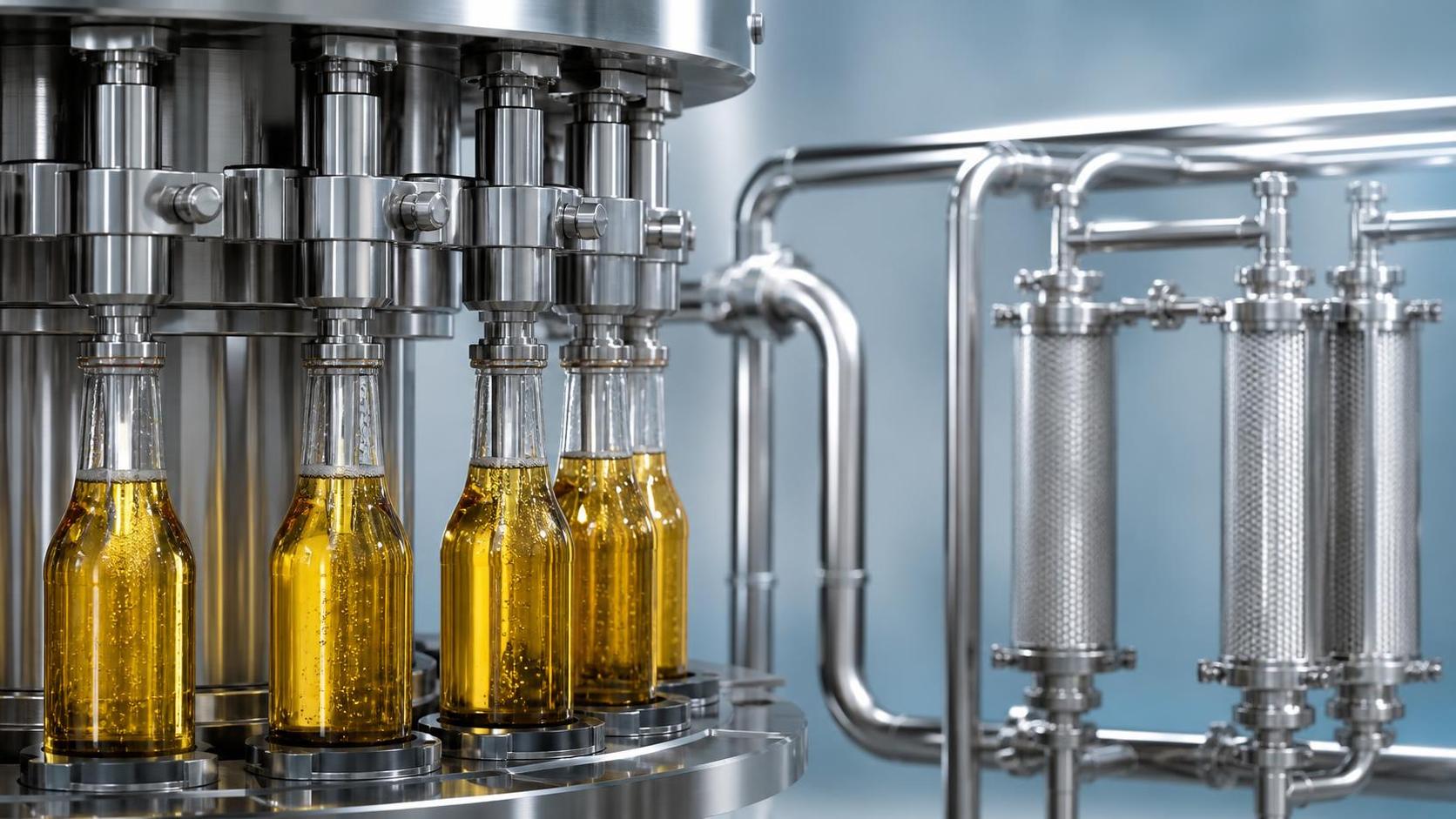
It starts with a shared tank. A malt drink factory repurposes its pasteurization line for a new craft beer co-packaging run. The sanitation logs look clean. The CIP cycle runs full-length. The microbiological swabs from yesterday’s non-alcoholic barley beverage batch came back negative. So why, three days into cold storage, does the first pallet of lager show faint pellicle formation in sample bottles—and a sour, barnyard note no one signed off on?
This isn’t theoretical. It’s what happens when hygiene protocols built for malt drinks are carried over—unadjusted—into beer production. Not because anyone cut corners, but because the underlying biological realities differ sharply: live fermenting yeast, residual sugars that feed wild microbes, extended refrigerated shelf life, and zero tolerance for Brettanomyces bruxellensis or Lactobacillus brevis in final product. At Jinpai Beer, where we develop and produce craft beer across styles—from classic lager to functional specialty beers—we’ve seen this misalignment stall launches, trigger rework, and erode trust in OEM partnerships. The issue isn’t equipment cleanliness alone. It’s how microbial risk is defined, measured, and controlled at each stage.
Where Malt Drink Hygiene Stops Short for Beer
A malt drink factory operates under different biostability assumptions. Its products are typically heat-treated, low-ABV or non-alcoholic, and formulated for rapid turnover. Pasteurization targets spoilage organisms like Acetobacter and Zygosaccharomyces, but rarely accounts for anaerobic, ethanol-tolerant yeasts that thrive below 4°C. In contrast, craft beer—especially unfiltered, unpasteurized, or bottle-conditioned variants—carries viable Saccharomyces cerevisiae or pastorianus through packaging. That same environment becomes fertile ground for Brettanomyces if even trace contamination persists in hoses, gaskets, or filler nozzles.
Microbial load thresholds also diverge. A malt drink line may accept ≤10 CFU/mL post-CIP based on sensory stability over 30 days. But for beer held at 2–6°C for 90+ days, that same level can seed detectable spoilage within 14 days—especially when Brettanomyces forms biofilms in stainless steel crevices that standard alkaline-peroxide CIP doesn’t fully disrupt. And unlike malt drinks, beer lacks preservatives or pH suppression to inhibit growth post-filling. The risk isn’t just flavor drift—it’s irreversible product loss and brand exposure.
Pasteurization: Not Interchangeable, Not Optional
If your facility uses flash pasteurization for malt drinks, don’t assume it applies directly to beer. Malt drinks often undergo HTST (high-temperature short-time) at 72°C for 15 seconds—sufficient to inactivate vegetative bacteria and yeasts in low-acid, low-ethanol matrices. Beer requires either higher temperature (e.g., 75–78°C), longer hold time (20–30 seconds), or both—particularly for high-gravity or fruit-infused batches where viscosity slows heat transfer. More critically, beer pasteurization must account for package type: glass bottles demand slower ramp-up to avoid thermal shock; kegs require uniform flow velocity to prevent channeling. Without validation runs using thermocouple mapping and D-value calculations specific to Brettanomyces (D75°C ≈ 2.8 min vs. D75°C ≈ 0.4 min for S. cerevisiae), you’re not achieving log-reduction—you’re assuming it.
Microbial Load Control: Beyond Swab Tests
Routine surface swabs tell only part of the story. They miss biofilm-embedded cells and fail to distinguish between transient contamination and established reservoirs. For beer lines, environmental monitoring must shift from “clean surface” to “no cultivable Brettanomyces in filler head gaskets, CO₂ lines, or yeast harvest tanks.” That means quarterly ATP testing *plus* targeted PCR assays for B. bruxellensis DNA—not just generic yeast/mold plates. It also means auditing rinse water quality: chlorine dioxide residuals above 0.3 ppm can corrode stainless steel and promote biofilm adhesion, while insufficient residual allows regrowth between cycles. Rinse water should be tested for total viable count *and* heterotrophic plate count before every beer run—not just once per shift.
Brettanomyces Risk: Location-Specific, Not Batch-Specific
Brettanomyces isn’t uniformly distributed. It colonizes specific niches: the underside of diaphragm valves, inside sight glasses with scratched surfaces, behind silicone gaskets in centrifuge bowls, and in the dead-leg of CO₂ sparging lines. A beer factory must map these zones annually—not by visual inspection, but by disassembling and culturing components after CIP. If your facility handles both malt drinks and beer, segregation isn’t about separate rooms; it’s about dedicated, non-interchangeable parts for beer-only lines. No shared gaskets. No shared hose reels. No shared yeast propagation vessels—even if cleaned identically. Cross-contamination occurs not during operation, but during maintenance handover.
Recalibrating SOPs: Practical Adjustments
Start with your CIP chemistry. Replace standard caustic-peroxide blends with formulations containing 0.5% ortho-phosphoric acid for passivation and 0.2% sodium metasilicate to chelate iron deposits—both proven to reduce Brettanomyces adhesion in pilot trials. Extend caustic contact time from 15 to 25 minutes at 80°C for all beer-contact surfaces downstream of fermentation. Add a pre-rinse with ozonated water (0.4 ppm O₃) before acid rinse—this oxidizes biofilm EPS without damaging seals. Then, validate each change with replicate membrane filtration tests on fill-line rinse water, targeting <1 CFU/100 mL for total yeast and mold, and <1 CFU/100 mL specifically for Brettanomyces.
For OEM partners or shared infrastructure users, require documented proof—not just cleaning logs—of microbial clearance: chromatograms showing absence of 4-ethylphenol (4-EP), gas chromatography-mass spectrometry (GC-MS) confirmation of no 4-ethylguaiacol (4-EG), and culture-based isolation attempts from critical points. Jinpai Beer’s internal protocol mandates this for any third-party facility handling our sugar-free low-calorie or fruit-flavored beer lines, where residual sugars increase vulnerability.
When Shared Infrastructure Makes Sense—And When It Doesn’t
Shared fermentation capacity? Often workable—if tanks are dedicated per product stream and cleaned with beer-specific CIP parameters. Shared packaging lines? High-risk unless segregated by time, chemistry, and component inventory. Shared yeast propagation? Never—unless the facility maintains separate, isolated propagation suites with independent air handling and sterilization protocols. The decision hinges less on volume and more on biological fidelity: if your process cannot guarantee absence of Brettanomyces at the point of filling, no amount of post-fill testing will recover it.
Hygiene isn’t transferable by checklist. It’s rebuilt—step by step—around what lives, where it hides, and how long it waits. For teams managing both malt drink factory and beer factory operations, the first adjustment isn’t technical. It’s perceptual: treating beer not as a stronger version of malt drink, but as a fundamentally different ecosystem—one where microbial silence isn’t assumed, but verified, repeatedly, at every interface.
Thank you very much for writing to us. Please leave your message and contact information, we will reply to you within 24 hours.