



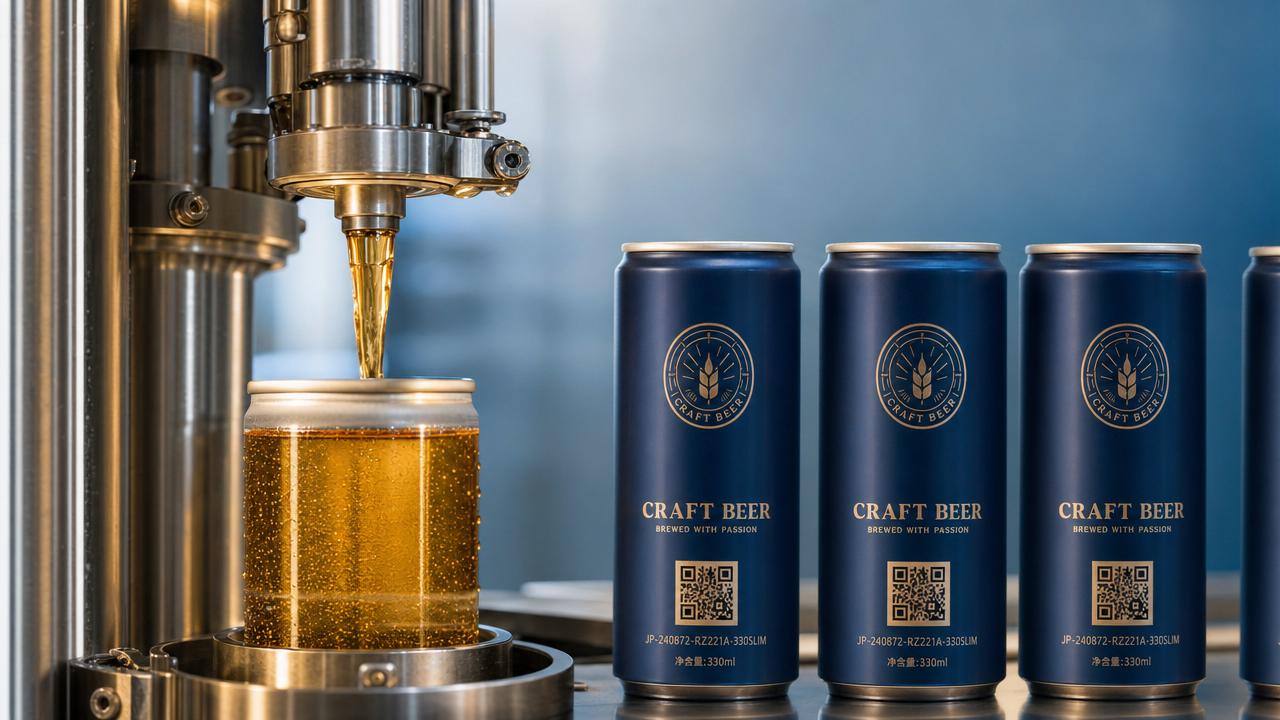
For quality control and food safety managers overseeing craft beer supply chains, Low MOQ Beer ODM partnerships offer welcome flexibility—but often at the cost of batch traceability. When small-batch co-packing multiplies SKU variations, inconsistent labeling, fragmented documentation, and real-time lot tracking become critical vulnerabilities. At Jinpai Beer, we specialize in traceable, audit-ready ODM and co-packing workflows—designed from the ground up for compliance, recall readiness, and end-to-end visibility—even at low minimum order quantities.
Why “Low MOQ” Triggers Traceability Trade-Offs in Craft Beer Production
Low MOQ Beer ODM isn’t just a commercial convenience—it’s a structural shift in production rhythm. Unlike high-volume runs where standardized batches, shared raw materials, and repeatable line setups support uniform recordkeeping, low-MOQ engagements demand rapid changeovers: different yeast strains, adjuncts (e.g., mango puree vs. hibiscus extract), canning formats (330 mL slim vs. 473 mL tallboy), and label designs may rotate daily. Each variation introduces new lot identifiers, storage conditions, and hold points—yet many co-packers treat traceability as an afterthought, applying manual logbooks or siloed ERP entries that lack cross-batch linkage.
The risk compounds during regulatory scrutiny. Under FDA FSMA 204, brewers must provide full one-step-back/one-step-forward traceability within 24 hours. EU FIC Regulation 1169 mandates allergen and origin transparency per batch—not per brand. When a fruit-flavored Low MOQ Beer ODM batch triggers a recall due to undeclared sulfites, fragmented records delay root-cause analysis by hours—or days. That delay isn’t operational friction; it’s liability exposure.
Three High-Risk Scenarios Where Traceability Breaks Down
Not all Low MOQ Beer ODM engagements carry equal traceability risk. The vulnerability escalates sharply under specific operational conditions:
- Multi-SKU Co-Packing on Shared Lines: Running five distinct Low MOQ Beer ODM recipes (e.g., sugar-free lager, passionfruit sour, ginger-kombucha hybrid) across one canning line without physical or digital segregation blurs lot boundaries—especially when rinse cycles or equipment swab logs aren’t timestamped and archived.
- Dynamic Labeling & On-Demand Packaging: When clients upload revised labels hourly or switch between shrink-sleeve, direct-print, and pressure-sensitive options mid-run, version-controlled print logs rarely sync with production timestamps—making it impossible to verify which label variant shipped with Lot #JP-240872.
- Ingredient Sourcing Variability Across Batches: A client’s “same” raspberry wheat beer may use freeze-dried raspberries (Lot RZ-221A) in Batch 1 but cold-pressed purée (Lot RP-88B) in Batch 2—yet both are logged only as “raspberry.” Without granular ingredient-level mapping, allergen verification and shelf-life modeling collapse.
How Jinpai Beer Aligns Low MOQ Beer ODM With Full Traceability
Jinpai Beer embeds traceability into every layer of Low MOQ Beer ODM execution—not as a compliance add-on, but as a foundational protocol. Our system operates on three integrated pillars:
What Most Partners Overlook—And Why It Matters
Many brands assume traceability is solved if their co-packer uses a “modern ERP.” But legacy systems often fail at granular beer-specific needs: yeast propagation logs, dissolved oxygen (DO) readings per tank, carbonation pressure variance per fill cycle, or even hop alpha-acid decay tracking—all of which affect stability, flavor consistency, and regulatory defensibility. Worse, some co-packers outsource traceability to third-party SaaS tools that don’t integrate with brewery SCADA or lab information systems (LIMS), creating data gaps no dashboard can reconcile.
Another frequent blind spot: label-to-lot binding. A QR code printed on a can may link to a generic product page—not the precise fermentation date, tank ID, or centrifuge run number. Jinpai ensures every scannable element maps to a time-stamped, immutable event in the production chain—so retailers, regulators, or consumers scanning a can of our German wheat Low MOQ Beer ODM instantly see its full journey.
Next Steps: Building Your Traceable Low MOQ Beer ODM Partnership
If you’re evaluating or already engaged in Low MOQ Beer ODM, take these concrete actions now:
- Audit your current co-packer’s traceability evidence: Request a live demo of their lot-reporting workflow—not just screenshots. Ask for proof of 24-hour FSMA-compliant reporting during a simulated recall drill.
- Require ingredient-level lot capture in contracts: Specify that each raw material (including yeast, enzymes, and flavorings) must be recorded with supplier lot numbers and COAs—not just “as received.”
- Validate label version control: Confirm that every label design revision is digitally signed, time-stamped, and linked to the exact production window it governed.
- Start with a pilot batch using Jinpai’s Low MOQ Beer ODM service: We offer transparent, real-time access to our traceability dashboard for any co-packed batch—no minimum commitment beyond the initial order.
Flexibility shouldn’t mean fragility. At Jinpai Beer, Low MOQ Beer ODM delivers speed, customization, and market agility—without compromising the rigorous traceability that defines responsible craft brewing. Whether you’re launching a seasonal fruit beer in six markets or scaling a functional specialty beer across EU distributors, traceability isn’t the price of flexibility. It’s the foundation.
Thank you very much for writing to us. Please leave your message and contact information, we will reply to you within 24 hours.