



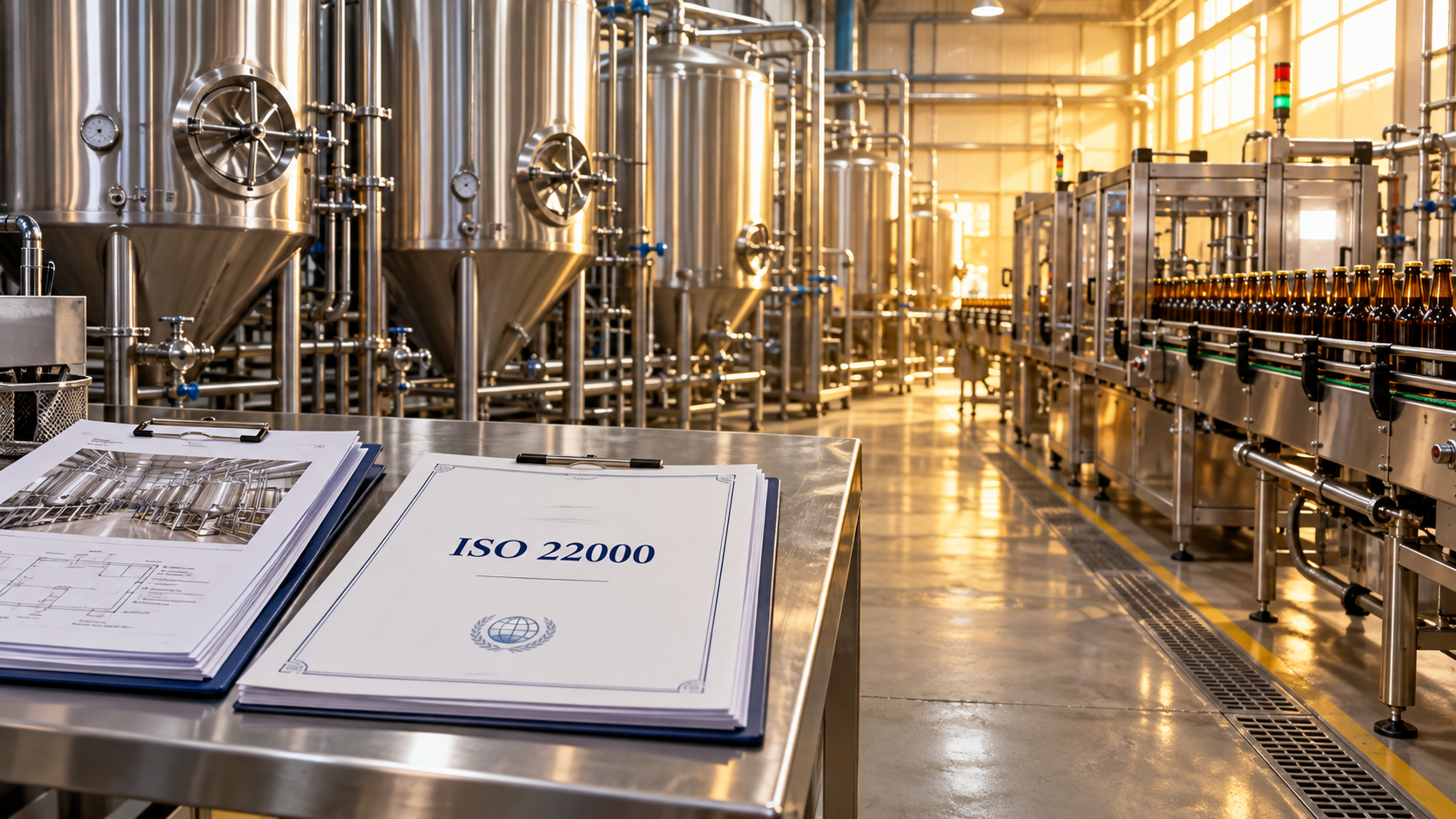
A beer factory’s ISO 22000 certificate is useful evidence of a food safety management system, but the PDF alone does not establish that the facility making your beer is covered. Check the certificate’s current status with the issuing certification body, then match its legal entity, production address and scope to the product and manufacturing activities in your order.
For wholesale and private-label sourcing, the most consequential mistake is accepting a certificate for the supplier’s trading company or another brewery in its group. The name on a sales contract, the brand on a can and the operator of the production line can all be different. Verification starts by identifying who actually makes and packs the beer.
Ask for the certificate and the production details together
Request a complete, readable copy of the current ISO 22000 certificate, including any annexes that list additional sites or activities. A cropped image or a certificate logo on a website does not provide enough information for a meaningful check.
Alongside the certificate, ask the supplier to identify the following for your proposed order:
- The legal name and address of the manufacturing site.
- The operations performed there, such as brewing, filling, packaging and storage.
- Any separate contractor responsible for brewing, blending, filling or packing.
- The certification body’s name and the certificate number.
These details give you something concrete to compare against the certificate. For example, a supplier may sell beer under its own name while production takes place at a contract brewery. In that case, the contract brewery’s site and certified scope matter more than a certificate belonging only to the brand owner’s office.
If several plants could produce your order, identify the intended site before approval. A certificate for one plant should not be treated as evidence that every plant in the same group operates under the same certified system.
Check the certificate’s status with the issuer
Find the certification body’s website independently, rather than relying only on a link or telephone number printed on the document. Many certification bodies provide an online directory or a way to contact their certificate verification team. Search using the certificate number and legal entity name where the service allows it.
Compare the information in the issuer’s record with the supplier’s copy. Look for the certificate holder, the standard, the sites covered, the scope and the stated dates. Most importantly, establish whether the certification is currently valid. An expiry date in the future is not conclusive: a certificate can be suspended or withdrawn before that date.
If the public directory does not show enough detail, contact the certification body through its published channels. Provide the certificate number and ask whether it is valid, whether the proposed site is included and whether the relevant scope is covered. Some bodies may limit what they disclose publicly, but they can often confirm the essential status of a certificate.
A certificate that cannot be found in a public search is not automatically false. Records may be organized differently or require a direct inquiry. Treat an unexplained mismatch, however, as an unresolved approval issue: ask the supplier and certification body to explain it before relying on the document.
Confirm that the certification body is accredited for the work
Certification and accreditation are different checks. The certification body audits and certifies the factory’s management system. An accreditation body assesses the certification body’s competence to perform certification within an approved scope.
If your purchasing policy requires accredited certification, identify the accreditation body shown on the certificate or named by the certification body. Then use the accreditation body’s directory to check that the certification body holds current accreditation for food safety management system certification and that its accredited scope covers the relevant food-chain activities.
Do not rely on an accreditation logo alone. Logos can be copied, and a certification body may hold accreditation for some activities but not others. A directory entry or direct confirmation should connect the issuing body, the certification program and the applicable scope.
Where relevant to your organization’s requirements, you can also check whether the accreditation body is a signatory to the appropriate international recognition arrangements, such as those maintained by the International Accreditation Forum. This helps assess recognition across markets, but it does not replace checking the specific certificate and accreditation scope.
An unaccredited ISO 22000 certificate is not, by itself, proof that a factory has no food safety controls. It does mean the certificate may not satisfy a customer’s accredited-certification requirement. Decide that requirement before comparing suppliers, so the distinction does not surface only after a purchase commitment.
Read the scope against the beer you intend to buy
The scope describes the activities, products and locations covered by the certification. Read it with the intended production route in mind. A scope that refers to beer production and packaging at the named brewery may be relevant to a conventional canned lager. A certificate covering only warehousing or distribution does not establish that brewing and filling are covered.
Pay particular attention when the order involves more than a standard brewing and packaging process:
- Private-label beer: Identify the site that brews the beer and the site that fills and labels it. If these are different businesses, assess each operation relevant to your order.
- Fruit-flavored or specialty beer: Check whether the certified scope covers the relevant manufacturing and blending activities. Ask how fruit preparations or other added ingredients are controlled and whether any blending is subcontracted.
- Low-calorie or reduced-sugar products: Certification is not evidence that a particular nutritional claim is accurate. Request the product specification and supporting information for the claim separately.
- Multiple packaging formats: If the same beer is offered in bottles, cans or kegs, establish where each format is filled. A certified brewing site does not automatically cover a separate filling contractor.
Certificate wording is often broader than a product specification, so the absence of a particular flavor or pack size from the document is not automatically a failure. If the connection between the stated scope and your process is unclear, ask the certification body and supplier to clarify it. Keep that clarification with the approval record.
Know what ISO 22000 does and does not establish
ISO 22000 concerns a food safety management system. A valid certificate indicates that a certification body has assessed the system against the standard within the stated scope. It is not a certificate for each batch, a guarantee that every product is defect-free or proof that a beer meets your commercial specification.
It also does not establish that the product is organic, gluten-free, alcohol-free or compliant with a particular market’s labeling rules. Those claims require their own supporting evidence and review. Similarly, a certificate held by one site does not automatically extend to outsourced processes or future production at another location.
Do not confuse ISO 22000 with a different food safety certification scheme. A supplier may hold another recognized certification, but it should be assessed against your purchasing criteria rather than described as ISO 22000 without checking the actual certificate and scheme.
For beer, the documents surrounding certification often matter as much as the certificate itself. Depending on the product and supply arrangement, request an agreed specification covering ingredients, alcohol content, pack format, shelf life, storage conditions and relevant labeling requirements. Ask how the supplier manages traceability, product withdrawal, complaints and changes to ingredients or production sites.
For flavored beers, review how ingredient changes and potential allergens are controlled. For packaged products, discuss the checks used to manage packaging integrity and the conditions expected during storage and transport. These questions do not require a supplier to disclose every confidential process detail, but they should produce enough evidence to judge whether the proposed product can be supplied consistently.
Warning signs that deserve a pause
One inconsistency may have an ordinary explanation, such as a recent company-name change. The concern is whether the explanation can be supported by reliable records and reconciled with the actual production site. Pause the approval when you encounter:
- A supplier that will not identify where the beer will be brewed or packed.
- A certificate issued to a different company or address, with no clear link to the proposed factory.
- An issuer that cannot confirm the certificate, or a record showing it is suspended, withdrawn or expired.
- A scope limited to trading or storage when the supplier presents it as proof of certified manufacturing.
- A certificate number, date, scope or site list that differs materially from the issuer’s record.
- A claim that ISO 22000 certification proves compliance with every product, labeling or import requirement.
A polished certificate design is not evidence of authenticity, and an unfamiliar certification body is not automatically illegitimate. Focus on verifiable status, accreditation where required, and the relationship between the certified operation and your purchase.
Turn verification into a supplier approval decision
Record the certificate number, issuing body, legal entity, covered sites, scope and status, together with the source and date of your check. Retain the certificate and any relevant confirmation from the issuer. Assign a person or team to revisit the record at expiry and when the supplier reports a material change.
For a routine wholesale purchase from a clearly identified brewery, a verified certificate, product specification and supporting supplier documents may form a practical starting point. A new private-label formulation, a multi-site production route or a product with sensitive ingredient claims may justify a more detailed document review or an audit under your organization’s approval process.
Before placing the order, make sure the contract and product specification identify the approved production arrangements and require notification of relevant changes. If production moves to another factory, or a new filling contractor is introduced, reassess the affected site and activities. The decision should follow the beer’s actual route from production to packing, not just the name printed on the original certificate.
Thank you very much for writing to us. Please leave your message and contact information, we will reply to you within 24 hours.