



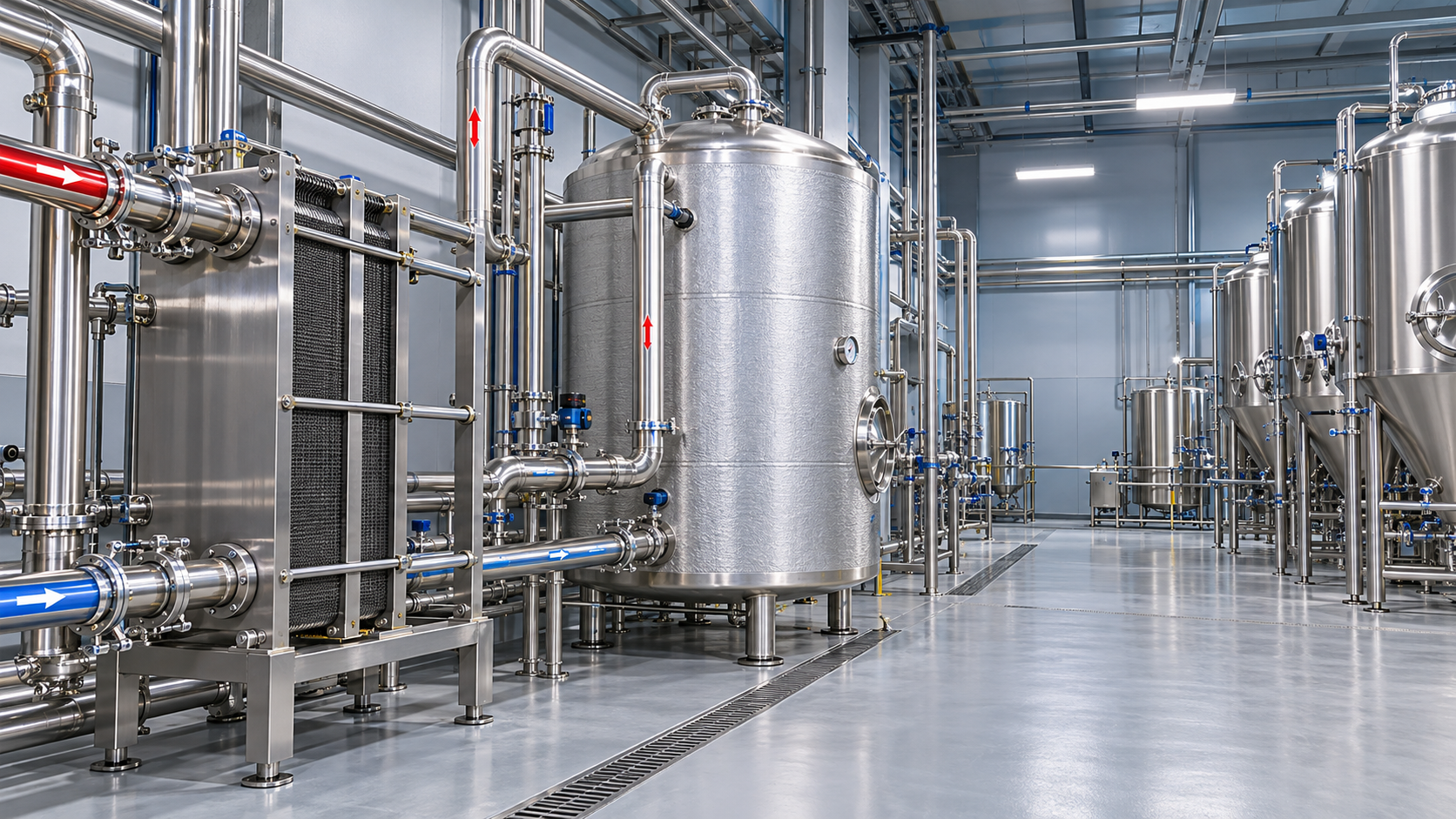
A beer factory can recover heat by capturing energy released during wort boiling, wort cooling, refrigeration and other operations, then transferring it to a useful heating process. The most practical opportunities are often those where a clean, repeatable heat source can serve a nearby demand, such as brewing liquor or hot-water preparation.
Whether a project is worthwhile depends on more than the amount of heat available. Source temperature, operating hours, timing, water quality and the cost of connecting equipment all affect the result. A large heat stream that appears briefly may be less valuable than a smaller stream available whenever the brewery needs hot water. For an engineering team, the first task is therefore to map heat sources and demands together, before choosing a heat exchanger, storage tank or heat pump.
Start with the brewery’s heat balance
Brewing uses heat at different temperatures and at different times. Mashing, wort boiling, cleaning and packaging may draw on hot water or steam, while wort cooling and refrigeration remove heat from the process. Some of that rejected heat can be reused directly; lower-temperature heat may require a heat pump or a suitable low-temperature application.
A useful assessment starts with a production schedule and utility data, ideally at intervals short enough to reveal individual batches and cleaning cycles. Monthly fuel consumption can establish a baseline, but it cannot show whether recovered heat is available when a hot-water tank needs charging.
For each potential source and heat user, record:
- Temperature at the beginning and end of the operation, including seasonal variation where relevant.
- Flow rate, operating duration and frequency, rather than only a nameplate capacity.
- Whether the stream is clean water, product, condensate, vapor, refrigerant or contaminated wastewater.
- Minimum required temperature and timing for the proposed heat user.
- Distance between equipment, available space and practical pipe routes.
These measurements help distinguish theoretical energy from energy that can actually be delivered. A simple heat calculation based on flow, temperature change and operating time is a useful starting point for liquid streams. For boiling vapor or refrigerant, the calculation also needs to account for phase change and the applicable fluid properties. Avoid adding up every theoretical source as though all of it can be recovered: some heat must remain in the process, some will be lost, and several proposed uses may compete for the same energy.
Where can heat be recovered?
Wort cooling: a direct route to hot water
After boiling, wort must be cooled before fermentation. In a common arrangement, cold brewing water passes through a heat exchanger and absorbs heat from the wort. The warmed water can then be stored for a subsequent brew or another suitable hot-water demand.
This arrangement is attractive because the cooling duty already exists and the recovered energy can displace part of the heat otherwise needed to prepare water. Its performance depends on the inlet water temperature, the heat exchanger configuration, the required wort outlet temperature and the brewery’s ability to use or store the warmed water. The temperature of the recovered water should be measured under actual operating conditions; it should not be assumed to meet every downstream requirement without additional heating.
Water quality and process segregation also matter. Where recovered water is intended for brewing, its source, storage and handling must meet the brewery’s product-water requirements. The heat exchanger must maintain separation between wort and water, with appropriate cleaning, inspection and leak-management provisions. A production schedule that leaves hot water standing for long periods may call for a different use or a review of storage hygiene.
Boil vapor: useful heat with demanding integration
Wort boiling releases vapor that can be condensed to recover heat. A vapor condenser transfers energy to a separate water circuit, which can charge a hot-water tank or supply another suitable process. Depending on the design, recovered energy may also be used as part of a wort preheating arrangement.
The engineering challenge is to recover heat without compromising the boil. Vapor handling affects kettle pressure and exhaust conditions, while boiling also serves process functions beyond heating. Any modification must be assessed against the kettle design, required evaporation and product-quality objectives. Condensate and fouling management, access for cleaning, corrosion resistance and control of non-condensable gases all influence exchanger performance.
Batch timing can make storage important. Vapor is available during the boil, whereas the best use for the recovered heat may occur before the next batch. A tank can bridge that gap, but only if its usable capacity, temperature range and charging rate match the schedule. An oversized tank cannot create demand that the brewery does not have.
Refrigeration: a steady source at a lower temperature
Fermentation control, cold storage and other cooling duties ultimately reject heat through the refrigeration system. A heat-recovery condenser or a suitable heat pump arrangement can capture some of that energy for water heating or another compatible load.
The temperature required by the receiving process determines the options. Direct recovery may be suitable for preheating water, while hotter water may require additional heat-pump lift or a conventional heater. Raising the delivery temperature generally increases the electrical work needed for a heat pump, so the project should compare total electricity and displaced fuel, not just recovered heat output.
Refrigeration reliability remains a production priority. The system needs an effective way to reject heat when there is no useful heating demand, and the controls must prevent heat recovery from interfering with cooling. Changes in condensing conditions can also alter compressor energy use. The assessment should include the whole refrigeration system, not treat recovered condenser heat as free.
Hot wastewater and cleaning streams: assess variability first
Hot wastewater from cleaning or packaging can contain recoverable energy, especially where discharge and heating demands occur regularly. A heat exchanger may transfer heat to a clean intermediate loop or preheat incoming water. Because wastewater is often contaminated and variable, the practical design depends heavily on solids, chemicals, temperature, flow and access for maintenance.
Cleaning streams deserve particular care. Some solutions may be suitable for controlled reuse within a cleaning system, while mixed effluent may foul equipment or require screening and frequent cleaning. Heat recovery must not compromise cleaning temperatures, chemical concentrations, contact times or verification procedures. Where a heat exchanger separates wastewater from clean water, the design should address leakage detection and the consequences of cross-contamination.
Match temperature and timing before selecting equipment
Heat flows naturally from a warmer stream to a cooler one, but a heat exchanger needs a temperature difference to transfer it at a useful rate. As the source cools or the receiving water warms, recovery becomes harder. Designers should therefore evaluate temperature profiles across the full operating cycle, not simply compare a single source temperature with a single target temperature.
A staged arrangement can improve the match. For example, recovered low-temperature heat may preheat incoming water, after which a boiler or heat pump raises it to the temperature required for use. This can be more practical than trying to make one source cover the entire heating duty. The final heating step must still have enough capacity to meet production when recovered heat is unavailable.
Timing is just as important. Batch brewing creates peaks: wort cooling, boiling and cleaning may happen in separate windows. Storage can connect those windows, but it introduces capital cost, heat loss, space requirements and hygiene considerations. The design should model a representative production week, including low-output periods, weekends and cleaning patterns. If production volumes or recipes vary substantially, the team should test several operating cases rather than rely on a single average day.
Keep process resilience in view. Bypasses, backup heating and a means of rejecting unwanted heat allow production to continue during maintenance, startup or a mismatch between heat supply and demand. Controls should define priorities clearly: for example, wort must reach its required cooling temperature even when a hot-water tank is full.
Protect hygiene and process control
Heat recovery connects systems that may previously have operated independently. That can introduce contamination pathways, pressure interactions and cleaning challenges. A design review should identify which fluids may contact product or brewing water, which remain in closed utility loops, and what happens if an exchanger leaks.
Material selection, exchanger construction, pressure arrangements and leak detection should reflect the fluids and the consequences of failure. Where cleanability is important, specify how the equipment will be drained, inspected and cleaned, including any dead legs created by new pipework. Recovered heat should not be assumed to provide a validated sanitation step merely because the water feels hot.
The project team should also review applicable local requirements and the brewery’s own food-safety, pressure-equipment and water-quality procedures. Operating limits need to be reflected in instrumentation and controls, with alarms and maintenance access considered before installation space is committed.
Build the investment case around usable heat
A credible business case starts with measured or well-supported operating data and calculates how much recovered heat can be used across the year. The calculation should account for production downtime, varying loads, storage losses, exchanger performance and periods when the receiving process has no demand.
Then compare the proposed system with the existing utility arrangement. Fuel savings depend on the efficiency of the equipment being displaced, while heat pumps and additional circulation pumps increase electricity consumption. Include water treatment, maintenance, cleaning, inspection and any changes to refrigeration power. If the project affects production during installation, the implementation plan should account for that constraint as well.
Capital costs extend beyond the main exchanger or heat pump. Pipework, insulated storage, controls, electrical upgrades, civil work and integration with existing equipment can determine whether a technically attractive source makes financial sense. A short pipe run and an existing hot-water demand may make a modest recovery project easier to justify than a larger source on the other side of the site.
Before approval, define how performance will be checked. Flow and temperature measurements on the recovery circuit, together with pump or heat-pump electricity and the operating hours of the displaced heater, can show whether heat is reaching its intended use. Meter locations should be included in the design, not left until commissioning.
For many projects, the best first step is a focused measurement campaign around one promising source and one dependable heat demand. That gives the engineering team a defensible basis for sizing equipment, comparing options and deciding whether a wider site integration is justified.
Thank you very much for writing to us. Please leave your message and contact information, we will reply to you within 24 hours.