



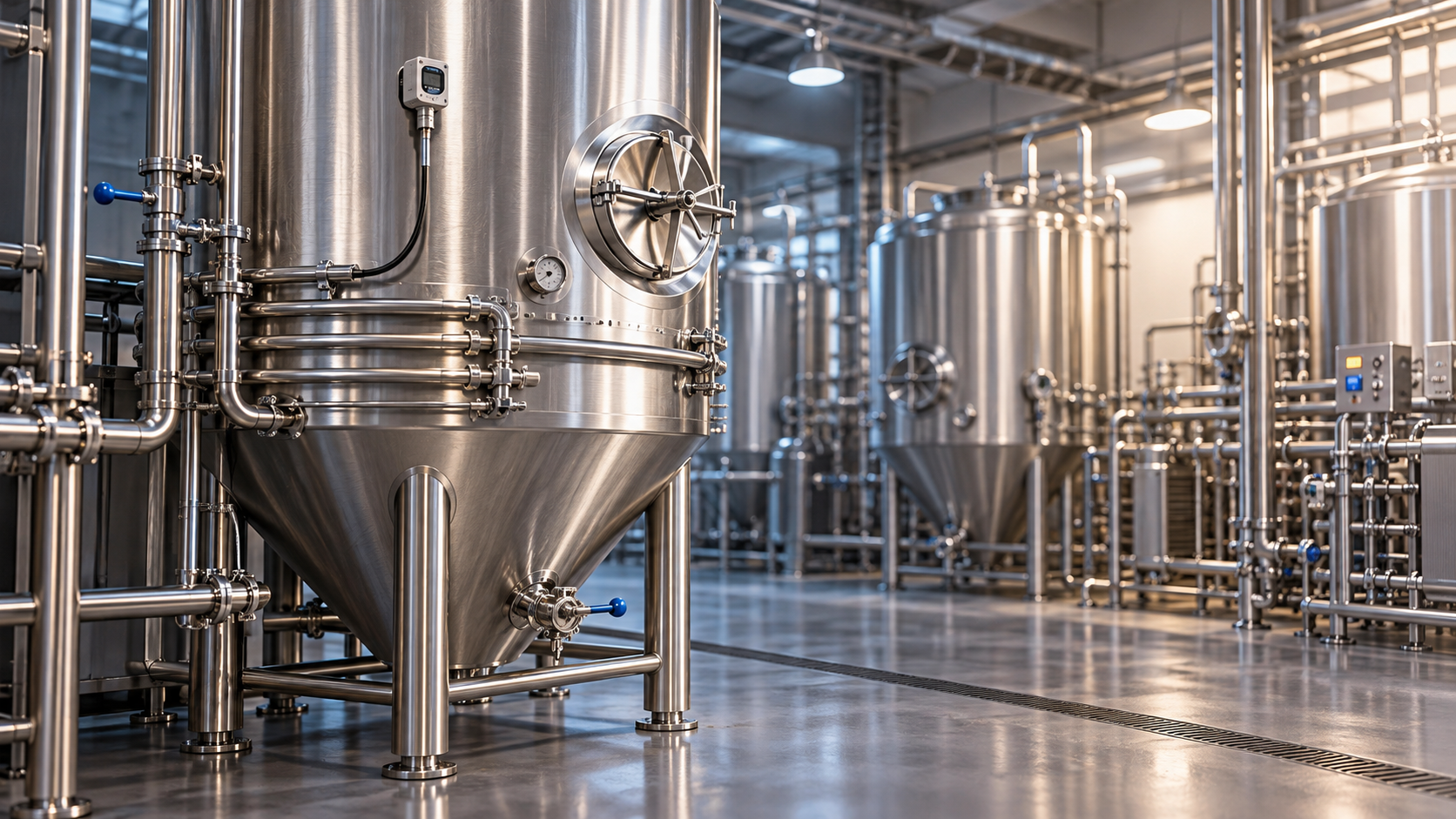
Fermentation temperature control affects far more than the speed at which beer reaches its final gravity. It shapes yeast metabolism, influences aroma and flavor, and determines whether a brewery can reproduce a beer across batches. When assessing a beer factory, the central question is not simply whether its tanks are cooled. It is whether the brewery can measure and manage the temperature of the fermenting beer throughout a process suited to the yeast, recipe, and finished product.
A tank held at a constant temperature is not automatically producing better beer. Some fermentations benefit from a controlled rise toward the end; others require a gradual reduction before maturation. The quality of control lies in following a defined profile, responding to deviations, and understanding how temperature interacts with pitching rate, wort composition, pressure, and yeast condition.
What temperature changes inside the fermentation tank
Yeast converts fermentable sugars into alcohol and carbon dioxide, but this conversion also produces heat and a range of flavor-active compounds. As fermentation becomes more active, the beer can become warmer than its surroundings. Without sufficient cooling, the temperature may drift above the intended range even when the cellar itself feels cool.
Within a yeast strain’s workable range, warmer conditions generally encourage faster activity. They can also change the balance of esters, which contribute fruity aromas, and higher alcohols, which may add warmth or a harsh impression when present at excessive levels. The relationship is not a simple rule that warmer beer is always more flavorful or less desirable: the strain, wort, oxygenation, pressure, and fermentation stage all influence the result.
Cooler conditions generally slow yeast activity and may favor a cleaner profile for suitable strains. If beer becomes too cold for the yeast or cools too abruptly, fermentation can slow excessively or stop before reaching its intended endpoint. Yeast may also settle before it has adequately reduced certain fermentation by-products. Raising the temperature again does not guarantee an immediate recovery, particularly if yeast health is poor or other process conditions are unfavorable.
For quality assessment, the useful measurement is therefore the temperature of the beer over time, interpreted alongside fermentation progress. A setpoint on a controller shows the target; it does not by itself show what happened in the tank.
Flavor balance depends on the whole temperature profile
Temperature has different effects at different stages. Early fermentation is particularly influential because yeast is growing and producing many of the compounds that define the beer’s character. A temperature excursion during this phase can change the aroma profile even if the beer is subsequently brought back to its target.
Later in fermentation, brewers may allow or encourage a controlled temperature rise to support completion and flavor maturation. One practical example is diacetyl management. Diacetyl can give beer a buttery or butterscotch-like character, and yeast can reduce it as fermentation progresses. The appropriate timing and temperature depend on the strain and process; a temperature rise alone is not proof that diacetyl has been reduced to an acceptable level.
Cooling after fermentation also needs a defined purpose. Reducing temperature can help yeast and other suspended material settle and prepare beer for maturation or downstream processing. Cooling too early, however, can remove active yeast from suspension before fermentation and flavor cleanup are complete. A reliable release decision combines fermentation measurements with an assessment of the relevant flavor compounds, rather than relying on elapsed time alone.
Temperature is only one cause of off-flavors. Excessive fruity or solvent-like notes, for example, may be associated with an unsuitable fermentation temperature, but yeast stress, pitching conditions, and wort composition can also contribute. Similarly, a beer that appears clean because it was fermented cold may still show other defects. Good troubleshooting considers the complete batch record before assigning a cause.
Why lagers and wheat beers need different approaches
Classic lagers are commonly fermented with lager yeast under cooler conditions than many ales, followed by a period of cold maturation. The aim is often a restrained fermentation character that allows malt, hops, and overall balance to remain clear. For this type of beer, a temperature profile must support both the desired clean flavor and sufficient fermentation and maturation. Simply keeping the tank as cold as possible can work against completion and flavor development.
German-style wheat beers often use yeast strains selected for a more expressive fermentation character. Depending on the strain and process, the beer may show fruity and spicy notes associated with esters and phenolic compounds. Temperature influences that balance, but it cannot independently create the intended profile: yeast selection and wort composition also matter. A brewery producing both lager and wheat beer needs process settings that reflect those differences rather than applying one schedule to every tank.
Low-calorie, sugar-free, fruit-flavored, and specialty beers add other considerations. A formulation designed for reduced residual sugar may require a carefully defined fermentation endpoint and control of fermentability. A fruit-flavored beer may also have ingredients added at a stage where yeast can ferment available sugars, affecting flavor, carbonation, and stability. Temperature management should be assessed as part of the complete recipe and production process, not treated as evidence that a particular nutritional claim or shelf-life target has been achieved.
What tank control can and cannot tell you
A fermentation tank typically uses cooling jackets or another heat-exchange arrangement connected to a cooling system. A sensor supplies temperature information to a controller, which regulates cooling against a setpoint. Some systems can also provide controlled heating, which may be useful when a process calls for a temperature rise or when the surrounding environment is cold.
For an assessment, ask where the sensor measures temperature and how that measurement relates to the beer in the tank. Sensor placement, tank geometry, liquid level, mixing caused by fermentation, and cooling jacket coverage can all affect whether one reading represents the full volume. A probe reading near the target is useful, but it is not proof that every part of a large tank has followed the same profile.
Cooling capacity also matters most when the process is under load. During vigorous fermentation, heat generation can rise quickly; several active tanks may compete for the same cooling supply. A system that maintains temperature in an idle tank may behave differently when the cellar is full. The practical question is whether the brewery has records showing that intended profiles are maintained under its normal production conditions, including simultaneous fermentations and relevant cleaning or utility demands.
Cooling performance should be considered together with control behavior. Repeated overshooting and correction can produce a fluctuating beer temperature even when the average appears acceptable. A gradual, intentional change is different from an uncontrolled cycle around a setpoint. Reviewing the trend makes that distinction visible.
Reading a fermentation record: what to look for
A useful batch record connects process targets to actual outcomes. It should make it possible to follow the beer from yeast addition through fermentation, maturation, and transfer, rather than showing only a final temperature or a pass/fail result.
- Recipe and yeast identification: The planned profile should correspond to the strain, beer style, and production process, including any relevant changes in yeast generation or handling.
- Actual temperature history: Look for the beer temperature over time, setpoint changes, and the duration and magnitude of any excursions. A planned rise should be distinguishable from a loss of cooling control.
- Fermentation progress: Gravity or another appropriate measure of fermentation should be reviewed alongside temperature. Temperature alone cannot demonstrate that the beer reached its intended endpoint.
- Maturation and release checks: Records should show how the brewery determines that fermentation and relevant flavor cleanup are complete before cooling, transfer, or packaging.
- Deviations and corrective actions: An excursion is more informative when the record explains what happened, how the beer was assessed, and what decision was made about the batch.
- Measurement reliability: Sensor calibration and maintenance records help establish whether the displayed temperatures can be trusted.
Compare records from more than one batch of the same beer where possible. Similar final gravity and sensory outcomes are useful, but they should be considered alongside the path taken to get there. Two batches can reach the same endpoint after very different fermentation histories, with differences in aroma or process reliability that a single final reading would miss.
How to interpret a temperature deviation
Not every departure from a setpoint has the same significance. A brief deviation late in fermentation may have a different effect from a similar deviation during active yeast growth. Its importance also depends on how far the beer moved from the intended profile, how long it remained there, and whether the yeast was already under stress.
Start by establishing the actual beer temperature, not only the controller alarm or cooling-fluid temperature. Then examine fermentation progress before, during, and after the event. A temperature rise accompanied by unexpectedly rapid gravity loss may indicate a different process effect from a cooling failure after fermentation has largely finished.
Next, evaluate the finished beer against the relevant specifications. Depending on the beer and the event, this may include sensory assessment, fermentation endpoint, and testing for compounds associated with the suspected defect. A batch can meet its gravity target yet have an altered flavor profile; conversely, an excursion does not automatically make the beer unsuitable. The disposition should follow the evidence and the product’s acceptance criteria.
Corrective action should address the cause as well as the individual batch. A sensor fault, inadequate cooling capacity, an incorrect profile, and poor yeast performance call for different responses. Changing the setpoint without identifying the cause may conceal the problem in the next batch rather than resolve it.
Comparing factory capability across products
For an OEM or wholesale project, begin with the intended beer specification and work backward to the process. Ask the producer how the fermentation profile is chosen for the yeast and recipe, what measurements trigger a change in temperature, and how the finished beer is assessed. For a range spanning lager, wheat, and flavored products, the ability to manage distinct profiles is more meaningful than a generic statement that fermentation is temperature-controlled.
Jinpai Beer offers craft beer products across several of these categories and provides OEM/ODM and wholesale services. When discussing a proposed product, the useful next step is to agree on the desired flavor, fermentation endpoint, and quality checks, then review how the proposed process and batch records support those requirements. The same questions apply when comparing any producer: equipment matters, but documented control and repeatable results show how it is used.
Thank you very much for writing to us. Please leave your message and contact information, we will reply to you within 24 hours.