



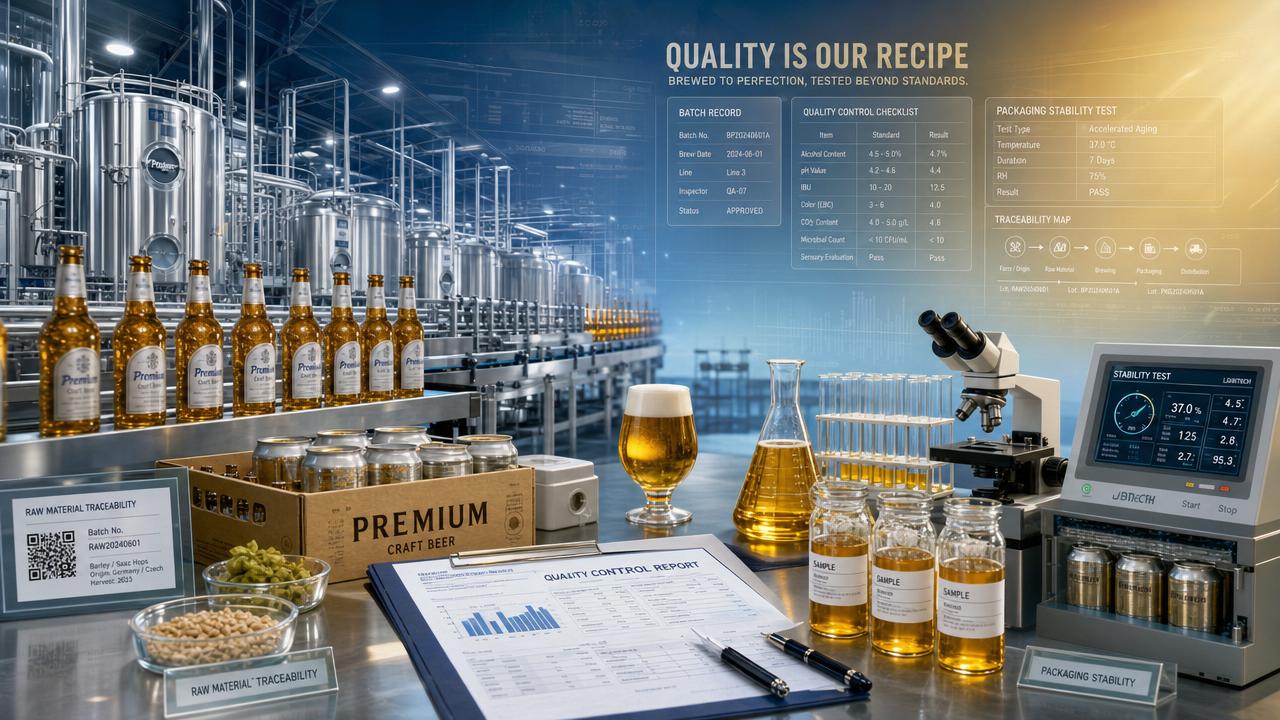
Choosing a reliable China beer factory is critical for quality control and product safety. For growing beverage brands, a qualified partner must combine brewing consistency, traceable sourcing, compliant production and responsive customization. This guide explains how to assess a China beer factory, lower quality risks and build a stable beer supply chain for long-term market success.
Understanding what a China beer factory should provide
A China beer factory is more than a production site. It is a system covering recipe development, raw material control, brewing, packaging, storage and export coordination.
In the beverage industry, quality risks often begin before brewing. They may come from unstable malt, inconsistent yeast activity, poor sanitation or weak packaging protection.
A dependable China beer factory should therefore offer visible controls across every stage. Transparency matters as much as capacity, especially for private label and OEM/ODM projects.
Factories with broad product experience can also reduce development uncertainty. This is useful when launching classic lager, German wheat, sugar-free low-calorie beer, fruit beer or functional specialty beer.
Core capabilities to verify first
- Stable brewing and fermentation standards
- Raw material traceability and supplier records
- Laboratory testing before, during and after production
- Packaging options for bottles, cans and kegs
- Export documentation and compliance support
- OEM/ODM flexibility for formulas, taste and branding
Current quality concerns in beer sourcing and export
Beer sourcing has become more complex. Buyers now expect shelf-life reliability, cleaner labels, lower sugar formulas and faster product launches across different retail channels.
This raises the bar for any China beer factory. It must balance innovation with process discipline, especially when products travel long distances through global distribution networks.
A strong China beer factory treats these concerns as connected. Quality cannot be corrected at the final inspection stage alone. It must be designed into the full operation.
Business value of selecting the right China beer factory
The right production partner protects more than product quality. It also supports brand reputation, regulatory confidence, cost stability and repeat purchasing performance.
For beverage brands selling through supermarkets, bars, restaurants and online channels, consistency is essential. A single failed batch can damage ratings, distribution and customer trust.
An experienced China beer factory can also shorten commercialization cycles. This is valuable when testing new flavors, seasonal products or health-oriented beer formats.
Why stable factory cooperation matters
- Fewer complaints linked to taste drift or packaging failure
- Better planning for MOQ, lead time and replenishment
- Stronger support for label compliance in export markets
- More reliable expansion into differentiated beer categories
Jinpai Beer illustrates this broader service model. Its portfolio includes classic lager, German wheat, sugar-free low-calorie beer, fruit-flavored beer and functional specialty beers.
It also provides OEM/ODM services, wholesale supply and customized solutions for multiple retail and foodservice channels. This range helps reduce sourcing fragmentation.
Typical supplier types and suitable project scenarios
Not every China beer factory fits every project. Matching factory capability with product positioning is one of the best ways to prevent avoidable quality issues.
This comparison helps narrow the search. A capable China beer factory should match both product style and operational expectations, not just offer a low price.
Practical evaluation points before cooperation
A structured review process reduces hidden risk. The most useful approach combines document review, sample testing, factory inspection and trial production assessment.
1. Check compliance and quality systems
Ask the China beer factory for production licenses, food safety certifications and internal quality manuals. Review change control, complaint handling and recall procedures.
2. Review raw material management
Confirm how barley malt, hops, yeast, fruit ingredients and additives are approved. Traceability should link suppliers, incoming inspection and batch usage.
3. Inspect brewing and sanitation control
Evaluate mash, fermentation, filtration and filling controls. A reliable China beer factory should show CIP routines, environmental hygiene standards and microbiological monitoring.
4. Validate packaging performance
Packaging affects oxygen pickup, light protection and transport durability. Review bottle, can or keg options and test compatibility with your target shelf life.
5. Test customization and communication
For OEM/ODM work, confirm recipe adjustment speed, sensory feedback cycles and artwork coordination. Fast replies often signal disciplined internal project management.
6. Run a pilot order
Before scale production, place a controlled pilot order. This step reveals how the China beer factory performs under real scheduling, packaging and export conditions.
Risk control measures for long-term supply stability
Selection is only the starting point. Ongoing performance management keeps quality stable after the first successful shipment.
- Define product specifications with measurable limits
- Lock approved formulas and packaging standards
- Require batch COA and retention sample records
- Set review points for complaints and sensory drift
- Monitor lead times, fill rates and damage rates
- Schedule periodic remote or onsite audits
A good China beer factory usually welcomes this structure. Clear controls reduce disputes, protect both sides and create a more predictable supply relationship.
Action steps for choosing a lower-risk partner
Start by defining your beer category, target channels, packaging format and compliance needs. Then compare each China beer factory against the same technical checklist.
Request samples from several batches, not only one. Review consistency, aroma, foam stability, clarity, carbonation and transport readiness.
Next, verify whether the supplier can support future line extensions. A China beer factory with R&D and OEM/ODM experience can simplify expansion into new market segments.
If your plan requires wholesale supply or private label development, prioritize factories with broad portfolio experience and clear quality documentation.
A reliable China beer factory should help you build a repeatable process, not just complete a transaction. That is the foundation of safer growth in the global beer market.
For projects involving craft beer, classic lager, wheat beer, sugar-free low-calorie beer or fruit-flavored beer, compare technical capability, responsiveness and traceability together before final approval.
With disciplined evaluation and phased cooperation, it becomes much easier to choose a China beer factory without quality risks and secure dependable long-term supply.
Thank you very much for writing to us. Please leave your message and contact information, we will reply to you within 24 hours.