



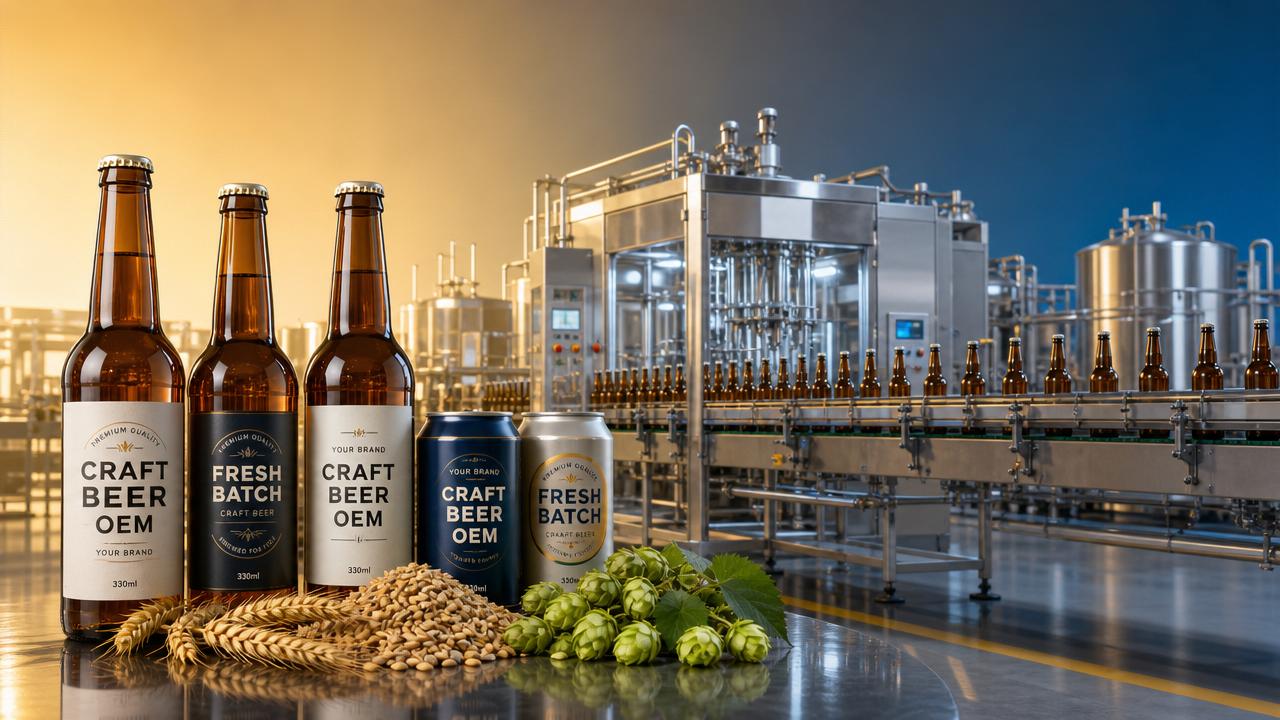
For brands trying to launch beer with limited capital, China beer OEM still offers a compelling route. Lower setup costs, scalable batches and faster commercialization can reduce financial pressure.
However, the answer is no longer a simple yes. Today, launch cost depends on formulation complexity, packaging options, compliance demands, target channels and repeat-order stability.
In beverage projects, the best sourcing model is the one that balances entry cost with quality, speed and margin durability. That is where China beer OEM should be evaluated by scenario, not assumption.
When China beer OEM makes the most sense for a fast market entry
A quick launch often favors China beer OEM. Existing brewing lines, proven packaging systems and ready technical teams shorten development cycles and reduce early fixed investment.
This is especially useful when the goal is to validate demand before building proprietary production. Instead of funding equipment, teams can test product-market fit with lower upfront exposure.
Scenario 1: New craft beer labels testing first-channel acceptance
For a new craft label entering bars, restaurants or specialty stores, the first challenge is controlled trial volume. Small-to-mid batch production matters more than owning a brewery.
Here, China beer OEM can lower launch costs through shared infrastructure. It also supports a broader portfolio, from classic lager to German wheat and fruit-flavored beer.
Scenario 2: Retail programs needing fast SKU expansion
Retail-driven launches often need multiple SKUs quickly. Seasonal beer, sugar-free low-calorie beer and functional specialty beer may all be required within one commercial calendar.
A capable OEM partner can reduce development overlap. Formula adaptation, canning formats and label updates move faster when one supplier manages integrated production and packing.
When launch savings from China beer OEM can be misleading
The lowest quote is not always the lowest cost. With China beer OEM, hidden expenses can appear in freight, compliance corrections, packaging waste and inconsistent repeat batches.
If a beer brand depends on stable taste and shelf presentation, quality variation can damage reorder velocity. Rework and channel complaints quickly erase initial savings.
Scenario 3: Premium positioning with strict sensory consistency
Premium craft beer cannot rely on price alone. It needs consistent aroma, body, bitterness balance and visual clarity across production runs and across destination markets.
In this case, China beer OEM works only when the supplier has strong R&D, batch control and documented quality systems. Otherwise, launch costs become brand repair costs later.
Scenario 4: Compliance-heavy exports entering multiple regions
Export beer projects face labeling rules, ingredient declarations, packaging marks and country-specific testing expectations. Delays at customs or relabeling can disrupt launch schedules.
For these programs, China beer OEM is beneficial only if export documentation, specification control and packaging review are built into the project from the start.
How different launch scenarios change the real cost equation
Beer sourcing decisions should match the route-to-market. The same OEM model may be ideal for one launch and inefficient for another.
This comparison shows why China beer OEM should not be judged only by manufacturing price. Total launch efficiency is shaped by batch size, lead time and channel demands.
What to check before choosing China beer OEM for your beer program
A practical evaluation should cover product, operations and market readiness. The strongest savings come from preventing avoidable errors before production begins.
- Confirm whether the supplier can produce your target style, such as lager, German wheat, fruit beer or functional specialty beer.
- Review minimum order quantities for cans, bottles, labels and outer cartons separately.
- Ask for batch records, sensory standards and shelf-life testing methods.
- Check whether formulation customization affects lead time or ingredient sourcing risk.
- Verify export support, including label review, documentation and loading coordination.
- Assess whether production capacity matches your reorder plan, not just your first order.
Jinpai Beer’s model aligns well with these decision points. Its portfolio covers mainstream and specialty beer styles, while OEM/ODM and wholesale supply support different launch paths.
That matters for beverage businesses serving restaurants, supermarkets, bars and mixed retail channels. One supplier with formulation and packaging flexibility can simplify execution.
Recommended sourcing approaches by launch scenario
Not every project should use the same sourcing structure. The right decision depends on how much uncertainty remains in demand, positioning and channel mix.
Common mistakes that make China beer OEM look cheaper than it is
One common mistake is comparing only per-unit production cost. Freight, packaging setup, compliance changes and damaged sell-through can change total profitability dramatically.
Another mistake is ignoring channel fit. A beer designed for bars may not work in supermarkets, where shelf life, carton strength and label visibility carry more weight.
Some launches also underestimate customization limits. If sugar-free, low-calorie or functional claims require special ingredients, timelines and testing may become longer than expected.
Finally, many teams fail to test repeatability. A successful sample run does not guarantee future consistency unless the China beer OEM partner has disciplined process control.
So, is China beer OEM still the best way to cut launch costs?
In many beverage launch scenarios, yes. China beer OEM remains one of the most effective ways to reduce upfront capital needs and accelerate market entry.
But it is the best option only when cost control is matched with quality assurance, packaging suitability, export readiness and reliable replenishment capability.
If the next beer project involves classic lager, German wheat, fruit-flavored beer, sugar-free low-calorie beer or functional specialty beer, start with a scenario-based supplier review.
A practical next step is to define target channels, expected order size, flavor direction and compliance needs, then compare OEM options against those criteria. That approach turns China beer OEM from a low-cost idea into a profitable launch strategy.
Thank you very much for writing to us. Please leave your message and contact information, we will reply to you within 24 hours.