



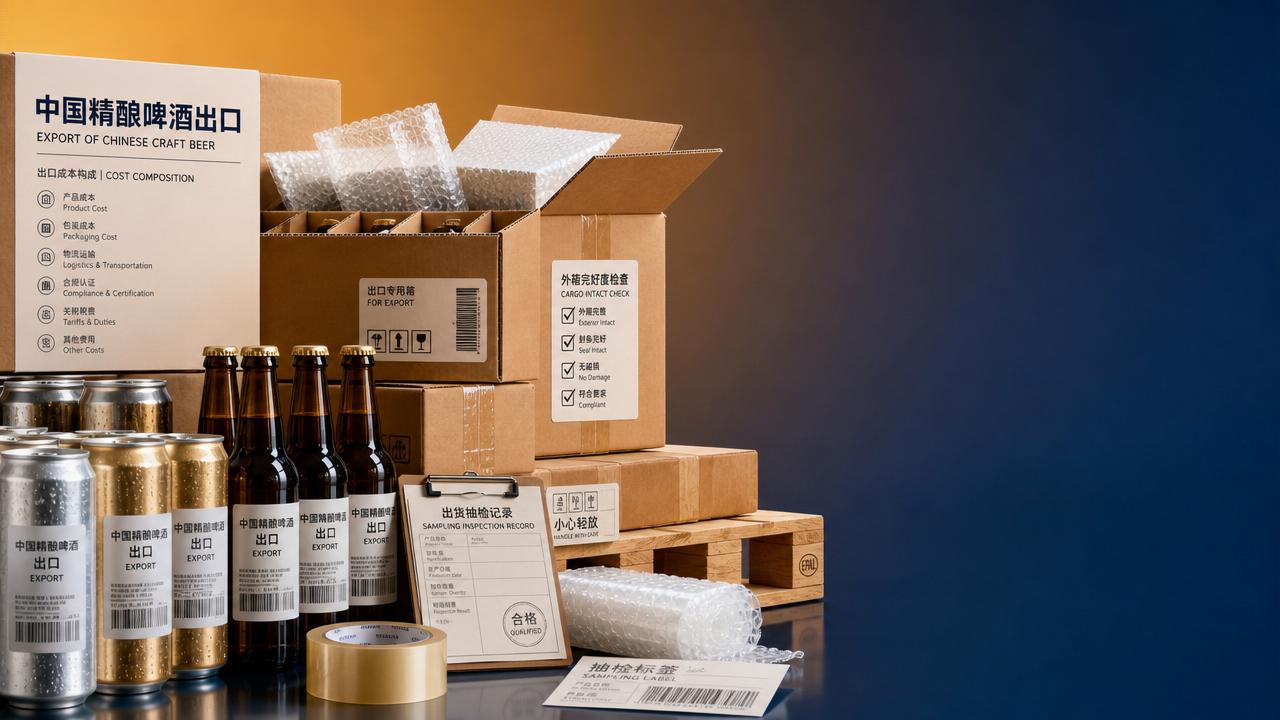
Why a Chinese craft beer factory export quote often surprises buyers
Many assume a Chinese craft beer factory export quote covers brewing, cans, bottles and cartons only.
In reality, export pricing also includes compliance work, recipe adaptation, shelf-life protection, freight volatility and destination channel demands.
That is especially true in beverage trade, where packaging integrity, flavor stability and labeling accuracy directly affect sales and legal clearance.
For any Chinese craft beer factory export project, cost visibility matters more than the lowest unit price.
Jinpai Beer develops and supplies classic lager, German wheat, sugar-free low-calorie beer, fruit beer and functional specialty beer.
It also supports OEM, ODM, wholesale supply and customized programs for online and offline markets worldwide.
This article explains where export costs really come from and how different sales scenarios change the final landed budget.
Scenario background: export costs change when the selling channel changes
The same beer can cost very differently depending on where and how it will be sold.
A bar-focused launch may need small batch diversity and premium presentation.
A supermarket program may require strict barcode systems, shelf-ready cartons and stable repeat orders.
An online retail pack may face higher breakage risks, stronger secondary packaging needs and more SKU complexity.
Because of this, a Chinese craft beer factory export plan should be evaluated by scenario, not by factory ex-works price alone.
The most common hidden costs appear when buyers compare offers without aligning destination requirements first.
Scenario 1: supplying restaurants and bars adds flexibility costs
Restaurants and bars often prefer differentiated flavors, seasonal releases and eye-catching labels.
That increases formulation work, packaging variation and production scheduling complexity.
For a Chinese craft beer factory export project, flexibility usually costs more than standard mass production.
Core judgment points in this scenario
- Low MOQ often raises packaging and filling cost per unit.
- Multiple flavors increase ingredient planning and inventory pressure.
- Short launch windows may require faster proofing and air sample shipping.
- Premium bars may request matte cans, embossed labels or gift-ready packs.
If the quote looks high, the reason may be customization intensity rather than inefficient brewing.
Scenario 2: supermarket retail creates compliance and packaging system costs
Retail chains usually focus on consistency, traceability and shelf efficiency.
That means a Chinese craft beer factory export supplier must prepare more standardized documentation and packaging details.
Where extra cost usually appears
- Destination-compliant label review and translation adjustments.
- Barcode application, carton coding and pallet labeling.
- Drop tests, stacking tests and transport durability upgrades.
- Slotting timing, warehouse appointments and delivery coordination.
Retail buyers may also reject mixed carton standards, which forces more uniform outer case specifications.
Those details influence both material cost and warehouse utilization.
Scenario 3: e-commerce and cross-border retail increase protection and return-related costs
Online sales create a different pressure point for any Chinese craft beer factory export program.
The product must survive parcel handling, temperature swings and consumer expectations for visual perfection.
A bottle that works for pallet shipping may fail in single-order delivery.
Core judgment points in this scenario
- Stronger inserts and protective corrugation add cost and volume.
- Mixed flavor bundles require more picking and packing labor.
- Customer return risk raises quality tolerance requirements.
- Product photography consistency often drives label and finish upgrades.
For online channels, freight damage cost can exceed small savings achieved from lighter packaging.
Scenario 4: private label and OEM projects include development costs before mass shipment
A private label project with a Chinese craft beer factory export partner rarely starts at full production efficiency.
Recipe testing, label proofing, can artwork setup and carton confirmation all happen before volume is stable.
Jinpai Beer supports OEM and ODM, but customized work still carries real setup cost.
Development items that often get underestimated
- Flavor matching trials for local taste preferences.
- Small run sampling and courier shipment.
- Printing plate, cylinder or digital artwork adjustment.
- Regulatory review for ingredient claims and nutrition statements.
These costs may be one-time, but they change the first-order economics significantly.
Different scenarios, different cost priorities
This comparison shows why a Chinese craft beer factory export decision should match the route to market.
Practical ways to evaluate a Chinese craft beer factory export offer
A lower quotation is only useful when the same scenario assumptions are included.
Use a structured checklist before comparing suppliers.
- Confirm Incoterms and whether inland transport is included.
- Ask which compliance documents are standard and which are extra.
- Check if artwork revisions and sample rounds are limited.
- Verify shelf-life support for target climate and transit time.
- Review packaging strength by sales channel, not by habit.
- Estimate landed cost with duties, port fees and local distribution.
This process makes any Chinese craft beer factory export quote far more transparent and actionable.
Common misjudgments that make export beer sourcing look cheaper than it is
The biggest mistake is treating export beer like a generic commodity.
Craft beer depends on freshness, flavor protection and market positioning.
- Ignoring destination label rules until production is finished.
- Using one packaging standard for retail, bars and e-commerce.
- Comparing FOB price without freight seasonality and port congestion.
- Assuming all flavor variants cost the same to formulate.
- Overlooking the cost of delayed launch due to revisions.
When these points are missed, the apparent savings from one Chinese craft beer factory export offer can disappear after arrival.
A better next step for building a realistic export plan
Start by defining the sales scenario before requesting a final quote.
Specify target market, channel, packaging format, compliance needs, flavor mix and order rhythm.
Then ask the supplier to separate brewing cost, packaging cost, customization cost and export support cost.
For a Chinese craft beer factory export partnership, that structure helps reveal both risk and value.
Jinpai Beer can support tailored discussions across classic lager, German wheat, sugar-free low-calorie, fruit and functional beer categories.
With OEM, ODM and wholesale supply options, the most effective approach is a scenario-based quotation instead of a simple unit-price comparison.
That is how a Chinese craft beer factory export decision becomes commercially realistic, scalable and easier to execute.
Thank you very much for writing to us. Please leave your message and contact information, we will reply to you within 24 hours.