



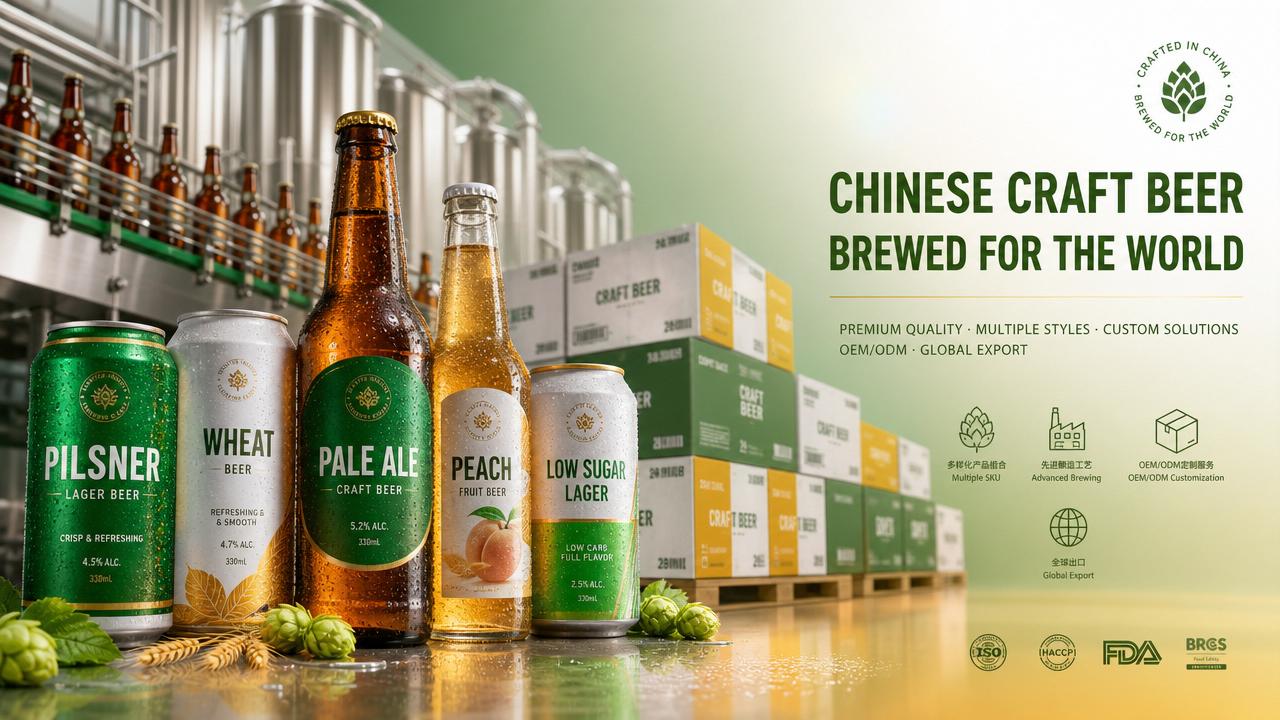
In 2026, Chinese craft beer factory export is gaining momentum as global buyers seek flexible OEM/ODM partners, diverse product portfolios and reliable supply capacity. For business evaluators, this trend reflects more than price advantage—it signals stronger R&D, customized brewing solutions and wider channel readiness. Understanding what drives this growth can help importers and distributors identify competitive, scalable partners in the evolving beer market.
For procurement teams, category managers, and investment reviewers, the rise of Chinese craft beer factory export is not a short-term spike. It is tied to broader shifts in private label demand, lower-alcohol innovation, sugar-free positioning, and the need for suppliers that can serve both online and offline channels across multiple markets.
Companies such as Jinpai Beer illustrate why this segment is attracting more cross-border attention. With craft beer R&D, production, wholesale supply, and OEM/ODM capabilities under one business model, Chinese breweries are increasingly able to support supermarkets, restaurants, bars, distributors, and retail chains with product range, packaging flexibility, and repeatable delivery processes.
Why Chinese craft beer factory export is accelerating in 2026
The first driver is product diversification. Many international buyers no longer want only 1 or 2 standard SKUs. They often need 4 to 8 styles within a single sourcing plan, including classic lager, German wheat, fruit-flavored beer, sugar-free low-calorie beer, and functional specialty beers that fit regional drinking trends.
The second driver is OEM/ODM readiness. In the past, smaller importers had to accept rigid formulas or high MOQs. In 2026, more Chinese suppliers are offering trial runs, formula adjustment cycles of 2 to 4 weeks, and packaging customization in cans, bottles, and mixed retail formats. That makes Chinese craft beer factory export more practical for both new market entries and mature beverage portfolios.
A third factor is operational maturity. Business evaluators are increasingly looking beyond unit cost and asking whether a brewery can maintain stable flavor, timely documentation, and channel-compatible packaging over repeated orders. A supplier that can support forecast planning for 3 months, 6 months, and 12 months offers stronger commercial value than one focused only on spot pricing.
Shifting buyer demand in beverage sourcing
Craft beer buyers in 2026 are more segmented than they were even 3 years ago. Supermarkets may want approachable styles with higher turnover. Bars may seek seasonal flavor innovation in 330ml or 500ml formats. E-commerce distributors may prefer visual packaging impact, moderate alcohol levels, and compact shipping configurations that lower per-case freight cost.
This shift benefits Chinese craft beer factory export because factories that handle multi-style portfolios can serve several channels from one production relationship. Instead of managing separate suppliers for low-calorie beer, fruit beer, and standard lager, buyers can centralize sourcing, quality review, and label adaptation through one qualified manufacturing partner.
The role of flexible manufacturing
Flexibility matters because beer programs often evolve after launch. A distributor may begin with 1 container of 2 SKUs, then expand to 5 or 6 SKUs once sell-through data is available after 60 to 90 days. A responsive factory can support reformulation, alcohol adjustment, sweetness balance, and branding updates without forcing a complete restart of the project.
- Broader SKU support across classic, health-positioned, and flavored segments
- OEM/ODM collaboration for label, taste profile, and packaging format
- Supply planning for pilot orders, repeat orders, and scale-up phases
- Compatibility with restaurants, supermarkets, bars, and retail channels
The table below summarizes the main commercial factors behind the growth of Chinese craft beer factory export and why they matter during business evaluation.
The key takeaway is that Chinese craft beer factory export is rising because buyers now value agility and portfolio depth as much as cost control. Suppliers that can combine brewing capability with channel-focused commercialization are becoming stronger long-term partners.
What business evaluators should examine before choosing a Chinese brewery
A growing export market does not remove sourcing risk. For business evaluators, the real question is not whether Chinese craft beer factory export is expanding, but which factories can deliver repeatable quality, commercially relevant customization, and efficient communication across the full order cycle.
1. Product portfolio fit
Portfolio fit should be reviewed against end-market demand, not just current catalog breadth. For example, a supplier may list 10 beer styles, but only 4 may suit your retail price band, local taste preference, or labeling rules. Evaluators should match target channels with alcohol profile, flavor direction, pack size, and shelf positioning.
Jinpai Beer’s range is commercially relevant because it covers classic lager for broad appeal, German wheat for premium drinkers, sugar-free low-calorie beer for health-oriented segments, fruit-flavored beer for younger consumers, and functional specialty beers for differentiated branding. That kind of structure helps buyers test mainstream and niche demand within one supplier framework.
Useful evaluation questions
- Can the factory support at least 3 product positioning levels: entry, mid, and premium?
- Are 330ml, 500ml, and mixed-case options available for different routes to market?
- Can sweetness, bitterness, or fruit intensity be adjusted within 1 to 2 sample rounds?
- Does the supplier understand retail, bar, and supermarket merchandising requirements?
2. OEM/ODM execution capability
OEM/ODM is often where apparent supplier strength is tested. A brewery may brew well but struggle with artwork coordination, multilingual labeling, formula version control, or carton configuration. Evaluators should confirm whether the supplier has a defined process from inquiry to sample approval, production confirmation, and shipment preparation.
A practical export workflow usually includes 5 stages: demand briefing, recipe or product selection, sample and packaging review, order confirmation, and delivery scheduling. If any of these stages lacks response discipline, launch timing can slip by 2 to 6 weeks.
The table below provides a structured checklist for assessing whether a Chinese craft beer factory export partner can support stable OEM/ODM cooperation.
For many buyers, the strongest export partner is not the one with the longest brochure, but the one with the clearest execution path. Process visibility lowers communication risk and makes future scale-up far easier.
3. Supply reliability and delivery planning
Reliable supply is essential in beer because reorder timing affects freshness, promotions, and shelf planning. Evaluators should ask about production scheduling lead times, typical order preparation windows, and how the factory handles urgent replenishment versus planned volume. Even a 7 to 10 day delay can disrupt launches tied to festivals, summer promotions, or chain-store resets.
Chinese craft beer factory export is becoming more competitive partly because some breweries now align production with channel forecasting rather than treating export as occasional overflow. This matters for buyers who want consistent monthly shipments or staged volume growth after a successful pilot period.
4. Communication quality and commercial responsiveness
Communication is a commercial asset, not just an administrative detail. Evaluators should test response speed, issue handling, and clarity of technical answers during the first 2 to 3 weeks of contact. If product questions require repeated follow-up or packaging revisions are not tracked clearly, larger cooperation may become costly later.
A strong supplier should be able to discuss beer style logic, target consumer use cases, wholesale requirements, and customization boundaries in practical terms. This is especially important when distributors need support materials for internal review, retailer listing, or market-entry budgeting.
How product innovation is strengthening export competitiveness
One major reason Chinese craft beer factory export is rising in 2026 is the shift from simple production capacity to market-oriented innovation. Buyers increasingly want beers that match current consumer narratives such as lower sugar, lower calorie intake, flavor experimentation, and occasion-based drinking.
Health-positioned beer is moving into mainstream retail
Sugar-free low-calorie beer has moved beyond niche demand. In many markets, it now serves a practical role in convenience retail, modern trade, and online assortment. Buyers often seek products that fit wellness messaging while keeping the approachable taste profile required for repeat purchase. This is one area where flexible Chinese breweries are gaining traction.
For evaluators, the key question is whether the supplier can turn a trend into a stable product line. That includes taste consistency, clear labeling, and packaging suited to broad retail circulation rather than one-time novelty sales.
Flavor innovation supports channel differentiation
Fruit-flavored beer and specialty craft variants can help distributors avoid direct price competition. In bars, these products expand menu variety. In supermarkets, they create visible shelf segmentation. In e-commerce, they improve trial conversion because flavor descriptions are easier for new consumers to understand than technical brewing terms alone.
A buyer may begin with 2 core styles and add 1 or 2 seasonal flavors every 6 months. A brewery with active R&D support is better positioned to keep that roadmap commercially fresh without forcing the buyer to switch manufacturers.
Where innovation creates export value
- Lower-calorie and sugar-free products address wellness-oriented retail demand
- German wheat and classic lager provide recognizable anchors for broad distribution
- Fruit-flavored beer improves assortment diversity in bars and younger consumer channels
- Functional specialty beers offer room for differentiated private label strategies
Risk points importers should manage in Chinese craft beer factory export
Growth does not eliminate risk. Smart buyers evaluate opportunity and control factors at the same time. In Chinese craft beer factory export, the most common issues are not always brewing quality alone. They often involve expectation gaps on packaging detail, market compliance, production timing, and long-range replenishment.
Common procurement mistakes
The first mistake is selecting only on price. A lower quote can become expensive if the supplier cannot support multi-SKU planning, clear sample management, or shipment coordination. The second mistake is approving a sample without confirming scale consistency. The third is launching too many SKUs before checking actual sell-through in the first 60 to 120 days.
A practical 4-point risk control approach
- Validate 1 to 3 priority SKUs before broad line expansion.
- Confirm packaging, labeling, and carton details in writing before mass production.
- Use phased forecasting with pilot, repeat, and scale-up order assumptions.
- Review service responsiveness during sampling, not only after payment terms are discussed.
This disciplined approach helps evaluators reduce launch friction while preserving the speed advantage that makes Chinese craft beer factory export attractive in the first place.
What a strong long-term partner looks like
A dependable brewery partner usually combines 4 capabilities: broad product coverage, responsive customization, stable supply planning, and channel-aware communication. That profile is especially valuable when buyers serve different customer groups such as supermarkets, restaurants, bars, and regional distributors at the same time.
Jinpai Beer’s business model aligns with this need by combining craft beer R&D, production, distribution, OEM/ODM services, and wholesale supply. For business evaluators, that means a single supplier can potentially support concept development, private label execution, and multi-channel supply under one cooperation structure.
How to move from evaluation to a workable sourcing plan
The best results usually come from a staged sourcing plan rather than an all-at-once commitment. Buyers can begin with a focused shortlist, review the most relevant 3 to 5 beer styles, compare packaging and channel fit, then move into sample confirmation and launch planning. This reduces complexity while preserving room for expansion.
In 2026, Chinese craft beer factory export is rising because the supplier base is becoming more commercially aligned with global beverage demand. For importers, distributors, and retail buyers, the opportunity lies in choosing a brewery that offers not just capacity, but also practical OEM/ODM execution, product innovation, and scalable support.
If you are evaluating craft beer sourcing for supermarkets, bars, restaurants, or retail distribution, Jinpai Beer can support product selection, private label development, wholesale supply, and customized solutions across multiple beer categories. Contact us now to discuss your target market, request a tailored product proposal, and explore a long-term export partnership built for real channel growth.
Thank you very much for writing to us. Please leave your message and contact information, we will reply to you within 24 hours.