



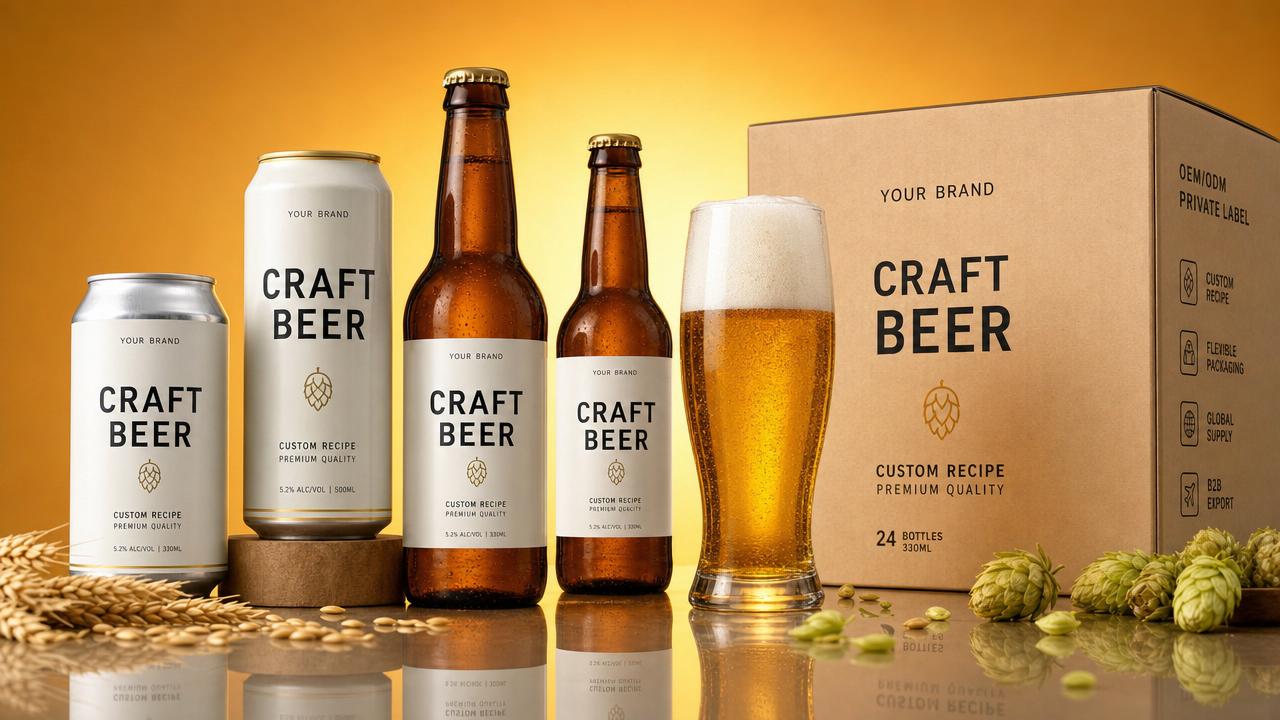
For business decision-makers evaluating new beverage opportunities, China beer OEM private label craft beer is becoming a practical way to enter the market with lower development costs and faster brand launch cycles. With growing demand for diverse craft styles, customizable formulas and flexible supply options, partnering with an experienced manufacturer can help brands balance quality, differentiation and scalability in today’s competitive beer industry.
For importers, retail chains, bar groups, restaurant suppliers, and beverage brand owners, the question is no longer whether private label craft beer is possible. The real question is whether it is commercially worth doing now, under current market conditions, cost pressures, and consumer expectations.
The answer depends on several factors: product positioning, order volume, packaging flexibility, recipe capability, lead time, and the manufacturer’s ability to support compliance and consistent quality. In many cases, China beer OEM private label craft beer can be a strong route to market when the project is managed with clear commercial criteria.
Why China beer OEM private label craft beer is attracting more B2B buyers
Over the past few years, beverage buyers have faced 3 linked challenges: higher product development costs, shorter trend cycles, and stronger demand for differentiated SKUs. Building a new craft beer brand from scratch through an in-house plant often requires 6 to 18 months, while OEM production can reduce launch time to roughly 4 to 10 weeks depending on formula and packaging complexity.
That speed matters in categories such as fruit beer, low-calorie beer, wheat beer, and functional specialty beer, where consumer interest can shift quickly. A private label strategy allows a brand to test 2 to 5 styles in the same season without committing to heavy fixed investment in brewing equipment, packaging lines, filtration systems, and warehouse operations.
Lower entry barriers for market testing
For many business decision-makers, the biggest value is controlled risk. Instead of investing in brewhouse systems, fermentation tanks, quality labs, and staffing, the buyer can focus capital on brand development, channel building, and sell-through. This model is especially useful when the first commercial target is 1 container, 5,000 to 20,000 liters, or a limited regional listing rather than a nationwide rollout.
China beer OEM private label craft beer is also suitable for companies that want product breadth. A single manufacturing partner may support classic lager, German wheat, sugar-free low-calorie beer, fruit-flavored beer, and functional specialty beers under different pack formats, helping buyers build a portfolio rather than a single-item offer.
Better alignment with channel-specific demand
Different channels need different beer profiles. Supermarkets often prioritize price stability, shelf appearance, and repeatability. Bars may want stronger sensory identity and seasonal rotation. Restaurants usually need balanced flavor, food pairing flexibility, and moderate ABV, often in the 3.5% to 5.5% range for broad consumer acceptance.
An experienced supplier can adjust bitterness, color, aroma, sweetness, carbonation, and packaging to fit those channel needs. This is where OEM becomes commercially meaningful, because buyers are not simply purchasing liquid; they are building a product that can match a specific retail or on-premise environment.
The table below outlines when private label craft beer tends to make more sense than building an in-house brewing project.
For most first-stage buyers, OEM offers a faster and less asset-heavy path. Self-owned brewing can make sense later, but usually after demand becomes stable enough to justify larger fixed costs and more complex operations.
What makes the model worth it now, not just possible
Private label beer has existed for years, but current market conditions make it more attractive than before. Buyers are dealing with tighter working capital, rising pressure for differentiation, and a more fragmented consumer taste profile. Instead of relying on one mainstream lager, many channels now benefit from 3 to 6 complementary beer styles with different price points and flavor profiles.
China beer OEM private label craft beer becomes worth it when the manufacturer can provide not only brewing capacity, but also development support across formulation, package selection, documentation, and repeat supply. That support reduces hidden costs that often damage early-stage beverage launches.
Product diversity supports faster brand positioning
A supplier with a broad portfolio can help buyers position by audience, season, or channel. For example, classic lager may fit convenience and mainstream retail. German wheat can support premium casual dining. Sugar-free low-calorie beer may target health-conscious urban consumers. Fruit-flavored beer can work well in younger demographics or mixed retail gift channels.
Functional specialty beers also create room for niche positioning, but they require more careful label review, ingredient selection, and market-specific compliance checks. For B2B buyers, the right partner should explain what is realistic for formulation, shelf life, and export readiness before mass production begins.
Common product decisions buyers need to make
- Choose 1 to 3 lead SKUs for launch rather than starting with too many variants.
- Define ABV target, bitterness range, sweetness level, and intended drinking occasion.
- Select packaging such as cans, bottles, or keg formats based on channel needs.
- Confirm whether the product is for retail shelves, bars, restaurants, or mixed distribution.
- Balance premium positioning with realistic landed cost and reorder potential.
OEM economics are often more favorable in pilot stages
A beverage launch rarely fails because the idea is bad. More often, it fails because forecasting, packaging choices, or margin planning are weak. With OEM, the buyer can start with a practical MOQ and validate demand through online and offline channels before scaling. This is particularly valuable when entering new geographies or testing a private label program for supermarket chains.
If a first order proves successful, scaling from 1 batch to recurring monthly or quarterly orders is typically much easier than rebuilding a supply chain from zero. This scalability is one reason many distributors and brand owners now view contract brewing as a strategic tool rather than a temporary solution.
How to evaluate a China beer OEM private label craft beer supplier
The value of the model depends heavily on supplier selection. Price alone is not enough. A lower quote can become more expensive if the supplier struggles with flavor consistency, packaging defects, unstable lead times, or weak communication during label approval and shipment planning.
Decision-makers should use a structured assessment process covering at least 4 areas: product capability, operational reliability, customization support, and export coordination. This approach helps prevent common sourcing errors that only appear after the first shipment is on the water.
Key supplier evaluation criteria
Before signing any OEM agreement, buyers should review how the brewery handles recipe development, pilot sampling, raw material control, filling standards, and packaging options. A supplier that can discuss carbonation, pasteurization approach, shelf life expectations, and flavor stability in practical terms is usually more reliable than one focused only on a sales pitch.
The following matrix can help compare potential manufacturers in a more disciplined way.
This type of comparison helps buyers separate low-price offers from genuinely workable supply partnerships. In beverage sourcing, reliability over the next 12 months often matters more than a small saving on the first order.
Questions worth asking during supplier discussions
- What is the typical sample development timeline, such as 7 to 21 days?
- What packaging formats are routinely supported for export projects?
- How are shelf life expectations communicated for different beer styles?
- Can the supplier support both OEM and ODM, including formula adjustment?
- What is the normal reorder cycle for repeat customers once packaging is finalized?
These questions are practical because they reveal operating maturity. A serious manufacturer should be able to explain process timing, development steps, and packaging considerations without vague language.
Commercial risks, hidden costs, and how to control them
China beer OEM private label craft beer can be worth it, but only when commercial controls are in place. Many projects run into trouble not because the brewery cannot make beer, but because buyers underestimate approval cycles, artwork revisions, channel fit, or inventory rotation speed.
A disciplined sourcing plan should include at least 5 checkpoints: sample confirmation, packaging approval, order quantity review, shipping window planning, and post-arrival market feedback. Missing even one of these steps can create avoidable cost leakage.
Frequent risk points in private label beer projects
- Launching too many SKUs at once, which weakens forecasting and inventory turnover.
- Choosing packaging based only on appearance, not shelf efficiency or freight impact.
- Underestimating label review and market-specific wording requirements.
- Ignoring the difference between a good sample and consistent mass production output.
- Targeting a premium retail price without enough margin for promotion and channel support.
Why packaging decisions matter more than many buyers expect
In beer projects, packaging affects freight efficiency, shelf presence, breakage risk, and channel acceptance. A bottle may support a premium perception, while cans often improve logistics efficiency and outdoor consumption convenience. For bar and restaurant supply, keg solutions may offer a stronger cost-per-serve model, but they require compatible dispensing systems and service planning.
The right choice depends on channel economics, not just brand aesthetics. For example, if a buyer expects faster turnover in modern retail, secondary packaging strength and stackability can matter as much as label design.
A practical control framework for first orders
A workable first-order strategy is to start with 1 to 2 flagship SKUs, one core package format, and a channel-specific launch plan. This keeps execution manageable and makes it easier to evaluate real sales data within the first 60 to 90 days after arrival.
Buyers should also define acceptance standards before production begins. These usually include flavor confirmation, packaging accuracy, labeling consistency, and documentation completeness. Clear standards reduce disputes and create a more professional supplier relationship.
Where suppliers like Jinpai Beer fit in the current market
For buyers looking for a balanced approach, manufacturers with both product breadth and customization capability can offer better long-term value. Jinpai Beer operates in the R&D, production, and distribution of craft beer, with product coverage that includes classic lager, German wheat, sugar-free low-calorie beer, fruit-flavored beer, and functional specialty beers.
That range matters because business decision-makers increasingly need portfolio flexibility. A supplier that can support OEM, ODM, wholesale supply, and customized solutions is better positioned to serve distributors, agents, supermarkets, bars, restaurants, and mixed retail channels across different markets.
Why capability breadth improves business resilience
When one supplier can support multiple styles and go-to-market paths, buyers gain practical advantages. They can test a mainstream lager for volume, a wheat beer for premium casual channels, and a fruit beer for seasonal promotions, all without rebuilding their sourcing structure every time the product mix changes.
This is particularly relevant in today’s beverage environment, where buyers may operate both online and offline. Products intended for e-commerce packs, retail shelves, and foodservice do not always require the same flavor intensity, packaging, or pricing architecture. A flexible manufacturer can help align those details earlier in the process.
Is it worth it now?
For many B2B buyers, yes, but with conditions. China beer OEM private label craft beer is worth it now when the project has a clear market target, realistic MOQ planning, disciplined packaging decisions, and a manufacturing partner capable of combining product development with dependable execution.
It is less attractive when the buyer has no channel strategy, no margin model, or no internal process for artwork, approvals, and replenishment planning. In other words, OEM is not a shortcut around strategy. It is a way to implement strategy faster and with lower fixed risk.
If your company is evaluating China beer OEM private label craft beer for supermarkets, bars, restaurants, distribution, or branded retail expansion, the strongest approach is to begin with a focused product plan, validated cost targets, and a manufacturer that can support both customization and stable supply. Jinpai Beer’s craft beer portfolio, OEM/ODM capabilities, and channel-oriented solutions make it a practical partner for businesses seeking scalable and differentiated beer offerings. Contact us to discuss product details, request a customized solution, or explore long-term cooperation opportunities.
Thank you very much for writing to us. Please leave your message and contact information, we will reply to you within 24 hours.