



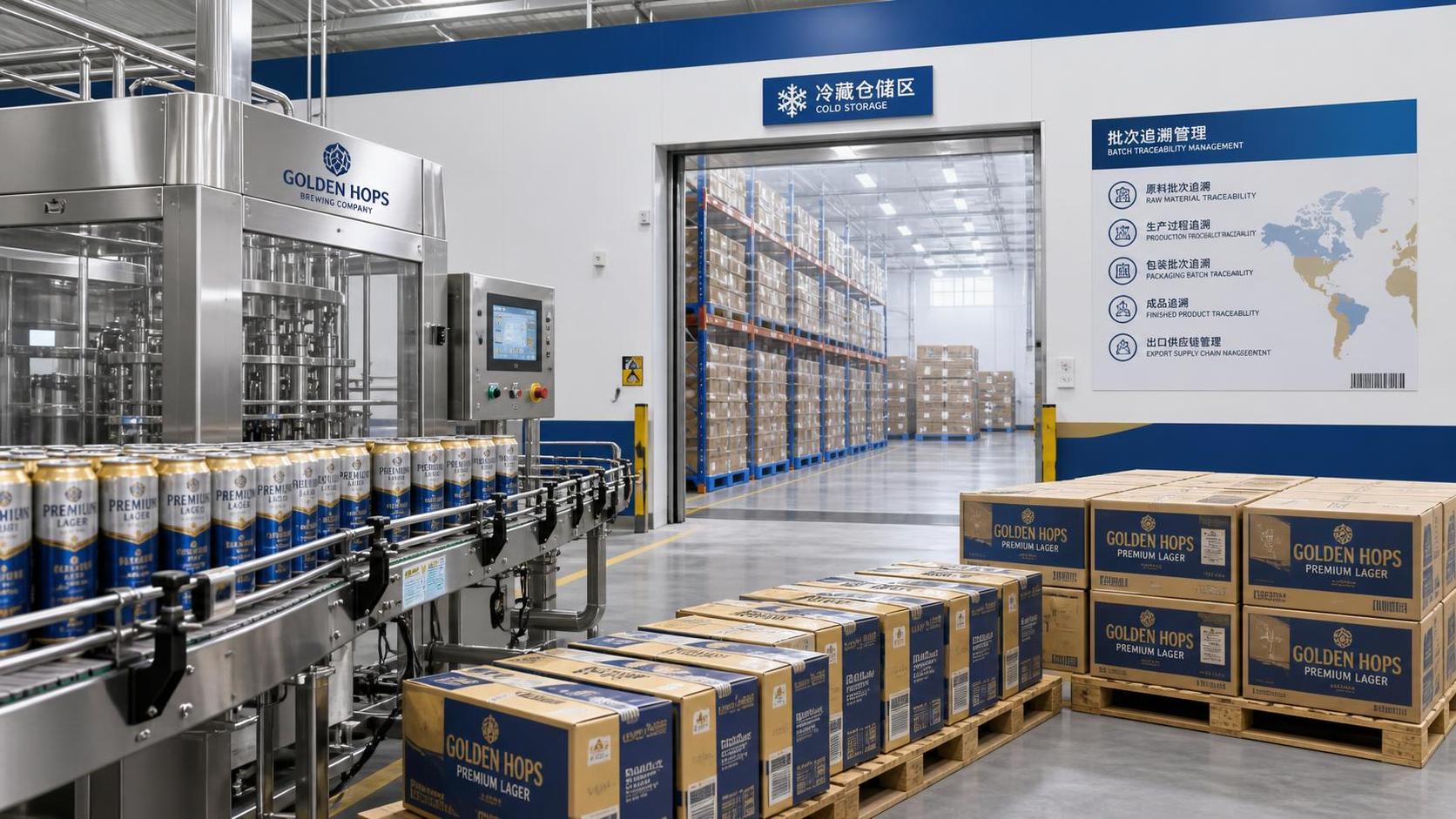
Traceability Is the Quality Memory of Every Beer Batch
Beer quality is often discussed in terms of recipe, brewhouse control, yeast management, filtration, and cold-chain performance. Those factors matter, but they do not answer a difficult question that quality teams eventually face: when a defect appears in the market, can the brewery prove exactly what happened, where it happened, and which products may be affected?
That is where traceability becomes practical rather than administrative. In the global beer supply chain, it creates a connected record from raw-material receipt to final delivery. A well-built system lets a quality manager link a finished bottle, can, keg, or carton back to its production batch, packaging line, ingredients, processing conditions, laboratory checks, warehouse movements, and shipping destination.
For breweries selling across borders, the task is more demanding than simply printing a lot code. Products may move through distributors, bonded warehouses, retail networks, restaurants, bars, and e-commerce fulfillment channels. A beer can be perfectly acceptable when it leaves the brewery yet suffer from poor storage, excessive heat exposure, packaging damage, or stock rotation failures further downstream. Traceability does not prevent every quality problem by itself. It gives the business a reliable path to investigate the problem without guessing.
The Chain Starts Before Brewing
Traceability should begin when malt, hops, yeast, water-treatment materials, fruit preparations, sweeteners, flavor systems, cans, bottles, crowns, labels, and cartons enter the site. The incoming record needs more than a supplier name. It should connect the supplier’s lot or batch information with the brewery’s internal receiving number, date of receipt, quantity, storage location, inspection status, and any relevant certificate or specification documents.
This is especially important for beers with a broader ingredient profile. A classic lager may have a relatively short materials list, while fruit-flavored beer, sugar-free low-calorie beer, wheat beer, or functional specialty beer can involve additional ingredients and more labeling considerations. The traceability burden is not necessarily complicated because the beer is innovative; it becomes complicated when materials are not clearly segregated, batch-issued, or reconciled.
A common weak point is the “partial use” problem. A hop lot may be used across several brews. A fruit base may be opened on one shift and consumed over several production days. Packaging materials can be issued to a line, returned, and reissued later. If records only show that a material was present in the warehouse, rather than identifying where and when it was used, the brewery may not be able to define the real scope of a quality incident.
Good traceability therefore works in both directions. Forward tracing asks: “Where did this malt lot, yeast culture, or printed label go?” Backward tracing asks: “Which inputs and process records were used for this finished product?” Both questions should have an answer that can be checked against physical inventory and production documentation.
Batch Identity Must Survive the Brewing Process
Brewing changes materials through milling, mashing, boiling, fermentation, maturation, blending, filtration, carbonation, and packaging. At each handoff, original supplier lot numbers may no longer be visible in the process. The brewery’s own batch identity becomes the bridge.
In practice, this means assigning a controlled brew or tank batch number and carrying it through every relevant record. The batch should be linked to the recipe version, raw materials issued, brew date, fermentation vessel, yeast handling record, transfer history, processing aids where applicable, laboratory results, release decision, and packaging run. If beer from more than one tank is blended before packaging, the record must show the relationship rather than treating the packaged beer as if it came from one source.
This is not paperwork for its own sake. Consider a packaging complaint involving unexpectedly low carbonation. The root cause might sit in the bright beer tank, the carbonation step, the filler, a closure issue, or even an improperly stored finished case. Without a clear connection between tank, line, time window, and destination, an investigation can become broad and expensive very quickly.
The same logic applies to microbiological concerns. Quality teams need to know whether a result relates to one vessel, one transfer route, a particular packaging run, or multiple finished lots. A traceability system cannot replace sanitation validation or laboratory testing, but it can show where to focus those technical checks.
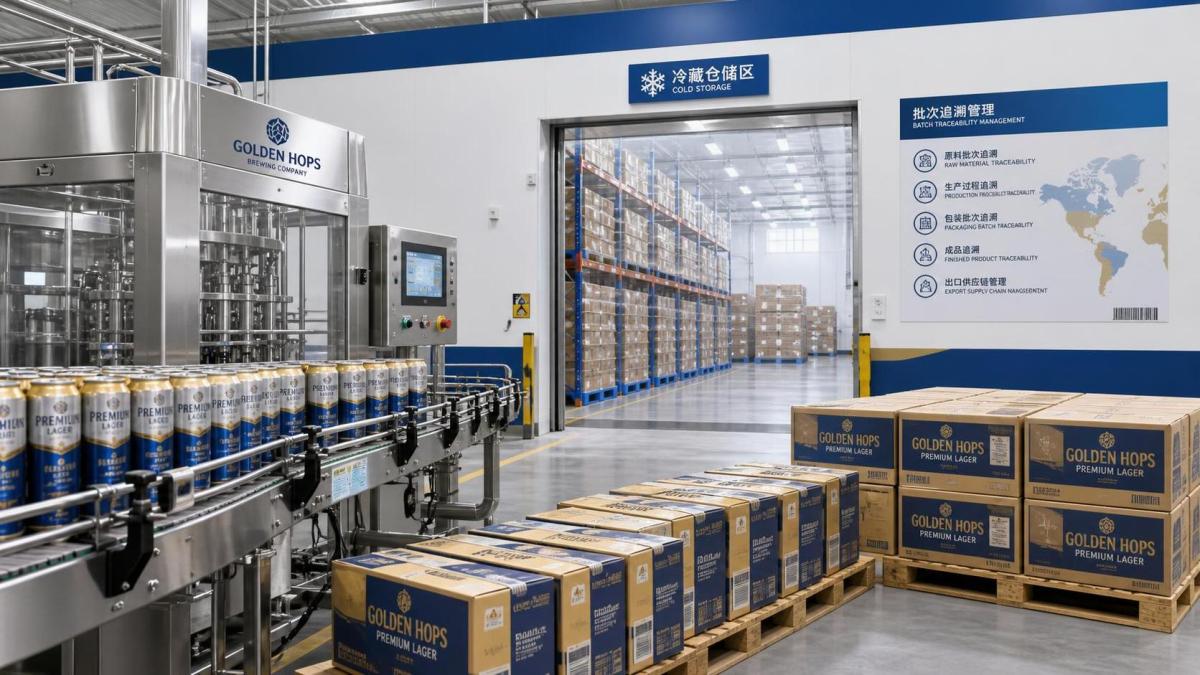
Packaging Is Often Where Traceability Either Works or Breaks
The packaging hall produces the code that customers, distributors, and inspectors are most likely to see. Yet a printed date or lot code is useful only if it can be decoded accurately and tied to production evidence. A code should allow the brewery to identify the product, packaging format, line or run where needed, production date or time logic, and finished batch relationship. The exact code design depends on the operation, market requirements, and internal control system, but ambiguity should be avoided.
There is a practical difference between a code that is readable and a code that is traceable. Faded ink, incorrect date settings, unreadable embossing, duplicate code formats, and labels applied to the wrong SKU can all undermine an otherwise capable system. During line start-up and changeover, checks should include not only visual pack appearance but also code correctness, legibility, and alignment with the scheduled product.
Packaging reconciliation is another underused control. If a run consumed a known number of cans, labels, cartons, or caps, the expected finished quantity, rejects, samples, and remaining material should broadly make sense together. Major unexplained differences do not automatically indicate a food-safety issue, but they can signal poor batch control, incorrect reporting, or unaccounted-for product. Those gaps become serious when a withdrawal or recall decision must be made.
For contract manufacturing and private-label work, documentation needs particular discipline. An OEM or ODM beer program may involve customer-specific recipes, artwork, language requirements, package formats, and destination-market labels. The brewery should preserve the approved version of the specification and artwork used for each run. Otherwise, a quality issue may become confused with a version-control issue: the beer may be sound, but the wrong declaration or market-specific label may have entered distribution.
Traceability Extends Through Warehousing and Export
Once beer is released, quality risk does not disappear. Finished goods need lot-controlled storage, stock rotation, and shipment records that connect each outbound consignment to the relevant batch or pallet identity. This becomes more important when one production lot is split across several distributors or when multiple lots are consolidated into one export shipment.
A useful warehouse record can answer simple but high-value questions: Which lot was loaded into this container? Which distributor received it? Was it delivered to a central warehouse, a supermarket chain, a bar wholesaler, or an e-commerce fulfillment point? Has any of the same lot remained in stock? If product is returned, can the returned cases be quarantined without mixing them back into saleable inventory?
Temperature and handling deserve attention, particularly for hop-forward craft beers and products with delicate flavor profiles. A shipment record alone cannot prove that every storage condition was ideal. However, shipping dates, receiving records, carrier details, container or pallet references, and documented deviations make it easier to establish whether distribution conditions may have contributed to flavor deterioration, haze, leakage, or package damage.
International trade also introduces document matching. Product name, SKU, lot code, pack configuration, quantity, and destination details should remain consistent across internal records and commercial shipping documents. Local import, labeling, deposit, shelf-life, or product-registration expectations vary by market, so compliance teams should confirm the applicable requirements for the destination rather than assume that one market’s practice applies everywhere.
What Quality Teams Need to Retrieve Quickly
A traceability exercise is valuable because it reveals whether the system works under time pressure. The objective is not to produce a large stack of records. It is to retrieve a coherent product history and define the affected scope with confidence.
The retrieval process should also identify what is not known. If the system can trace beer to a distributor but not to the distributor’s onward customers, that limitation should be visible in the risk assessment. Traceability responsibilities need to be discussed in distributor agreements and operating procedures, especially where product is sold into fragmented bar and restaurant channels.
Digital Tools Help, but Governance Decides the Result
Barcodes, QR codes, ERP platforms, warehouse management systems, and production software can reduce manual work and improve data retrieval. They do not automatically create a dependable traceability system. The underlying master data must be controlled: product codes, recipe versions, supplier names, units of measure, lot-number formats, and status definitions all need consistency.
Many failures are remarkably ordinary. A warehouse operator selects the wrong lot during picking. A line operator records the planned batch rather than the actual one. A supplier lot is typed incorrectly. A quality release is completed after stock has already moved. Technology can flag some of these errors, but it cannot replace clear work instructions, training, verification, and a culture in which staff are expected to stop and correct a mismatch.
For a producer such as Jinpai Beer, serving products ranging from classic lager and German wheat beer to sugar-free, fruit-flavored, and functional specialty beers, traceability also supports product differentiation without losing operational discipline. Different formulations and customer specifications may require different control points, yet the basic chain should remain consistent: approved input, identified batch, verified process, controlled packaging, released stock, and documented destination. This is equally relevant for branded production, wholesale supply, and customized OEM/ODM programs.
A System Should Be Tested Before It Is Needed
The best test is a realistic internal trace exercise. Select a finished pack from the warehouse or market sample and ask the team to reconstruct its history. Then reverse the exercise by selecting an incoming ingredient or packaging lot and identifying every finished batch and shipment connected to it. Do not judge the exercise only by speed. Review whether records agree, whether quantities reconcile plausibly, whether released and quarantined stock are distinguished, and whether responsible people know who makes a hold decision.
If the exercise exposes gaps, fix the process before buying more software. A simple, consistently followed batch-record structure is more useful than a sophisticated digital platform populated with incomplete data. For the global beer supply chain, traceability protects quality because it turns scattered operational events into evidence. When a complaint, deviation, or safety concern arises, that evidence allows the brewery to act precisely—protecting consumers without treating every case on the market as suspect.
Thank you very much for writing to us. Please leave your message and contact information, we will reply to you within 24 hours.