



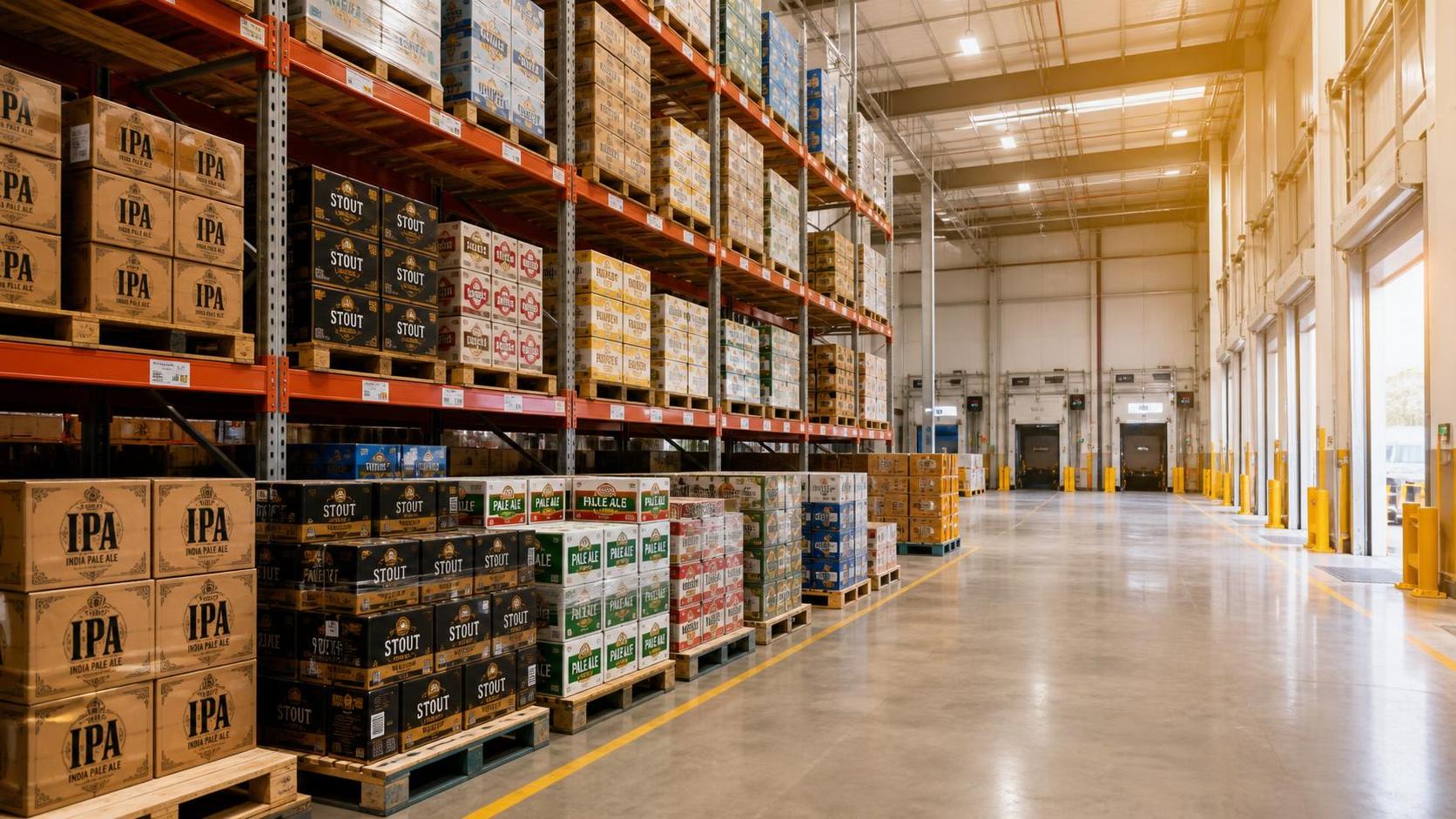
Regional warehousing can be a strategic asset in the global beer supply chain when buyers need faster replenishment, lower delivery risk and more reliable inventory planning across markets. For companies sourcing craft beer, specialty beverages or OEM/ODM products, a well-positioned warehouse network can balance freight cost, product availability and channel responsiveness. The important question is not whether a regional warehouse is inherently better than direct shipment from the brewery. It is whether the commercial and operational conditions justify placing inventory closer to the market.
Beer is a particularly demanding category for this decision. It is relatively bulky, often sensitive to heat exposure and transit delay, subject to market-specific alcohol regulation, and increasingly sold through channels with very different ordering patterns. A supermarket chain may require predictable case-level availability months ahead, while bars, restaurants and online sellers may need mixed-SKU replenishment in much smaller but more frequent orders. The right warehousing model depends on which of these demands dominates the business.
Regional storage is most useful when demand is repeatable, not merely promising
The most common mistake is treating strong initial market interest as evidence that a warehouse should be established. A successful trade show, a large first container order or an enthusiastic distributor can indicate opportunity, but does not yet demonstrate stable replenishment demand.
Regional warehousing becomes commercially credible when sales have moved beyond isolated imports and the market shows measurable ordering rhythm. This typically means that buyers can estimate reorder intervals, that the product mix is becoming clearer, and that stock-outs are beginning to create identifiable lost sales or channel penalties. The warehouse is then not simply a storage location; it becomes a service mechanism for a known flow of inventory.
Useful signs include:
- Several customers in the same region reorder regularly rather than buying only for promotional periods.
- Lead times from origin are causing missed listings, delayed seasonal launches or incomplete deliveries.
- Customers increasingly request mixed pallets, smaller drop sizes or rapid replacement of fast-moving SKUs.
- The same products have sufficient turnover across more than one country or city cluster.
- Local competitors are winning orders mainly because they can deliver available stock faster, rather than because their product is fundamentally different.
Where demand is uncertain, direct container shipment, shipment through an importer’s own facility, or a shared third-party logistics arrangement is generally less risky. Holding finished beer in a regional warehouse before the market has demonstrated repeatability can convert commercial uncertainty into inventory exposure.
The case is strongest where speed affects channel access
Not every beer channel values lead time equally. For some importers, a 45- to 75-day replenishment cycle may be acceptable if they place full-container orders and plan their promotions well in advance. For other channels, that timing is commercially unworkable.
Regional stock provides the greatest benefit in fragmented, service-sensitive channels. Independent bars and restaurants often need flexibility: a buyer may add a fruit-flavored beer for summer, replace a missing wheat beer before a weekend event, or trial a low-calorie option without committing to a full import lot. E-commerce operators may require daily order fulfillment and reliable stock visibility. Specialty retailers may expect deliveries of assorted SKUs rather than single-product pallets.
In these conditions, inventory positioned within the region allows the supplier or local distribution partner to convert bulk imports into market-appropriate orders. The warehouse creates value by breaking down full-container economics into sellable quantities that match the buyer’s operating reality.
This is especially relevant for a portfolio containing classic lager, German wheat beer, sugar-free or low-calorie beer, fruit-flavored products and functional specialty beers. Different segments can have very different sales velocity. A mainstream lager may support predictable replenishment, while a seasonal fruit beer may be purchased in short bursts. A regional warehouse allows these products to be allocated separately rather than forcing every customer to import the same fixed assortment.
Freight savings alone rarely justify a warehouse
It is tempting to frame the decision as a comparison between ocean freight to each destination and one consolidated shipment into a regional hub. Consolidation can reduce transport cost per case, particularly where several markets are served from a major port or logistics corridor. But freight is only one part of the landed-cost equation.
A realistic assessment includes inbound freight, terminal handling, customs clearance, duties and excise arrangements, warehouse rent, inbound and outbound handling, pallet storage, picking, local delivery, insurance, inventory finance, damaged-stock allowance and obsolescence risk. For beer, stock ageing and quality loss cannot be treated as minor accounting details. A lower freight rate is not a saving if the business subsequently discounts inventory because it has spent too long in the system.
The relevant comparison is therefore not “central shipping versus local stock” in isolation. It is:
What is the total cost of achieving the required service level, at the expected sell-through rate, while preserving product quality and regulatory compliance?
For a limited number of large customers buying full pallets or containers, direct shipment may remain the lower-cost model. For a dispersed customer base ordering mixed cases, the incremental warehouse cost may be offset by reduced delivery failures, better customer retention and fewer emergency airfreight or courier interventions. Those service benefits should be quantified rather than assumed.
Beer freshness changes the inventory calculation
Beer does not have one universal “safe” storage period. Shelf life depends on formulation, packaging, pasteurization approach, oxygen control, hop profile, alcohol content and the producer’s stated specifications. The warehouse decision must therefore begin with product-level quality parameters, not with generic food-storage assumptions.
Hoppy craft beers, for example, may lose their intended aroma profile sooner than a more stable lager even when both remain technically within date. Fruit-based and functional specialty beers may also require closer monitoring of flavor stability, sedimentation or ingredient-related changes. A regional warehouse that shortens final delivery time can improve freshness at the point of sale, but only if inventory is replenished in sensible lot sizes.
This creates an important trade-off. More regional stock can improve availability, yet too much stock can raise the probability that beer reaches customers with reduced remaining shelf life. The best networks are not necessarily those with the largest buffer. They are those that match inbound shipment frequency to actual consumption and operate disciplined first-expired, first-out inventory control.
Warehouse capability should be tested in practical terms:
- Can the operator maintain appropriate temperature conditions during storage and loading?
- Are temperature records available for customers or quality investigations where required?
- Can stock be managed by production lot, best-before date and destination market?
- Is first-expired, first-out execution embedded in the warehouse management process?
- Are there procedures for damaged cans, broken glass, leakage, recalls and blocked inventory?
- Can the facility segregate products with different labeling, language or regulatory status?
A standard dry warehouse may be adequate in some climates and for some beer styles, but that conclusion should not be assumed. Heat exposure during port dwell, local trucking and warehouse storage can be more consequential than the ocean transit itself. Seasonal temperature peaks and delivery-route conditions deserve attention during supplier qualification.
Regulatory design may matter more than geography
In alcoholic beverages, the most convenient map location is not always the most practical supply-chain location. Customs rules, excise treatment, bonded-storage availability, labeling requirements and the legal role of the importer can all determine whether a regional warehouse simplifies trade or adds another layer of complexity.
A warehouse serving multiple markets must not be evaluated only by distance to customers. It must also be assessed against the movement of alcoholic goods between the hub and each destination. In some trading blocs, established procedures can support regional distribution efficiently. In other cases, every onward shipment may trigger separate declarations, tax treatment, local label checks or licensed-importer requirements. A hub that appears efficient on a freight map may become administratively expensive once country-level obligations are included.
Label compliance is a frequent source of avoidable delay. Requirements can differ by market for language, alcohol declaration, ingredient information, allergen statements, deposit marks, recycling symbols, health warnings and local responsible-party details. If a warehouse holds stock intended for multiple markets, the operator must be able to prevent misallocation of market-specific packaging. Overstickering can offer flexibility in some jurisdictions, but it is not a universal solution and should be confirmed before inventory is shipped.
For this reason, the warehouse model should be designed alongside the import model. Questions such as who acts as importer of record, who holds excise liability, when title transfers, and who is responsible for withdrawal or recall must be contractually clear. These are not secondary legal details; they determine working capital, risk ownership and the speed at which stock can be released.
A regional hub is not always the right answer
There are situations where direct import remains more rational. A new market with unproven demand should generally avoid a dedicated stock position. The same is true where one national distributor has sufficient scale, has its own compliant warehouse and is willing to carry inventory risk. In that case, duplicating storage may add cost without improving service.
Direct shipment also suits products with highly concentrated demand. If most volume goes to a small number of large retail accounts, a full-container or full-pallet model can preserve freshness and reduce handling. A warehouse adds limited value when orders are already large, predictable and geographically concentrated.
Another caution applies to broad but shallow portfolios. Offering many beer styles is commercially attractive, but each additional SKU requires a demand forecast, minimum stock threshold, packaging control and shelf-life plan. Regional warehousing can hide poor assortment discipline for a while, but it cannot solve it. Slow-moving specialty products should usually be held in smaller quantities, replenished against confirmed programs, or managed through a make-to-order approach where feasible.
Choosing between a distributor warehouse, 3PL and dedicated facility
There are three common models, each with different implications for control and capital commitment.
A distributor-held warehouse works well when one importer has genuine market reach, strong execution capability and willingness to purchase stock. It reduces the producer’s operational burden, but may limit visibility into inventory, pricing and customer demand. The arrangement is strongest when sales reporting, minimum stock obligations and brand-handling expectations are clearly defined.
A shared third-party logistics warehouse is often the practical intermediate step. It can provide scalable storage, customs or bonded capability where available, and multi-customer fulfillment without the fixed cost of a dedicated site. However, service levels vary substantially. Beer suppliers should assess not only storage price but cut-off times, order accuracy, claims handling, lot traceability, temperature management and experience with alcohol products.
A dedicated regional facility offers the highest level of control over inventory allocation, customer service and market data. It is usually justified only when volume is sustained, the region serves multiple meaningful markets, and the business can support dedicated management, compliance and working-capital needs. A dedicated site is a strategic infrastructure decision, not simply a larger version of a 3PL contract.
Build the decision around inventory velocity and failure cost
A sound evaluation starts with a demand and service model rather than a property search. Map each destination by expected annual volume, order frequency, average order size, required lead time, product mix, import route and shelf-life sensitivity. Then identify the cost of failure: lost retail shelf space, missed promotional windows, bar delistings, stock write-offs, emergency transport or customer penalties.
The warehouse proposition is strongest when the cost of frequent stock failure exceeds the cost of holding a carefully controlled regional buffer. It is weakest when the business is simply trying to compensate for inaccurate forecasting or uncertain market ownership.
Before committing, run a staged scenario: begin with a limited SKU set, define maximum days of stock by product family, use a 3PL or established importer facility, and review actual sell-through before expanding. Measure fill rate, stock ageing, order-to-delivery time, handling cost per case, damage rate, forecast error and the share of inventory approaching its preferred sales window. These indicators reveal whether the warehouse is improving the supply chain or merely relocating inventory risk.
The practical threshold: service advantage with disciplined stock control
Regional warehousing is useful when it creates a measurable service advantage that direct shipment cannot reliably provide. In the global beer supply chain, that usually means serving multiple customers or markets from consolidated inbound shipments, enabling faster mixed-SKU fulfillment, protecting continuity for important retail and hospitality accounts, and managing inventory without compromising freshness.
It is not automatically the best model for every exporter, brewery or beverage portfolio. The commercial case depends on demand stability, channel fragmentation, regulatory architecture, product shelf-life behavior and the true cost of capital tied up in stock. Companies that evaluate those variables together are far more likely to build a warehouse network that supports profitable expansion rather than adding complexity to an already challenging international beer operation.
Thank you very much for writing to us. Please leave your message and contact information, we will reply to you within 24 hours.