



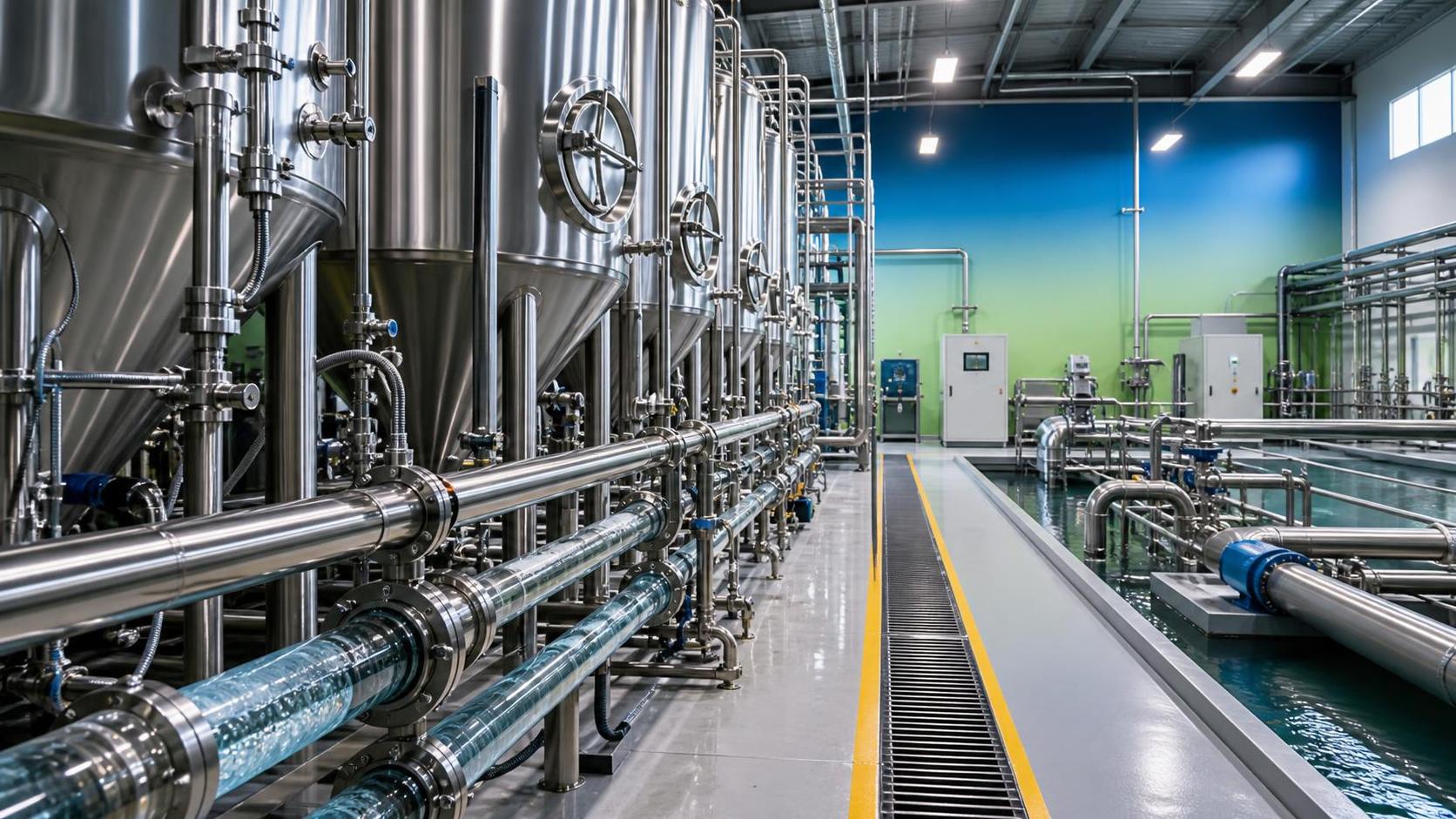
Large-scale beer production affects water use in two ways at once: it raises total site demand as output grows, and it can either improve or worsen water efficiency per hectoliter depending on plant design and operating discipline. A larger brewery has more opportunities to recover heat, automate cleaning, reuse suitable non-product water, and stabilize processes. It also has larger cleaning circuits, more packaging equipment, greater wastewater volumes, and less tolerance for small losses repeated across many shifts.
For a brewery owner, contract manufacturer, or beverage investor, the relevant question is therefore not simply how much water a brewery consumes. It is whether water availability, treatment capacity, wastewater discharge conditions, and unit water use can support the planned production mix without creating a cost, compliance, or capacity constraint.
Beer itself is largely water, but the liquid in the bottle or keg represents only part of the brewery's water footprint. Water is also used to mill and mash raw materials, brew, cool, rinse, clean tanks and pipelines, sanitize filling equipment, generate steam, manage refrigeration systems, and wash packaging. Every additional production stage introduces a different water-quality requirement and a different potential loss point.
Why production scale changes the water equation
A small brewery may operate with relatively simple equipment and intermittent production. Its absolute water demand is limited, but its water use per unit of beer can be high because cleaning and changeover water are spread across shorter production runs. A large site can produce longer runs, centralize utilities, and use automated cleaning-in-place systems. Those advantages can reduce water intensity, provided the plant is engineered and managed around measurable water targets.
Scale also magnifies inefficiency. A rinse valve that runs longer than required, a tank that receives an unnecessary extra cleaning cycle, or a cooling-water circuit with poor controls may look minor during one shift. Across multiple brewhouses, filling lines, fermentation vessels, and round-the-clock production, the same issue becomes a material operating cost.
Large-scale beer production can therefore lower water use per hectoliter while increasing total withdrawals from the local water source. Both statements can be true. This distinction matters when evaluating expansion projects. A brewery may improve internal efficiency but still place substantial pressure on a municipal supply, industrial water network, or local aquifer because its total output has grown sharply.
Decision-makers should separate three measurements:
- Total water withdrawal: the volume entering the site from municipal, groundwater, surface-water, or other approved sources.
- Water-to-beer ratio: total brewery water used divided by packaged beer volume, usually monitored as a site efficiency indicator.
- Water discharge and load: the volume and composition of wastewater leaving the facility, including organic load, cleaning chemicals, suspended solids, temperature, and pH considerations.
Focusing on only one of these measurements can produce a misleading picture. A site with a strong water-to-beer ratio may still require major wastewater infrastructure. A brewery with moderate total withdrawal may face serious operating difficulty if its incoming water quality varies or if local discharge limits are restrictive.
Where water is consumed beyond the brewhouse
The brewhouse is highly visible, but it is rarely the only area that determines site water performance. Water embedded in the product is relatively predictable. The larger management challenge comes from cleaning, packaging, utilities, and the handling of process losses.
Cleaning-in-place systems are often among the most important areas to examine. Fermentation tanks, bright beer tanks, filters, transfer lines, fillers, and kegging equipment must be cleaned consistently to protect microbiological stability and flavor quality. On a large production site, cleaning sequences can account for a considerable share of non-product water use. The issue is not that cleaning should be reduced indiscriminately. Poor sanitation can create product loss, recalls, damaged brand reputation, and even more water use when equipment must be re-cleaned.
The useful operational question is whether each cleaning step is matched to the equipment condition, production schedule, and validated hygiene requirement. Excessively conservative cycle times, uncontrolled final rinses, poorly maintained spray devices, and unnecessary cleaning between compatible runs can all increase water demand without improving product protection.
Packaging operations introduce another large set of water demands. Returnable bottles and kegs require washing. Filling lines may need regular rinsing and sanitation. Conveyor lubrication, pasteurization, labeler cleaning, and floor washdown can add up, particularly when a facility operates several package formats. Cans, bottles, kegs, and bulk supply arrangements do not create identical water profiles. A brewery expanding into new formats should assess packaging water use early rather than treating it as a later utility detail.
Utilities matter as well. Steam generation may require feedwater treatment and blowdown management. Cooling towers can lose water through evaporation, drift, and controlled bleed-off. Refrigeration systems, air compressors, and heat exchangers can create indirect water demand when their controls or maintenance are inadequate. A water-reduction project limited to the brewhouse will often miss these recurring losses.
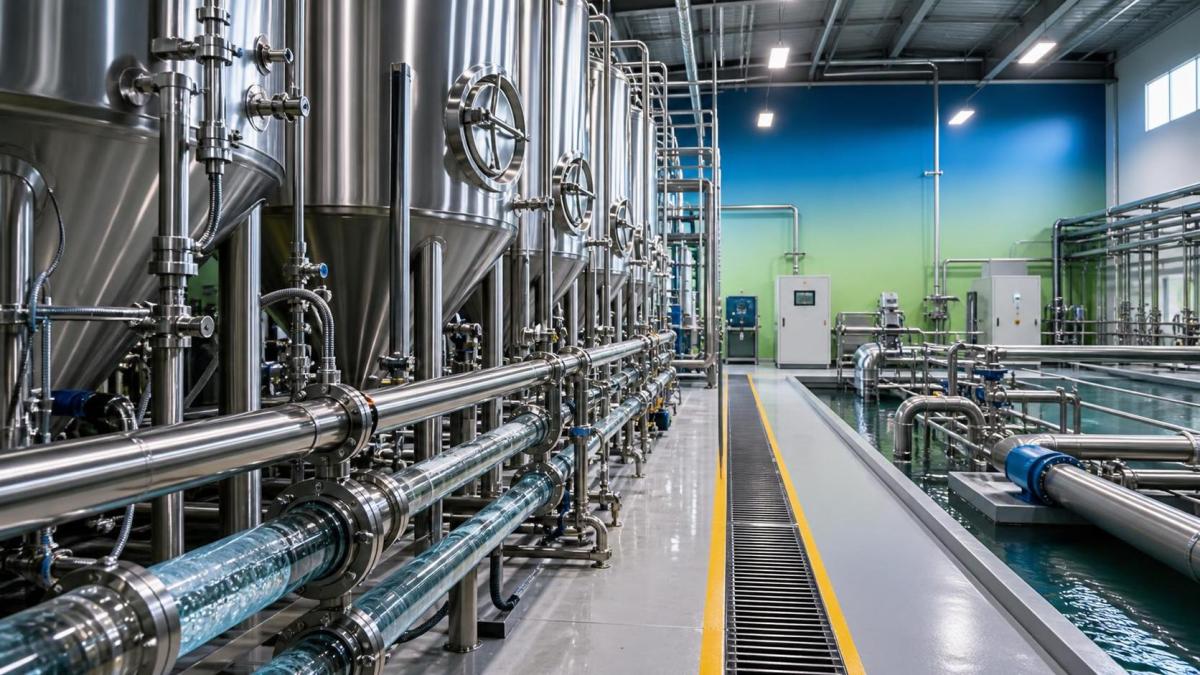
Water quality can become a production constraint
More water is not always the answer to brewery growth. Large sites need water of appropriate and consistent quality for different uses. Brewing liquor affects mash performance, hop expression, fermentation behavior, and flavor balance. Water used for final rinsing or product-contact applications needs stricter control than water used for some utility functions. Treating all incoming water to the highest standard for every task can waste energy and treatment capacity, yet using inadequately treated water in critical operations can compromise beer quality.
This is particularly relevant for breweries producing a broad portfolio. A classic lager, a German-style wheat beer, a fruit-flavored beer, and a specialty functional beer may have different processing sensitivities, cleaning requirements, and changeover profiles. Product diversification can increase the frequency of tank turnover and line sanitation even when total volume remains stable.
Water chemistry also affects equipment reliability. Hardness, alkalinity, dissolved minerals, organic matter, and microbiological conditions may influence scaling, corrosion, filtration performance, membrane treatment, and cleaning effectiveness. If source-water conditions fluctuate, the brewery may need more robust pretreatment and tighter monitoring. That requirement has a direct effect on capital expenditure, operating cost, and production continuity.
For this reason, expansion planning should not assume that an existing water source can simply be scaled up. The evaluation should include source capacity, seasonal reliability, treatment needs, emergency storage, monitoring points, and the quality specification required for each use category.
Wastewater is part of water use, not a separate afterthought
Water that leaves the brewery has operational and financial consequences. Brewing wastewater can contain spent yeast, beer losses, sugars, proteins, cleaning agents, and solids. Its organic load may change substantially with production losses, tank dumping, packaging incidents, or changes in cleaning schedules. High-strength discharges can increase treatment requirements or create difficulty for municipal systems, depending on local discharge arrangements.
At large scale, avoiding product loss is often one of the most effective water-management measures because spilled or discarded beer carries both product value and wastewater load. A line stop, overfill event, off-spec batch, or poor recovery during transfer creates a compound loss: the brewery has already used water, energy, ingredients, labor, and treatment capacity before the product becomes waste.
Wastewater strategy should be considered alongside expansion decisions for brewing, filtration, and packaging. Questions worth resolving before capacity is added include:
- Can the existing wastewater system handle the planned peak flow, not only the average daily volume?
- How will high-organic-load streams be identified and controlled before discharge?
- Are cleaning chemicals, pH swings, and temperature variations compatible with the treatment approach?
- Will additional packaging lines create washwater flows that occur at the same time as brewing or cleaning peaks?
- Is there enough monitoring to distinguish normal process use from leaks, losses, and abnormal discharge events?
A wastewater facility designed around average output can become a bottleneck during high-volume periods. Production planning and utility planning should therefore use peak conditions, scheduled cleaning windows, and foreseeable product-mix changes rather than a single annual production estimate.
How to reduce water use without weakening beer quality
The most reliable improvement programs begin with measurement by process area. A single monthly utility bill cannot reveal whether water is being used in the brewhouse, cellar, packaging hall, cleaning system, cooling plant, or general site services. Submetering does not solve waste by itself, but it allows operators to see abnormal consumption and compare water use against production activity.
Metering should be linked to practical operating signals: brew count, hectoliters packaged, cleaning cycles, package format, tank occupancy, and line downtime. This helps separate legitimate increases from poor control. A higher water reading during a planned bottle-washer run may be expected. The same increase during an idle period should trigger investigation.
Cleaning optimization is usually a better starting point than arbitrary water cuts. Facilities can review rinse duration, conductivity-based phase separation, recovery of suitable final-rinse water for lower-grade applications, spray-device performance, and the conditions that trigger a full cleaning cycle. Any reuse arrangement must respect hygiene design, local requirements, chemical compatibility, and the risk of cross-contamination. Water intended for product contact should not be treated casually simply because it appears clean.
Recovery opportunities also exist in utilities. Condensate return, heat recovery, optimized cooling-tower control, leak detection, and appropriately designed rinse-water collection can reduce the amount of fresh water required. Each project should be assessed as a system. A reuse scheme that saves water but increases microbial risk, maintenance burden, energy demand, or wastewater complexity may not improve the brewery's overall performance.
Production scheduling can have a meaningful effect. Longer compatible runs may reduce cleaning frequency and changeover losses. However, scheduling decisions must also account for freshness, inventory risk, contract commitments, and the different handling requirements of flavored or specialty beers. The objective is not to maximize run length at every cost; it is to reduce avoidable cleaning and product loss while maintaining service levels and quality control.
What investors and operators should ask before expanding capacity
Water should be treated as a core capacity input alongside malt supply, fermentation volume, packaging speed, energy, and labor. Before approving a large-scale beer production project or selecting an OEM manufacturing partner, decision-makers should ask for a process-based water assessment rather than a general sustainability statement.
There is no single water-use figure that can determine whether a brewery is efficient or ready to scale. Production technology, package mix, local source conditions, cleaning validation, reuse options, and discharge requirements all shape the result. A brewery with a lower headline ratio is not automatically the stronger operating model if that result depends on fragile hygiene controls or excludes important water streams.
The more durable approach is to build water management into plant design and daily operations from the start: measure by area, protect product quality, control loss before treatment, and test capacity against peak conditions. For large beer producers, water is not merely a utility expense. It is a production-limit, quality-control, and resilience issue that becomes more visible as volumes rise.
Thank you very much for writing to us. Please leave your message and contact information, we will reply to you within 24 hours.