



How China Beer OEM Partnerships Are Shifting in 2026 Amid New Export Compliance Rules
As new export compliance rules take effect in 2026, China beer OEM partnerships are undergoing strategic recalibration—impacting lead times, documentation, and quality certification requirements. For global beverage brands and distributors seeking agile, compliant manufacturing partners, understanding these shifts is no longer optional. Jinpai Beer, a certified craft beer OEM/ODM provider specializing in lagers, wheat beers, low-calorie, fruit-infused, and functional brews, helps international clients navigate evolving regulations while maintaining brand integrity and market readiness. Discover how forward-thinking China beer OEM collaborations are adapting—and why timing matters now.
What’s Really Changing for Global Brands in 2026?
The 2026 regulatory updates aren’t just procedural tweaks—they’re structural shifts. China’s General Administration of Customs (GACC) and the State Administration for Market Regulation (SAMR) have introduced mandatory pre-shipment verification for all alcoholic beverage exports, including batch-level traceability, ingredient origin mapping, and third-party lab validation against destination-market standards (e.g., EU Regulation (EC) No 110/2008 or U.S. TTB labeling rules).
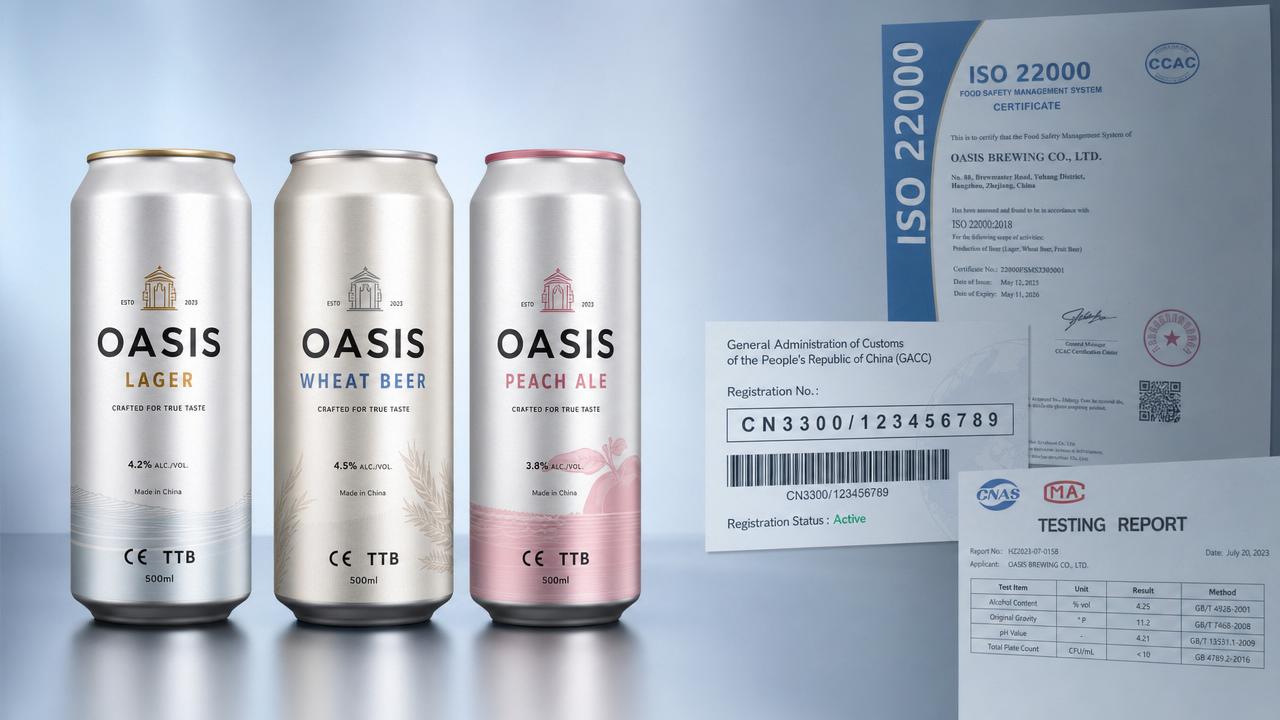
Crucially, OEM contracts signed *before* Q2 2026 will operate under grandfathered documentation protocols. Those signed after April 1, 2026 must comply with the new “Three Certifications” framework: (1) GACC Export Food Producer Registration (updated annually), (2) ISO 22000 + HACCP integration audit reports, and (3) product-specific conformity declarations validated by CNAS-accredited labs. This isn’t about more paperwork—it’s about verifiable, auditable control points across the supply chain.
Why Lead Times Are Extending—and How Smart Brands Are Compensating
Under the new rules, average OEM lead time has increased from 8–10 weeks to 14–18 weeks for first-batch production. The delay stems not from brewing capacity but from mandatory pre-production compliance staging: raw material vetting (especially imported hops/malt), formulation review by SAMR-designated technical consultants, and dual-signature batch release approvals.
Yet leading global partners aren’t waiting—they’re compressing timelines upstream. Jinpai Beer now offers “Compliance-Ready Onboarding”: a 3-week pre-contract audit that maps your target market’s regulatory thresholds (e.g., residual sugar limits in Japan, gluten-free claims in Germany, or sweetener disclosures in Canada) and pre-validates formulations against them. Clients using this service reduce post-signing delays by 40% on average and avoid costly reformulation mid-cycle.
Quality Certification Isn’t Just About “Passing”—It’s About Market Access
Many decision-makers assume ISO 9001 or BRCGS certification is sufficient. It’s not. Under 2026 rules, certification validity hinges on *scope alignment*. A brewery certified for “non-alcoholic beverages” cannot legally produce beer under OEM—even if the facility is identical. Jinpai Beer holds GACC-certified scope for “alcoholic malt beverages up to 12% ABV,” covering lagers, wheat beers, fruit-infused variants, and functional brews with added vitamins or botanicals.
More importantly, we maintain parallel certification pathways: one aligned with EU food safety directives (including allergen cross-contamination controls), another with U.S. FDA FSMA Preventive Controls, and a third for ASEAN’s ASEAN Guidelines on Alcoholic Beverages. This means your OEM partner doesn’t just meet baseline Chinese export rules—they embed your destination market’s compliance logic into every production SOP.
OEM Flexibility vs. Regulatory Rigidity: Where Customization Still Wins
Some fear the new rules will erode customization. In practice, they’ve elevated it. With stricter input controls, breweries like Jinpai now co-develop formulations *with* regulatory constraints baked in from Day One—e.g., selecting only TTB-accepted natural flavorings for U.S.-bound batches or using only EU-authorized stabilizers for European SKUs.
This transforms OEM from “contract brewing” into “compliant co-creation.” We’ve supported clients launching sugar-free hazy IPAs in Australia (meeting FSANZ’s novel food provisions), low-calorie sour beers in Mexico (aligned with NOM-189-SCFI-2018), and functional ginger-turmeric lagers in Singapore (validated under HSA’s health claim framework). The constraint breeds precision—not limitation.
What to Audit in Your Next China Beer OEM Partner (Beyond Certificates)
Certificates verify capability; operational discipline ensures consistency. When evaluating a China beer OEM partner in 2026, go beyond the audit report. Ask for:
• Evidence of *active* GACC registration renewal (not just issuance date);
• Batch records showing real-time traceability from barley lot to finished can—ideally with QR-linked digital logs;
• Proof of annual third-party re-audits for *each* destination market you serve;
• Sample export documentation packages—including completed GACC Form AQSIQ-07 and destination-specific health certificates.
Jinpai provides full transparency here: All client-facing documentation templates are pre-vetted by our in-house regulatory affairs team, and every export shipment includes a compliance dossier—digital and physical—ready for customs inspection upon arrival.
Strategic Timing: Why Q2 2025 Is the Optimal Window for Partnership Review
Signing an OEM agreement in Q2 or Q3 2025 positions you to leverage grandfathered protocols for initial production runs while using the 6–9 month ramp-up window to align internal systems (labeling workflows, QA checklists, distributor training) with 2026 requirements. It also allows time to stress-test your chosen partner’s compliance responsiveness—e.g., how quickly they adapt a label for South Korea’s new KFDA allergen font-size mandate or adjust carbonation levels for Saudi Arabia’s halal-certified packaging line.
Conversely, delaying until late 2025 or 2026 risks bottlenecks: accredited labs are already booking 4–6 months out for pre-shipment validation, and GACC’s online filing portal shows peak congestion in November–December. Forward-looking brands are locking in capacity and compliance pathways now—not when shelf dates loom.
Conclusion: Compliance Is Now a Core OEM Differentiator—Not a Checkbox
The 2026 export rule changes haven’t made China beer OEM harder—they’ve made it *more strategic*. What used to be a cost-driven sourcing decision is now a risk-mitigated, market-integrated growth lever. The most valuable partners don’t just “meet compliance”; they translate regulatory complexity into speed-to-shelf, brand-aligned quality, and jurisdiction-specific agility.
Jinpai Beer operates at this intersection: certified, craft-capable, and built for global scalability. Whether you’re scaling a regional craft brand into Asia, launching a functional beer line in Europe, or refreshing your low-calorie portfolio for North America—we design OEM partnerships where compliance enables—not constrains—your market ambitions. The shift is underway. The question isn’t whether your OEM model adapts. It’s whether it leads—or follows.
Thank you very much for writing to us. Please leave your message and contact information, we will reply to you within 24 hours.