



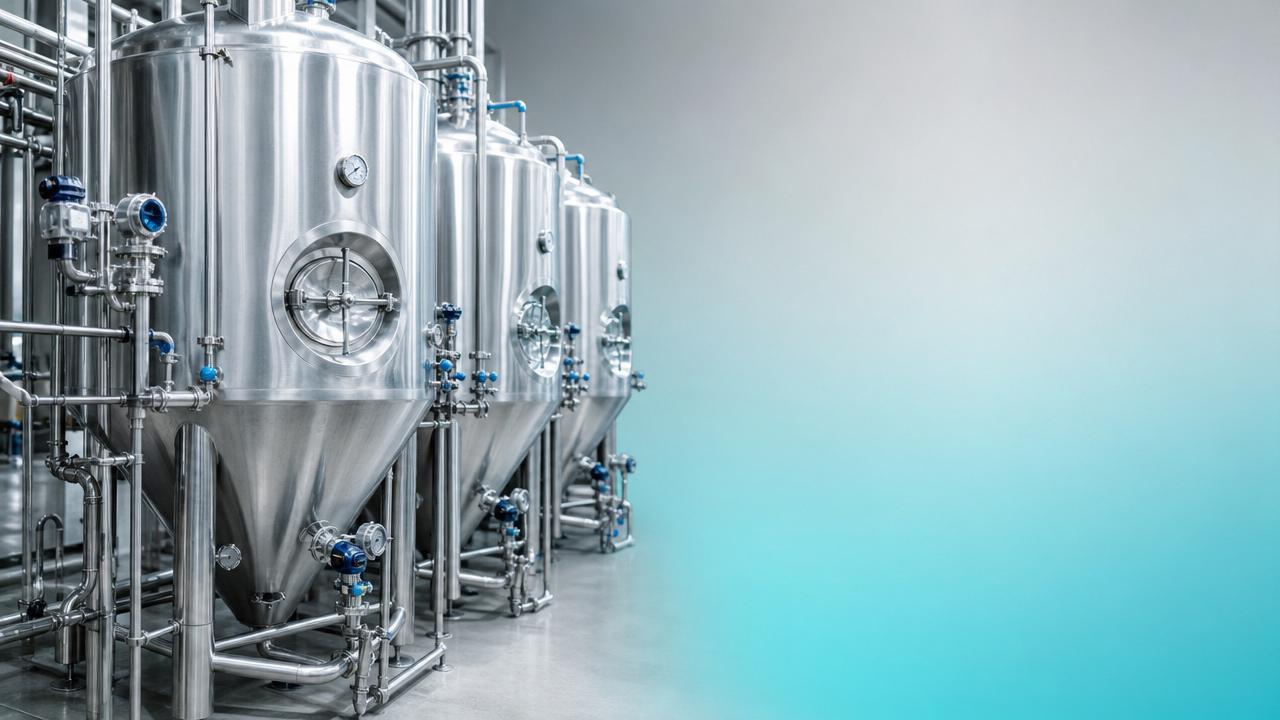
In today’s competitive craft beer market, consistency is non-negotiable—especially for quality- and safety-focused teams managing a Beer factory. At Jinpai Beer, we’ve integrated next-generation control systems into our brewing automation to minimize batch-to-batch variability, enhance real-time monitoring, and strengthen HACCP compliance. This article explores how intelligent automation empowers quality control and safety personnel to achieve unprecedented repeatability, traceability, and regulatory confidence—without compromising the artisanal integrity of lagers, wheat beers, low-calorie variants, or functional specialties.
What Is Beer Factory Automation?
Beer factory automation refers to the coordinated use of programmable logic controllers (PLCs), distributed control systems (DCS), sensor networks, and data analytics platforms across mashing, boiling, fermentation, conditioning, and packaging stages.
It replaces manual logging, analog gauges, and isolated SCADA interfaces with synchronized digital workflows. Each process step is governed by validated setpoints, dynamic feedback loops, and audit-ready electronic batch records.
For a Beer factory producing diverse styles—from German wheat to sugar-free low-calorie beer—automation ensures identical thermal profiles, oxygen management, and yeast pitching accuracy across every 30-hectoliter batch.
Why Batch Variability Remains a Critical Challenge
Even minor deviations during key phases introduce measurable inconsistencies:
- ±0.5°C in mash temperature → altered enzyme activity → inconsistent fermentability
- ±2 minutes in whirlpool hop contact time → variable IBU and aroma oil retention
- ±0.1 bar pressure fluctuation in fermentation vessels → shifted ester/phenol ratios in wheat beers
- Inconsistent dissolved oxygen (DO) pre-fermentation → sluggish starts or off-flavor formation in low-calorie variants
These variables compound across production lines. A Beer factory supplying global restaurants and supermarkets cannot rely on sensory review alone to catch drift before release.
How Modern Control Systems Reduce Variability
Jinpai Beer deploys a layered architecture combining three core elements:
- Adaptive Process Controllers: Self-tuning PID algorithms adjust steam flow, cooling rates, and agitation speed in real time based on live temperature, pH, and density readings.
- Unified Data Historian: All sensors feed into a time-synchronized database with millisecond-level timestamps—enabling precise root-cause analysis of any deviation.
- Automated Batch Release Logic: Final validation checks include gravity stability, CO₂ saturation, microbiological hold times, and spectral absorbance thresholds—no human override permitted without dual-manager approval.
This system reduced standard deviation in original gravity (°P) from ±0.8 to ±0.2 across 12 months of lager production. For fruit-flavored beers, colorimetric consistency improved by 92% versus manual spectrophotometer sampling.
Impact Across Product Categories
Automation delivers differentiated value per formulation type:
Operational and Compliance Benefits
Beyond quality, automation strengthens foundational operations:
- HACCP alignment: Automated critical limits enforcement eliminates manual deviation reporting delays.
- Traceability: Full genealogy tracking from barley lot ID through yeast strain passage number to finished can lot code.
- Resource efficiency: 12% reduction in steam consumption and 8% lower CIP chemical usage via optimized cycle sequencing.
- OEM/ODM flexibility: Recipe templates store exact parameters for client-branded variants—switching takes under 90 seconds.
Every Beer factory seeking wholesale distribution to EU retailers or FDA-regulated markets gains faster audit readiness and fewer corrective actions.
Practical Implementation Considerations
Successful deployment requires attention to three dimensions:
- Phased Integration: Start with fermentation and filtration controls—highest ROI and lowest process disruption.
- Sensor Calibration Discipline: Schedule quarterly third-party verification of all inline pH, DO, and turbidity probes.
- Personnel Upskilling: Train brewers not as operators but as system interpreters—emphasizing data diagnosis over mechanical troubleshooting.
Avoid “big bang” rollouts. Jinpai Beer completed full automation in 14 months across six production lines—each line maintained >99.2% uptime during transition.
Next Steps for Your Beer Factory
If your Beer factory produces multiple SKUs for global retail channels—or supports OEM partners requiring certified repeatability—start with a targeted assessment:
- Map your top three variability-prone processes using historical QC failure logs.
- Compare current manual intervention frequency against industry benchmarks (e.g., >3 adjustments per brew day signals automation readiness).
- Request a recipe-specific feasibility report—including ROI timeline and integration scope—for your lager, wheat, low-calorie, or functional beer lines.
Jinpai Beer offers turnkey automation consulting, custom control system design, and co-manufacturing support for brands scaling internationally. Contact us to align your Beer factory’s next evolution with precision, compliance, and craft authenticity.
Keywords: Beer factory, beer factory automation, batch variability, brewing control systems, craft beer consistency, lager production automation, wheat beer fermentation control, low-calorie beer manufacturing, functional beer quality assurance, HACCP-compliant brewing.
Thank you very much for writing to us. Please leave your message and contact information, we will reply to you within 24 hours.