



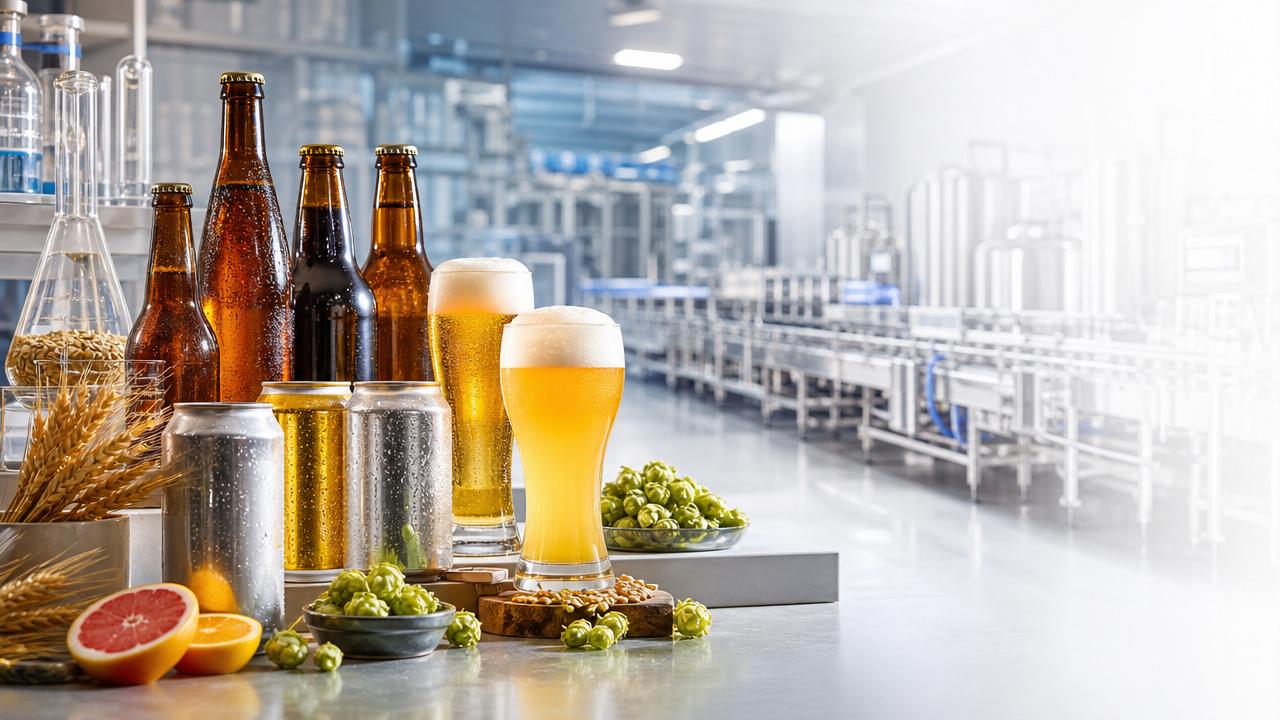
Do China beer OEM factories offer R&D support in 2026? In many cases, yes—but the quality and depth of that support vary widely. For importers, private-label buyers and beverage brand owners, the real question is not whether a factory says it can do R&D, but whether it can turn market demand into commercially viable beer products. In 2026, the strongest China beer OEM factories are no longer just production sites. They increasingly act as development partners that help clients refine concepts, adjust formulations, test packaging, align with local regulations and launch products faster.
That matters because the beer market is more fragmented than ever. Buyers are not only sourcing standard lager at competitive cost. They are also looking for sugar-free low-calorie beer, fruit-flavored beer, German wheat styles, functional specialty beers and differentiated craft offerings that can stand out in retail, horeca and e-commerce channels. A capable OEM partner should support more than filling and packaging. It should help reduce development risk.
For companies exploring cooperation in China, understanding what R&D support really includes is critical. Some factories offer only basic recipe adjustment, while others provide full OEM/ODM development, sensory evaluation, stability testing, packaging matching and market-oriented customization. Jinpai Beer, for example, combines craft beer R&D, flexible production and customized development to help partners create products tailored to evolving consumer demand across global channels.
What buyers are really asking when they search “Do China beer OEM factories offer R&D support”
Searchers using this keyword are usually not looking for a simple yes-or-no answer. Their real intent is commercial due diligence. They want to know whether a China beer OEM factory can help them launch a product successfully, not just manufacture an existing beer formula. In most cases, these readers are comparing suppliers, assessing capability gaps and trying to avoid expensive trial-and-error.
Their concerns are practical. Can the factory develop a beer based on a target flavor profile? Can it adapt alcohol content, bitterness, sweetness, body or calorie positioning for a local market? Can it create a private-label beer that feels differentiated instead of generic? Can it support functional concepts, fruit combinations or sugar-free positioning without compromising taste and shelf stability? These are the questions behind the search.
That is why the most useful answer focuses on capability, process and evidence. Buyers need to know what level of R&D support is realistic, how to evaluate a supplier and what warning signs indicate weak technical support. In 2026, that evaluation has become a core part of supplier selection for beer OEM and ODM projects.
Yes, many China beer OEM factories offer R&D support—but the level differs sharply
China’s beer manufacturing sector has evolved quickly. As global demand for private-label beverages, contract brewing and customized alcoholic drinks has expanded, more factories have invested in pilot brewing, formulation teams and product development services. However, “R&D support” is often used loosely in sales communication. One factory may mean it can tweak bitterness or color. Another may be able to build a new product concept from scratch.
In practical terms, R&D support from a beer OEM factory typically falls into three levels. The first is basic adaptation: changing alcohol by volume, bitterness, sweetness or packaging format for an existing product. The second is guided customization: creating a modified version of a style such as classic lager, German wheat or fruit beer to match a buyer’s brand brief. The third is full ODM development: converting a market opportunity into a new beer concept, testing formulations, optimizing cost structure and preparing it for large-scale production.
For buyers in 2026, the difference between these levels has strategic importance. If your brand already has a finalized recipe and only needs compliant mass production, a basic OEM may be enough. But if you want to enter a fast-changing category like low-calorie beer, sugar-free beer or functional specialty beer, you likely need a factory with stronger R&D, pilot testing and category insight.
What R&D support should include in 2026
A strong beer OEM partner should provide more than recipe discussion. In 2026, useful R&D support usually starts with demand translation. This means taking a buyer’s commercial brief—target consumer, price range, channel, taste direction, alcohol level and packaging preference—and converting it into a workable product plan. Without that step, many projects fail because the technical outcome does not match the market goal.
Formulation development is the next key element. This may include malt and hop selection, yeast choice, fruit or botanical integration, sweetness control, calorie reduction, mouthfeel adjustment and fermentation planning. For specialized products, such as sugar-free low-calorie beer or functional specialty beers, formulation work needs to balance drinkability, stability and cost. A technically weak factory may create a sample that tastes attractive initially but performs poorly in production or transport.
Sample creation and iterative testing are equally important. Serious R&D support should involve multiple sample rounds based on structured feedback. This allows buyers to compare versions and make informed decisions rather than approving a product too early. In some cases, the right supplier will recommend changing the target profile because a preferred concept may be unstable, too costly or unsuitable for the intended shelf-life and market conditions.
Packaging compatibility is another overlooked area. Beer development is not only about liquid. Can design concepts work with cans, bottles, labels and transport requirements? Will carbonation, pasteurization or filling conditions affect flavor retention? Does the package fit supermarket distribution, bar service or online retail logistics? Good OEM R&D support connects the beer formula with packaging reality.
Finally, reliable support should include manufacturability review. A product that works in a small trial but cannot be reproduced consistently at scale creates major risk. The best China beer OEM factories evaluate process control, ingredient sourcing consistency, filling performance and storage behavior before pushing a product into mass production.
Why R&D support matters more now than it did a few years ago
In 2026, beer competition is no longer centered only on volume. In many markets, buyers need sharper positioning and faster product cycles. Traditional lager still matters, but retailers, restaurants, bars and online sellers increasingly look for differentiated products with clearer consumer hooks. That includes fruit-flavored beer for casual drinkers, German wheat beer for premium positioning, low-calorie beer for health-conscious consumers and functional concepts for niche segments.
This shift makes R&D support more valuable because product success depends on fit, not just cost. A factory with strong development ability can help a buyer avoid copying overcrowded market offerings. It can also improve speed to market by narrowing the gap between concept and production. For importers and private-label operators, that can mean launching a seasonal flavor on time, responding to a retail chain brief faster or adjusting to local consumer preferences without rebuilding the project from zero.
There is also a growing compliance and quality expectation in international trade. Buyers need products that are stable, consistent and aligned with destination-market labeling and product standards. While regulations differ by country, a supplier with development experience usually communicates more clearly about what can and cannot be claimed, what ingredients may affect approval and how packaging decisions interact with export requirements.
How to tell whether a China beer OEM factory has real R&D capability
The simplest way is to look beyond catalogs. A long product list does not automatically prove development strength. Many factories can show multiple beer categories, but that may reflect trading flexibility rather than in-house innovation. Buyers should ask for specifics: how new products are developed, who handles formulation, how sample revisions are managed and what customization cases the factory has completed.
One strong signal is category breadth combined with logical technical explanation. If a factory can discuss classic lager, German wheat, fruit-flavored beer, sugar-free low-calorie beer and functional specialty beers in a clear, commercially grounded way, it is more likely to understand formulation trade-offs. Technical teams should be able to explain why certain ingredients, flavor directions or processing choices affect taste, clarity, foam retention, stability and cost.
Another sign is whether the factory uses a structured development workflow. Serious suppliers usually have a clear path from initial brief to sample, feedback, optimization and final production confirmation. If the process is vague, overly fast or based only on verbal promises, the buyer may later face inconsistency, delays or unexpected reformulation.
Ask about pilot batches and sample iteration. A capable OEM partner should not treat the first sample as final by default. It should be prepared to refine flavor balance, mouthfeel, aroma intensity, alcohol content or sweetness after review. For customized projects, iteration is normal. A factory that resists revision may not have the internal systems needed for dependable R&D support.
It also helps to review how the supplier connects R&D with production. Development teams that work in isolation sometimes create impressive samples that are difficult to replicate at scale. Better factories coordinate technical, production and quality teams from the beginning, which improves consistency when a product moves from trial stage to commercial output.
Questions buyers should ask before choosing an OEM/ODM beer partner
If you are evaluating suppliers, ask focused questions instead of general ones. Rather than asking, “Do you offer R&D?” ask, “Can you develop a beer based on a target consumer profile and retail price?” This reveals whether the supplier thinks commercially as well as technically. It also helps distinguish factories with genuine product planning experience from those offering only standard recipes.
Other useful questions include: What beer categories do you customize most often? How many sample rounds are typically included? Can you adjust formulas for sugar-free, low-calorie or fruit-flavored requirements? How do you evaluate taste stability during transport and storage? Can you recommend packaging formats based on distribution channel? What minimum order quantities apply to custom products versus standard products?
Buyers should also ask about confidentiality and exclusivity when developing a differentiated beer. If a supplier helps create a market-specific formula, brand owners will want clarity on whether that product remains exclusive to them or can be sold to other buyers with minor changes. Clear expectations at the start reduce future disputes.
Lead time questions matter too. Product development can affect launch schedules, especially when multiple sample rounds or packaging adjustments are involved. A reliable partner should be honest about timing and should explain what parts of the process take the longest. Fast answers are useful, but realistic answers are more valuable.
Common limitations and risks buyers should watch for
Not every China beer OEM factory that claims R&D support can deliver meaningful customization. One common limitation is superficial development. The supplier may change labeling, can design or a small flavor note and present it as a new product. For buyers trying to build a distinctive brand, this offers limited competitive value.
Another risk is unstable specialization. For example, sugar-free low-calorie beer and functional specialty beers often require deeper formulation knowledge than standard lager. If a factory is entering these categories mainly because they are trendy, it may not yet have enough technical experience to ensure taste balance and production consistency. In such cases, the buyer could face reformulation, quality variation or disappointing market feedback.
Communication gaps are another issue. Even a technically competent supplier may struggle if the product brief is incomplete or if expectations are not translated clearly. Buyers should provide target market details, desired taste direction, packaging preference, price goals and channel context. Good R&D support is collaborative. Weak briefs often lead to weak outcomes.
Finally, some buyers focus too heavily on unit price and underestimate development cost. The cheapest factory may not be the most economical choice if poor R&D creates delays, repeat sampling, wasted packaging or a product that underperforms after launch. In many OEM/ODM projects, development quality has a greater long-term impact than the initial quotation difference.
How Jinpai Beer supports custom beer development for global partners
For companies seeking a China beer OEM partner with broader product development capability, Jinpai Beer positions itself around integrated R&D, production and distribution support. The company is engaged in the research, development, production and distribution of craft beer and offers a wide portfolio including classic lager, German wheat, sugar-free low-calorie beer, fruit-flavored beer and functional specialty beers.
This range matters because it allows customization across different consumption scenarios and channel needs. A supermarket buyer may need approachable fruit-flavored beer with strong visual appeal. A bar or restaurant partner may prefer a more distinctive wheat beer or craft-style offering. A brand entering a health-oriented segment may need lower-calorie or sugar-free options that still deliver drinkability. A factory with category diversity is better placed to propose workable paths instead of forcing every project into one standard template.
Jinpai Beer also provides OEM/ODM services, wholesale supply and customized solutions for global channels. From a buyer perspective, that means the partnership can go beyond liquid production to include product direction aligned with real sales environments. Whether the target route is online retail, offline distribution, bars, supermarkets or broader hospitality channels, development choices can be shaped around where and how the beer will be sold.
For distributors, agents and private-label operators, this kind of support can reduce launch friction. Instead of sourcing one party for formulation, another for production and another for channel adaptation, they can work with a supplier that understands both technical development and commercial application. That integrated approach is increasingly valuable in 2026, especially for brands that want to move quickly but still maintain product differentiation.
Final answer: should buyers expect R&D support from China beer OEM factories in 2026?
Yes, buyers should expect some level of R&D support from many China beer OEM factories in 2026—but they should not assume all suppliers offer the same depth. The strongest factories provide practical product development support that connects market demand, formulation, sample testing, packaging and scale-up. Weaker suppliers may offer only limited recipe adjustments or standard private-label options.
For information researchers, importers and brand owners, the smartest approach is to evaluate R&D support as a business capability, not a marketing phrase. Ask how the factory develops products, what categories it can customize, how sample iterations are handled and how it ensures consistency from concept to production. That process will tell you far more than a brochure ever can.
If your goal is to launch differentiated beer products—whether classic lager, German wheat, fruit-flavored beer, sugar-free low-calorie beer or functional specialty beers—R&D support is not a bonus. It is a core part of supplier value. In 2026, the best China beer OEM factories are the ones that help partners create products that are not only manufacturable, but commercially relevant and market-ready.
Thank you very much for writing to us. Please leave your message and contact information, we will reply to you within 24 hours.