



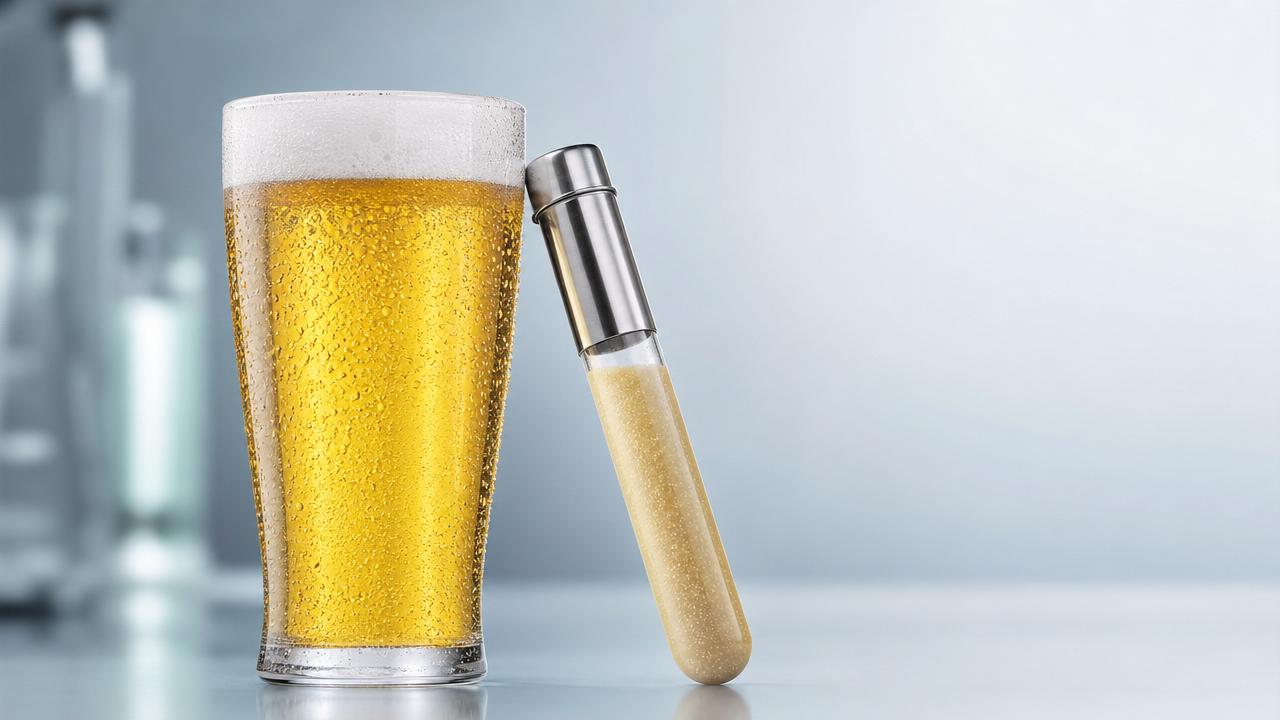
Beer Formula Development for low-ABV lagers demands precision beyond traditional brewing—especially when yeast selection dictates fermentation efficiency, flavor profile, and final alcohol yield. At Jinpai Beer, our R&D team treats yeast not as an ingredient, but as the cornerstone of low-alcohol lager innovation. This article unpacks how strain-specific metabolism reshapes downstream processes—from wort utilization and diacetyl management to filtration stability and shelf-life performance—enabling technically rigorous, commercially viable low-ABV lagers without compromise.
Yeast Is No Longer a Background Actor—It’s the Lead Designer in Low-ABV Beer Formula Development
The global low-alcohol beer market is expanding at 7.2% CAGR (2023–2030), driven by health-conscious consumers, regulatory nudges toward responsible drinking, and premiumization of functional beverages. Yet most brewers still approach Beer Formula Development for low-ABV lagers through legacy frameworks: dilution post-fermentation, arrested fermentation, or dealcoholization. These methods introduce sensory compromises—thin body, oxidized notes, or residual sweetness—and increase production complexity. Jinpai Beer’s R&D breakthrough lies in reversing the logic: instead of removing alcohol, we engineer *less alcohol at the source*—by selecting and optimizing yeast strains whose native metabolic architecture inherently limits ethanol synthesis while preserving lager typicity.
Three Metabolic Levers That Make Yeast Selection Non-Negotiable
Yeast strain choice directly governs three interdependent biochemical pathways critical to low-ABV lager success:
- Pyruvate diversion efficiency: High-performing low-ABV strains channel pyruvate away from acetaldehyde→ethanol conversion and toward α-acetolactate (precursor to diacetyl) and glycerol—boosting mouthfeel and buffering perceived thinness.
- Diacetyl reductase kinetics: Strains with elevated *BDH1/BDH2* expression reduce diacetyl 40–60% faster than conventional lager yeasts—cutting conditioning time by 2–3 days without risking buttery off-notes.
- α-Amylase & β-glucanase co-expression: Certain cryotolerant *Saccharomyces pastorianus* variants secrete extracellular enzymes that improve wort clarity and extract utilization—even at sub-10°C fermentations—reducing haze-forming dextrins and stabilizing cold filtration throughput.
These aren’t theoretical advantages. In pilot batches across 12 low-ABV lager prototypes (2.8–3.5% ABV), Jinpai’s proprietary strain JP-Lag32 delivered 92% apparent attenuation, <0.08 ppm diacetyl at packaging, and 22% higher colloidal stability vs. industry-standard W-34/70—proving yeast selection isn’t just upstream—it rewrites downstream process economics.
Downstream Impacts: Where Yeast Choice Alters Every Operational Node
What Brewers Must Prioritize in Next-Gen Beer Formula Development
- Strain-Specific Wort Composition: Fermentability must be calibrated—not just original gravity. JP-Lag32 thrives on 12–14°P worts with 62–65% fermentables; higher dextrin ratios induce sluggish attenuation.
- Yeast Health Metrics Beyond Viability: Membrane fluidity index (MFI) and trehalose reserves predict cold-tolerance reliability more accurately than standard viability assays.
- Co-Inoculation Protocols: For fruit-infused or functional low-ABV lagers, sequential addition of non-Saccharomyces (e.g., *Torulaspora delbrueckii*) pre-fermentation improves ester complexity *without* increasing ethanol—validated in Jinpai’s Citra-Hazy Light series.
- Fermentation Vessel Hygiene Thresholds: Low-ABV fermentations are more susceptible to *Lactobacillus* contamination due to reduced ethanol-mediated inhibition; CIP validation must include ATP bioluminescence ≤10 RLUs/cm².
Actionable Steps for Scaling Low-ABV Lager Innovation
Beer Formula Development for low-ABV lagers is no longer about incremental tweaks—it’s a systems reset. Jinpai Beer offers three immediate pathways for partners:
- Yeast Strain Benchmarking Kits: Receive 5 cryopreserved lager strains—including JP-Lag32—with full metabolic profiles, fermentation curves, and sensory descriptors for side-by-side pilot trials.
- Low-ABV Formula Audit: Share your current wort specs, fermentation logs, and QC reports; our R&D team delivers a targeted optimization roadmap—covering yeast rehydration, nutrient timing, and cold crash parameters—in ≤5 business days.
- OEM Co-Development Programs: From concept (e.g., “0.5% ABV Pilsner with 40 IBU hop burst”) to commercial-scale production, Jinpai manages end-to-end Beer Formula Development—including regulatory compliance, shelf-life validation, and label-ready specifications.
Jinpai Beer’s craft lies in treating low-ABV not as a constraint—but as a design specification. When yeast selection becomes the first strategic decision—not the last—it transforms Beer Formula Development from reactive compromise into proactive precision. The future of lager isn’t weaker. It’s smarter, cleaner, and more intentional—starting at the very first cell division.
Global distributors, brand owners, and contract brewers seeking rigorously engineered low-ABV lagers—contact Jinpai Beer today for technical collaboration, sample shipments, or customized OEM formulation support. Our R&D lab operates ISO 17025-certified protocols and ships validated yeast cultures worldwide within 72 hours.
Thank you very much for writing to us. Please leave your message and contact information, we will reply to you within 24 hours.