



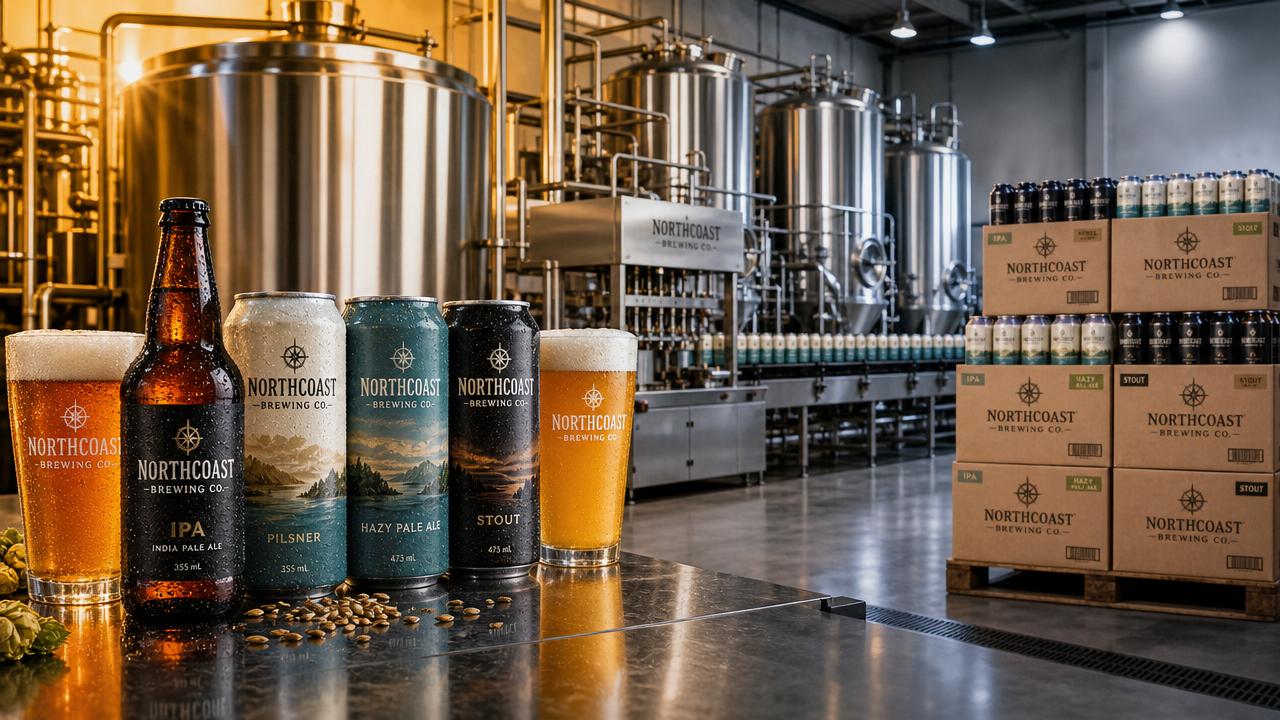
As craft breweries plan for 2026, choosing between craft beer contract brewing and in-house expansion has become a critical business decision. For businesses evaluating cost, speed, quality control, and market flexibility, the right model can directly influence profitability, risk exposure, and long-term brand positioning. In the beverage sector, where consumer demand shifts quickly across lager, wheat beer, low-calorie options, fruit beer, and functional specialty styles, the comparison is no longer theoretical. It is a practical question of how to scale efficiently without compromising product consistency or market timing.
Understanding craft beer contract brewing and in-house expansion
Craft beer contract brewing refers to outsourcing beer production to a qualified brewing partner that already has equipment, technical staff, packaging lines, and regulatory systems in place. The brand owner typically controls recipe direction, market strategy, packaging identity, and sales channels, while the contract facility handles part or all of the manufacturing process. Depending on the agreement, support may also include formulation refinement, raw material sourcing, canning, bottling, labeling, and export coordination.
In-house expansion, by contrast, means increasing capacity within one’s own brewing operation. This may involve installing larger brewhouses, adding fermentation tanks, upgrading filtration or packaging systems, expanding warehouse space, or investing in utilities such as refrigeration, steam, water treatment, and quality laboratories. The advantage is deeper operational control, but the capital burden and execution complexity are much higher.
For 2026 planning, the decision is not simply “outsource versus own.” It is really about selecting a growth model that fits production volume, product complexity, channel strategy, cash flow, and geographic expansion goals. In many cases, craft beer contract brewing works as a bridge to new markets, while in-house expansion supports long-term brand manufacturing autonomy.
Market signals shaping brewery decisions in 2026
The craft beer industry is entering 2026 with several forces affecting capacity planning. Premiumization remains important, but product diversity now matters just as much as brand story. Buyers increasingly expect flavor innovation, health-conscious choices, and stable supply across multiple retail and foodservice channels. This environment makes both craft beer contract brewing and self-operated expansion more strategic than before.
One notable trend is the rise of hybrid operating models. Brands increasingly use craft beer contract brewing for seasonal launches, private label programs, export batches, or rapid volume spikes, while preserving their own facility for flagship products and local taproom identity. This blended approach reflects a more disciplined view of expansion in the modern beverage market.
Comparing cost, speed, control, and flexibility
The most practical way to compare these two models is to evaluate the four dimensions that affect scaling most directly: capital cost, launch speed, quality control, and operational flexibility.
For many brands, craft beer contract brewing provides a cash-efficient route to growth. Instead of tying up funds in tanks and packaging lines, resources can be directed toward branding, channel development, distributor support, and product innovation. This matters especially when launching multiple styles such as German wheat, fruit-flavored beer, or low-calorie alternatives where demand may still be developing.
However, in-house expansion can offer stronger long-term economics once production volumes become stable enough to absorb depreciation, labor, maintenance, and utility costs. It also helps when a brewery depends on proprietary process details or highly sensitive flavor profiles that require close control over fermentation and packaging conditions.
Business value across product categories and channel strategies
Different beer categories respond differently to each scaling model. A standard lager with steady year-round demand may justify internal capacity investment more easily than a limited fruit series or a functional specialty beer aimed at trial markets. That is why craft beer contract brewing often performs best where product variety and channel experimentation are central to growth.
- Classic lager: Suitable for either model, depending on volume stability and packaging scale.
- German wheat beer: Benefits from strong process consistency and yeast management; partner expertise matters.
- Sugar-free low-calorie beer: Requires technical precision, making qualified contract production attractive if internal systems are limited.
- Fruit-flavored beer: Ideal for market testing through flexible batch outsourcing.
- Functional specialty beer: Often better suited to staged rollout using craft beer contract brewing before major equipment commitments.
Channel strategy also changes the equation. Retail chains and supermarkets usually need repeatable supply, compliant packaging, and scalable logistics. Bars and restaurants may prioritize freshness, style rotation, and seasonal exclusives. Cross-border online and offline distribution adds further requirements, from labeling adaptation to customs documentation. In these situations, a brewing partner with OEM/ODM capability and export experience can reduce operational friction and shorten launch cycles.
For businesses seeking customized solutions, craft beer contract brewing can support private label development, regional flavor adaptation, and multi-format packaging without immediate asset expansion. This is particularly valuable when entering new countries or serving diverse channel mixes that demand different can sizes, bottle formats, or recipe profiles.
Typical decision scenarios in 2026
The right choice often becomes clearer when reviewed by real operating scenario rather than theory alone.
Practical evaluation points before choosing a model
Before committing to either path, several checkpoints should be reviewed carefully. These practical factors often determine whether a scaling decision creates momentum or operational strain.
- Demand visibility: Confirm whether projected volume is sustained, seasonal, or experimental.
- Recipe transferability: Assess how well the beer can be reproduced outside the original facility.
- Quality assurance: Define standards for raw materials, brew logs, microbiological checks, and package integrity.
- Packaging needs: Review bottle, can, carton, and labeling requirements by target market.
- Lead time and planning: Compare installation timelines with contract production slot availability.
- Commercial focus: Decide whether growth depends more on manufacturing ownership or market reach.
When evaluating craft beer contract brewing, partner capability matters more than price alone. A qualified supplier should offer stable brewing quality, transparent production processes, technical support, and the ability to handle customized formulations. Experience in OEM/ODM service, wholesale supply, and export-oriented compliance is especially relevant for businesses targeting supermarkets, bars, restaurants, and wider retail channels.
A scalable path for the next stage of growth
In 2026, the strongest growth strategy may not be defined by ownership alone, but by fit. Craft beer contract brewing is often the better option when speed, flexibility, lower capital exposure, and product variety are priorities. In-house expansion becomes more attractive when volume is predictable, process control is central, and long-term internal capacity utilization is clear.
For businesses exploring a scalable beer supply model, it is useful to begin with a product and channel review: which styles need rapid rollout, which markets require localized packaging, and which volumes justify asset investment. From there, a phased strategy can be built around flagship stability and flexible outsourced growth.
Jinpai Beer supports this approach through craft beer R&D, production, and global distribution across classic lager, German wheat, sugar-free low-calorie beer, fruit-flavored beer, and functional specialty beers. With OEM/ODM services, wholesale supply, and customized solutions for online and offline channels, the company can help transform craft beer contract brewing from a short-term capacity fix into a structured expansion tool. A practical next step is to compare target product lines, forecast volumes, and packaging requirements against available partner capability before finalizing the 2026 growth plan.
Thank you very much for writing to us. Please leave your message and contact information, we will reply to you within 24 hours.