



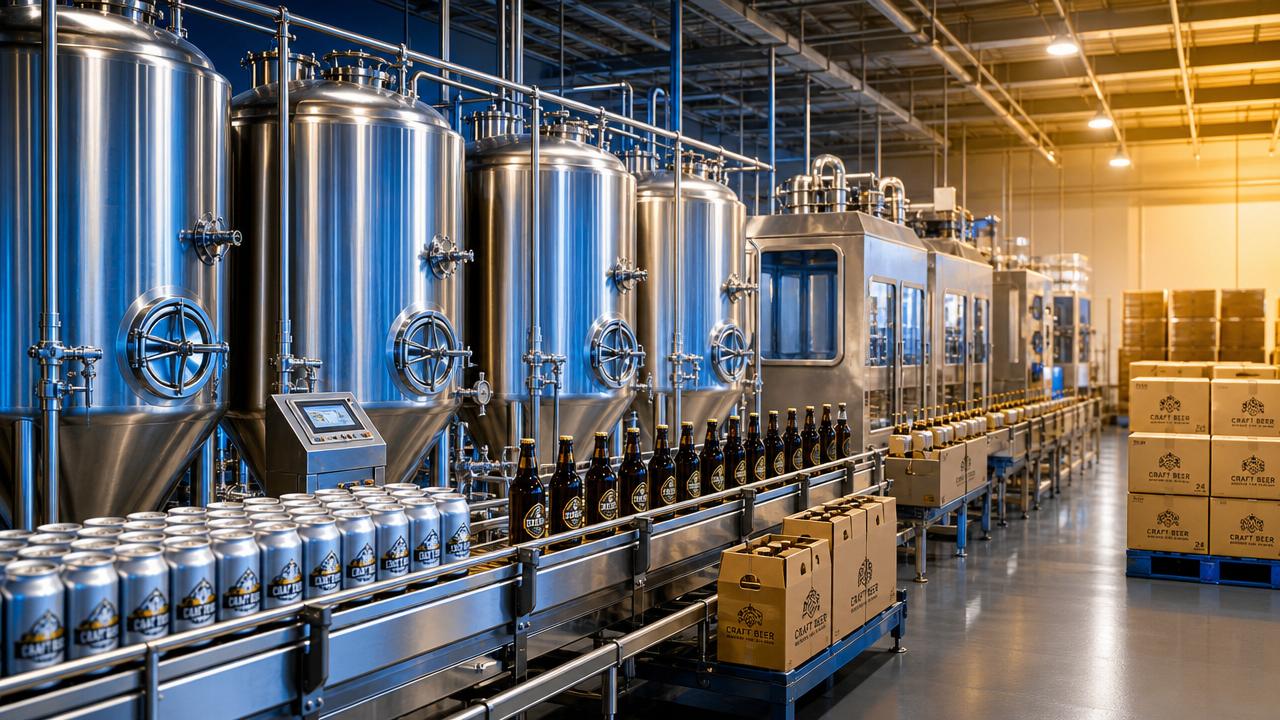
In craft beer contract brewing, capacity and lead time are not just operational details—they are early signals of supply reliability, launch feasibility and cost control. When a brewing project moves from recipe approval to commercial release, the true constraint is often not creativity but production scheduling, tank availability, packaging flow and logistics coordination. A realistic understanding of craft beer contract brewing helps reduce missed launch windows, avoid stock gaps and improve planning across online and offline channels. For brands evaluating external brewing support, these signals can reveal whether a partner is ready for stable scale, flexible customization and long-term cooperation.
What does capacity really mean in craft beer contract brewing?
In craft beer contract brewing, capacity is more than total annual output. It includes brewhouse size, fermentation tank turnover, bright beer tank availability, filtration or non-filtration options, packaging line speed and warehouse readiness. A brewery may advertise strong output numbers, yet still struggle to support a new product if its usable capacity is already committed to existing SKUs, seasonal peaks or maintenance cycles.
For beer and beverage projects, capacity should be viewed in layers. The first layer is brewing capacity: how much wort can be produced in a day or week. The second is fermentation capacity: whether tank time matches the style being produced. A classic lager often occupies tanks longer than a fruit-flavored beer, while German wheat may require a different scheduling rhythm. The third is packaging capacity: cans, bottles, labels, trays and cartons can all become bottlenecks even when brewing tanks are available.
This is especially important for diversified portfolios such as classic lager, sugar-free low-calorie beer, functional specialty beers and custom OEM/ODM products. Different formulas may require different process windows, ingredient lead times and quality controls. In practical craft beer contract brewing evaluation, the key question is not “How big is the brewery?” but “How much compatible, schedulable capacity is available for this product type at this time?”
How should lead time be assessed beyond the quoted production date?
Lead time in craft beer contract brewing should be measured from confirmed specification to finished, shippable product. Many delays happen before brewing starts: formula confirmation, sample review, packaging artwork approval, can or bottle sourcing, carton procurement and compliance labeling for destination markets. If these steps are excluded, the quoted lead time can look attractive but fail in execution.
A useful way to assess lead time is to divide it into five checkpoints:
- technical confirmation, including recipe, ABV, bitterness, color and shelf-life targets;
- raw material readiness, such as malt, hops, yeast, fruit base or functional additions;
- brewing and fermentation scheduling;
- packaging and final inspection;
- dispatch preparation and export documentation if required.
A mature craft beer contract brewing partner can usually explain where time is fixed and where flexibility exists. For example, changing can size late in the process may create more delay than adjusting a flavor note in an early sample stage. Understanding this distinction makes launch planning much more accurate.
Which signals show a brewing partner can support stable supply?
Stable supply in craft beer contract brewing depends on system discipline, not only equipment. Several operational signals are worth checking before committing volume:
- Whether production planning is updated regularly rather than arranged order by order.
- Whether the brewery can share typical lead time ranges for standard and customized products.
- Whether core materials have backup sourcing plans.
- Whether quality records link each batch to process and packaging data.
- Whether seasonal demand spikes are anticipated in advance.
For global distribution, another positive sign is channel adaptability. A brewery serving restaurants, bars, supermarkets and retail distributors usually understands variation in packaging formats, reorder rhythm and commercial timing. That matters because supply reliability is not only about making beer; it is about matching product flow to real selling channels.
Jinpai Beer, for example, operates across R&D, production and distribution, with a broad craft beer range and OEM/ODM support. In a craft beer contract brewing context, this kind of integrated capability can be valuable because product development, manufacturing and channel requirements are more likely to be aligned from the start.
How do product type and customization affect capacity and lead time?
Not all beer styles behave the same in craft beer contract brewing. A standard classic lager may have a relatively predictable process, but it can require longer tank occupation. German wheat often needs style-specific process control. Sugar-free low-calorie beer may involve additional formulation precision. Fruit-flavored beer can introduce extra ingredient coordination, while functional specialty beers may require validation for ingredient stability, sensory balance and packaging compatibility.
Customization increases complexity in three main ways. First, it can add development time if the recipe needs multiple sample rounds. Second, it can lengthen sourcing time for special ingredients or non-standard packaging materials. Third, it can reduce scheduling flexibility because unique products may not fit efficiently into an already crowded production calendar.
This does not mean customization is a problem. In well-managed craft beer contract brewing, custom work becomes more efficient when specifications are frozen early and order forecasts are shared in advance. Even a creative product line can move smoothly when formulation, packaging and replenishment cadence are coordinated as one plan instead of separate decisions.
What are common mistakes when comparing craft beer contract brewing options?
A frequent mistake is comparing price per unit without comparing actual deliverability. A lower quote may hide longer lead time, limited packaging windows or weak raw material backup. In craft beer contract brewing, a slightly higher cost can be commercially better if it reduces delays, protects quality consistency and supports repeat orders.
Another mistake is treating initial sample success as proof of long-term supply capability. A brewery may produce an excellent trial batch but still lack stable capacity for repeat production in larger cycles. The opposite can also happen: a technically strong producer may be overlooked because its first quoted timeline seems conservative, even though that timeline is more realistic and dependable.
A third error is ignoring packaging and logistics as part of craft beer contract brewing evaluation. Beer can be ready in tank, yet delayed by printed can lead times, label revisions, carton shortages or export paperwork. End-to-end review is essential if launch timing matters.
What practical questions help judge capacity and lead time before placing an order?
A strong evaluation process uses direct, operational questions instead of broad promises. The table below summarizes practical checkpoints for craft beer contract brewing decisions.
These questions help separate promotional language from operational readiness. In craft beer contract brewing, clarity at the start saves time, money and relationship friction later.
How can capacity planning become a commercial advantage instead of just a production concern?
The best craft beer contract brewing relationships use capacity planning as a growth tool. If a product line is expected to expand across supermarkets, bars and e-commerce channels, forecast sharing allows the brewery to align tanks, materials and packaging windows before urgency appears. This often improves cost control, shortens replenishment cycles and reduces the need for rushed decisions.
Capacity planning also supports portfolio strategy. Standard products can be scheduled as regular runs, while limited seasonal items or functional specialty beers can be inserted into controlled windows. That balance helps maintain innovation without weakening supply reliability. For beverage businesses using OEM/ODM support, this planning model is particularly useful because it links brand ambition with operational feasibility.
In short, craft beer contract brewing works best when capacity and lead time are treated as decision signals, not afterthoughts. They reveal whether a brewing partner can support current demand, future scale and channel-specific requirements with confidence.
Capacity and lead time are among the most practical indicators in craft beer contract brewing because they connect quality, cost and market timing in one framework. A reliable brewing partner should be able to explain available capacity by product type, break down lead time by process stage and show how packaging, sourcing and repeat orders are managed. For projects involving classic lager, German wheat, sugar-free low-calorie beer, fruit-flavored beer or customized functional products, early alignment on these details can significantly improve launch success. If the next step is to evaluate OEM/ODM possibilities or wholesale supply options, start with a concrete production timeline, a fixed product brief and a realistic volume forecast. That approach turns craft beer contract brewing from a reactive purchase decision into a more stable and scalable business solution.
Thank you very much for writing to us. Please leave your message and contact information, we will reply to you within 24 hours.