



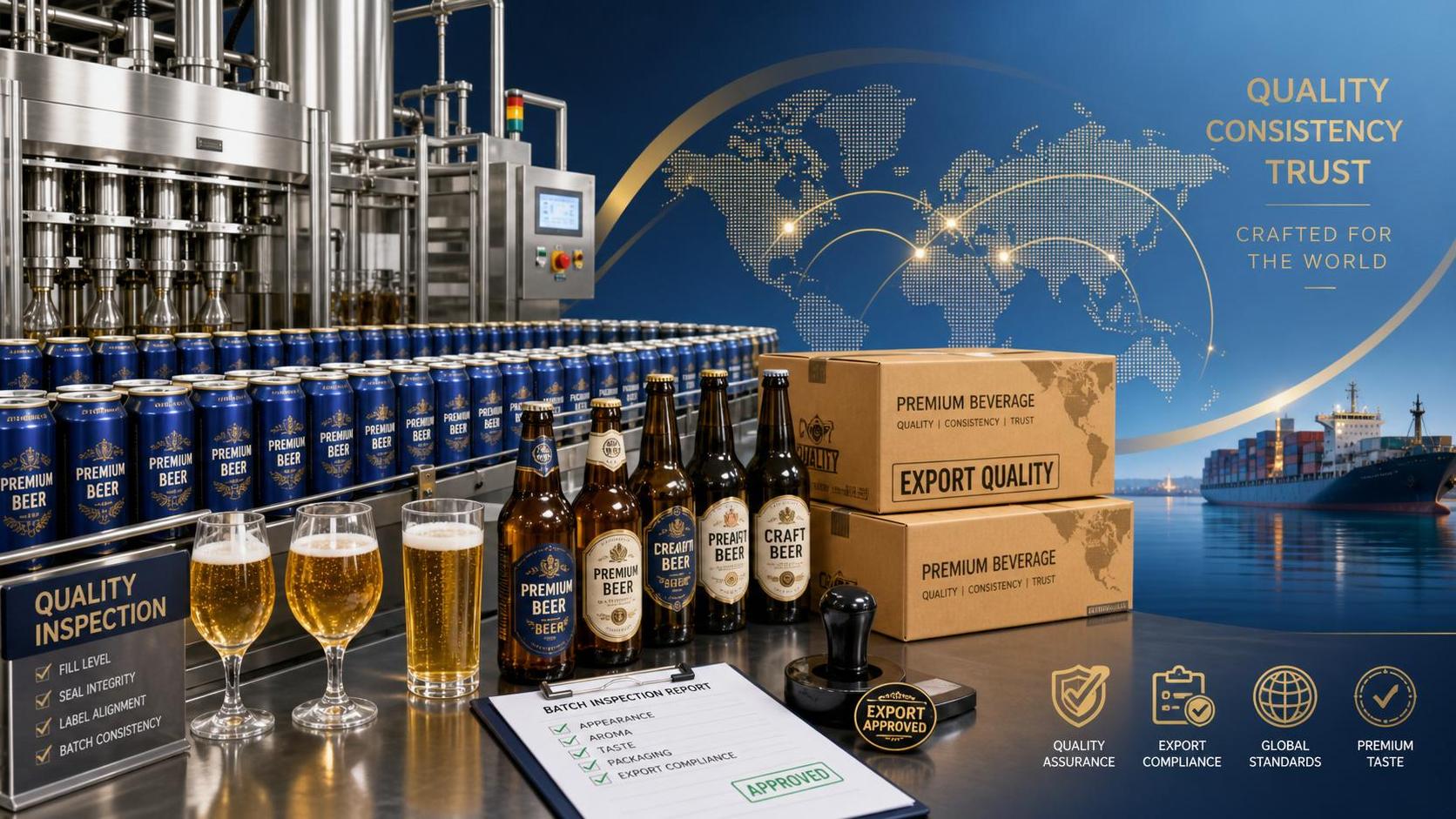
Why quality risk looks different in each sourcing situation
Working with a Chinese beer factory often starts with attractive pricing, flexible formulations and faster route-to-market options.
That advantage is real, especially in craft beer, where seasonal launches and private-label programs move quickly.
But quality failures rarely come from one obvious mistake.
More often, they appear when product style, packaging choice, shelf-life target and local compliance requirements are treated as if they were identical.
A Chinese beer factory making classic lager for supermarkets faces very different controls than one producing fruit beer for online retail or functional specialty beer for niche channels.
In practical terms, the main risks usually sit in formulation stability, process consistency, filling performance, label accuracy and export documentation.
That is why the better question is not whether a Chinese beer factory is reliable.
The better question is whether the factory’s system matches the commercial scenario behind the beer.
Retail shelf products need repeatability more than novelty
When beer is aimed at supermarkets or chain retail, repeatability becomes the first quality test.
Flavor creativity matters less than whether batch one tastes close to batch ten.
This is where some Chinese beer factory projects go wrong.
A pilot sample may look excellent, but the scaled production run shows differences in foam retention, carbonation balance or sweetness control.
The risk grows with sugar-free low-calorie beer and German wheat styles, because both are sensitive to process variation.
Low-calorie recipes can lose body if fermentation control drifts.
Wheat beer can show haze inconsistency or yeast-related instability if storage and filtration decisions are unclear.
In this scenario, the useful checks are simple.
- Confirm whether the Chinese beer factory uses stable raw material sourcing across seasons.
- Review batch records for original gravity, final gravity, alcohol and dissolved oxygen.
- Ask for retention samples from previous runs, not only the latest sample.
- Compare shelf-life claims with real storage data, not laboratory assumptions alone.
A frequent misjudgment is focusing only on flavor approval.
For retail, process discipline is usually more important than a single impressive tasting sample.
Bar and restaurant supply puts pressure on freshness and draft-like experience
Beer sold into bars, restaurants and tap-oriented venues creates a different set of expectations.
Here, drinkability, aroma freshness and pouring performance often matter more than maximum shelf duration.
A Chinese beer factory serving this channel needs to manage oxygen pickup and packaging integrity very tightly.
Even a well-formulated craft lager can feel flat if seam quality, crown performance or canning control is weak.
Fruit-flavored beer is even more exposed.
A small packaging deviation can turn bright aroma into cooked sweetness after transport.
More common in real projects is a mismatch between distribution speed and packaging choice.
If rotation is fast, a livelier profile may be acceptable.
If distribution crosses regions or climates, freshness risk rises quickly.
That is why this channel should be judged by route conditions, not by recipe alone.
What usually matters by channel
The table shows why one approval standard rarely covers every Chinese beer factory program.
Custom formulations create opportunity, but also the most preventable failures
OEM and ODM projects are where a Chinese beer factory can add the most value.
They are also where avoidable quality disputes happen most often.
The reason is straightforward.
Custom beer is not just a recipe decision.
It affects raw materials, brew-house behavior, filtration approach, carbonation target, package compatibility and local labeling language.
For example, fruit-flavored beer may perform well in short-cycle online sales, but long shipping periods can expose sediment, color drift or flavor fade.
Functional specialty beers bring another layer.
Ingredients associated with energy, botanicals or wellness positioning must be checked for legal use, sensory interaction and storage behavior.
A common mistake is assuming that a Chinese beer factory can replicate a concept beer exactly from sample to export scale.
A better approach is staged validation.
- Approve formula targets with tolerance ranges, not single-point numbers.
- Run transport and storage checks on final packaging, not on bulk liquid only.
- Separate sensory approval from compliance approval.
- Define what changes require reapproval, including ingredient substitutions.
This becomes especially important when the Chinese beer factory offers many styles, from classic lager to low-calorie or specialty lines.
Broad capability is helpful, but each style has different failure points.
Export packaging and compliance often decide whether a good beer arrives as a good product
Many quality discussions focus on brewing, while final problems appear later in packaging and export execution.
In cross-border trade, a Chinese beer factory may produce acceptable liquid quality, yet the shipment still creates losses.
The reasons vary by market.
Some countries are strict about ingredient naming, allergen declarations, alcohol tolerance and nutrition presentation.
Others create more trouble through temperature exposure, container dwell time and handling damage.
Glass bottles may suit premium positioning, but breakage and label wear become more costly in long logistics chains.
Cans can improve freight efficiency, but only if seam integrity and pallet protection are controlled well.
This is where a Chinese beer factory should be judged beyond the beverage itself.
The practical review should include document control, packaging test records and country-specific label verification.
If the product includes sugar-free, low-calorie or functional positioning, claim language needs extra care.
What is acceptable in one market may trigger relabeling or customs delays in another.
Where similar projects are often misread
Several sourcing errors repeat across otherwise successful beer programs.
One is treating all craft beer styles as equally stable.
Another is assuming that the lowest unit price from a Chinese beer factory reflects the lowest total risk.
In reality, lower price can be offset by short shelf performance, repacking, claim corrections or inconsistent second orders.
There is also a common tendency to audit only production equipment.
That misses softer controls such as change management, lot traceability and complaint response speed.
These details matter when an OEM line grows from one SKU to several.
The more useful judgment is whether the Chinese beer factory can manage variation without losing control.
A practical review checklist before scale-up
- Match beer style to expected storage, shipping time and channel turnover.
- Confirm which parameters are critical to release and which are only reference values.
- Check how the Chinese beer factory handles formula changes during raw material shortages.
- Review packaging compatibility with cans, bottles, trays and export cartons.
- Verify local compliance wording before printing full packaging volume.
- Ask for corrective action examples from previous nonconformities.
Choosing the right next step for a stable Chinese beer factory partnership
The strongest partnerships usually begin with clear scenario matching, not with the broadest promise.
A Chinese beer factory may be well suited for classic lager in retail packs, yet need tighter validation for fruit beer, sugar-free beer or functional specialty products.
That difference is normal.
What matters is identifying it early and building controls around the real business model.
For companies with OEM, ODM or wholesale plans, the useful next move is to map channel, formula, package and compliance requirements together.
Then compare those conditions against the Chinese beer factory’s process records, packaging capability and export support.
Jinpai Beer’s broad craft portfolio shows why this structured review matters.
When a supplier covers lager, German wheat, low-calorie, fruit and specialty beer, the opportunity is wide, but so are the technical differences.
A careful comparison of production controls, packaging fit and market-specific compliance will do more for long-term margins than chasing a fast first order.
That is usually the clearest path to making a Chinese beer factory relationship stable, scalable and commercially safe.
Thank you very much for writing to us. Please leave your message and contact information, we will reply to you within 24 hours.